Tether Reports First Full Audit with Unqualified Opinion from KPMG
Key Takeaways
- •Tether reportedly received an unqualified opinion—the cleanest possible audit result—from KPMG for what it describes as its first full comprehensive audit, a step beyond the periodic attestations it has historically published.
- •The full audit report, specific reserve totals, and reporting dates have not yet been independently verified as of the time of writing.
- •USDT is the largest stablecoin by market capitalization and is widely used across global crypto exchanges, giving the credibility of its reserve backing systemic significance across digital asset markets.
- •Tether previously paid $41 million to settle CFTC charges in 2021 over misrepresentation of reserves and reached a separate settlement with the New York Attorney General's office.
- •A clean audit opinion does not eliminate market, custody, or counterparty risks and covers only a defined scope and period rather than serving as a permanent guarantee.
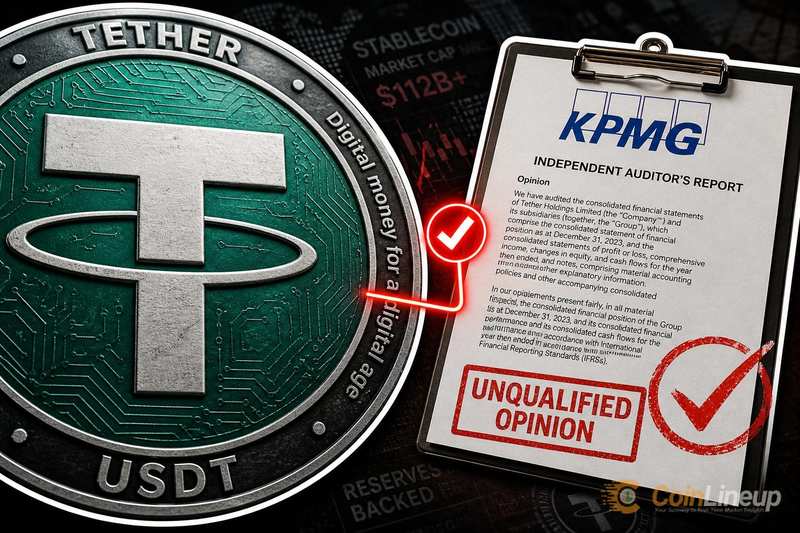
Tether, the company behind the largest dollar-pegged stablecoin, is reported to have completed its first full audit and received an unqualified opinion from KPMG — a milestone that bears directly on how the reserves backing its token are verified.
The two parties named in the announcement are Tether, the stablecoin issuer, and KPMG, one of the world's largest global audit firms. Tether publishes corporate updates through its own channels, including its official news page and press releases, which are the appropriate places to confirm any formal audit statement.
What "First Full Audit" Means
The claimed milestone is described as a "first full audit." That framing is significant because stablecoin issuers have historically relied on attestations — narrower, point-in-time checks performed by accounting firms — rather than a comprehensive audit. Tether itself has for years published periodic attestations, and the gap between those and a full audit has been a persistent line of criticism from market observers and regulators. In 2021, Tether paid $41 million to settle CFTC charges that it misrepresented reserves, and reached a separate settlement with the New York Attorney General's office. At the time of writing, specific reserve totals, dates, and the full audit report have not been independently verified.
An "unqualified opinion" is the cleanest possible result in accounting. It means the auditor found no material problems and signed off without carve-outs or reservations. It is the standard clean outcome any company hopes to receive; it is neither extraordinary praise nor a forward-looking guarantee.
Why a Clean Opinion Matters for Stablecoin Holders
For everyday holders, a stablecoin's value depends on trust that each token is backed by real, redeemable assets. An unqualified opinion signals that an independent firm reviewed those books and flagged no material discrepancy. USDT is the largest stablecoin by market capitalization, widely used across crypto exchanges and trading pairs globally, so the credibility of its backing has systemic weight across digital asset markets.
The practical difference is one of degree. A company asserting its own reserves is one thing; an outside firm like KPMG reviewing them and issuing a clean sign-off is a stronger, more accountable check — analogous to an external review rather than a business grading its own homework. Competing stablecoin issuers such as Circle, which issues USDC, have also pursued regular independent attestations, making audit transparency an increasingly visible differentiator among major issuers.
A clean opinion, however, does not eliminate risk. An audit covers a defined scope and period, not a permanent promise. It does not remove market, custody, or counterparty risks that can affect any stablecoin. It should be treated as one important data point, not a final verdict.
Tether's broader activity — from its USAT launch on Celo to its Tether Gold Shariah certification — reflects a company expanding across product lines where reserve credibility carries over.
What Changes Now and What to Watch Next
The available research does not confirm any meaningful price reaction tied to this announcement. No verified market-move data supports a claim that the news shifted trading.
What would matter next is fuller evidence: the complete audit report, detailed reserve breakdowns, the reporting cadence going forward, and independent coverage. Reuters, for instance, indexes ongoing reporting through its Tether KPMG search results, which is a reasonable place to track verification as it develops.
If confirmed in full, a first complete audit with a clean opinion would strengthen the credibility of Tether's stated backing. It does not, however, change how the token functions or eliminate the need to monitor future disclosures. The audit milestone also comes as regulatory frameworks such as the EU's Markets in Crypto-Assets Regulation (MiCA) begin imposing reserve and disclosure requirements on stablecoin issuers, placing audit transparency at the center of both market and supervisory expectations. The broader push toward institutional accountability in digital assets is also visible in efforts such as MUFG testing blockchain settlement for government bond trades.
Disclaimer: This article is for informational purposes only and does not constitute financial or investment advice. Cryptocurrency and digital asset markets carry significant risk. Always do your own research before making decisions.
