Tether's First Big Four Audit Finds Reserves Exceeded Liabilities by $6.8 Billion
Key Takeaways
- •Tether's first full audit by a Big Four accounting firm found that reserves exceeded liabilities by $6.8 billion at the audit date.
- •A full audit provides stronger assurance than the quarterly attestations previously prepared by BDO Italia, which only reported figures at a single point in time.
- •USDT's market capitalization has surpassed $100 billion, and the token underpins a large share of global cryptocurrency trading pairs.
- •The GENIUS Act, a U.S. federal stablecoin law enacted in July 2025, requires payment stablecoin issuers to back tokens with permitted high-quality assets and disclose reserve composition on a regular schedule.
- •The audit result reflects a single date and does not permanently eliminate risk, as reserve composition and market conditions can change between reporting periods.
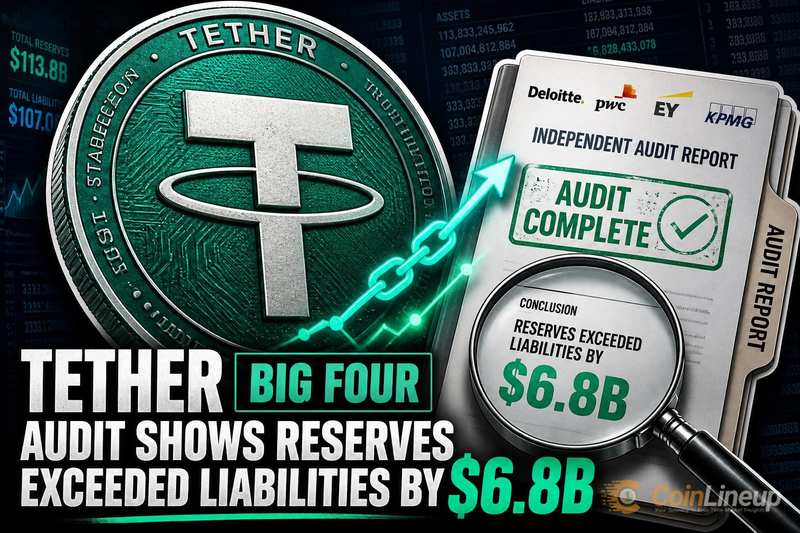
Tether has completed its first full audit by a Big Four accounting firm, with the review finding that the stablecoin issuer's reserves exceeded its liabilities by $6.8 billion at the audit date — a milestone that marks a shift from the lighter attestation work that has long backed USDT.
What Tether's first Big Four full audit found
The company said it engaged a Big Four firm to complete its first full audit, describing the move as a new quality standard for the digital asset economy, according to Tether's announcement. The completed review found that reserves stood $6.8 billion above those liabilities.
Reserves are the assets Tether holds to back its tokens, while liabilities are the obligations it owes to holders who could redeem USDT for value.
A full audit differs materially from the quarterly attestations Tether previously published, which in recent years were prepared by BDO Italia, an accounting network outside the Big Four. An attestation reports figures at a single point in time; a full audit involves an independent opinion on the financial statements, a distinction explored in coverage of the firm's move toward an unqualified audit opinion.
Why the $6.8 billion reserve cushion matters for USDT
The surplus implies that Tether's assets were greater than its obligations at the audit date, leaving a buffer on top of full backing rather than a shortfall. USDT's credibility rests on holder confidence that every token can be redeemed; with a market capitalization that has surpassed $100 billion, USDT also underpins a large share of global cryptocurrency trading pairs, so the condition of Tether's reserves matters to market plumbing well beyond the company itself.
Full backing means liabilities are covered dollar-for-dollar; an excess reserve is the amount held beyond that line. For holders, a positive cushion supports confidence in the ability to redeem, though the two concepts should not be conflated.
A single audit result reflects one date and does not permanently eliminate risk. Reserve composition and market conditions can change between reporting periods, so the finding is a snapshot rather than a guarantee.
What the audit could mean for the wider market
Tether is the largest stablecoin issuer, so a stronger assurance standard around its reserves carries relevance beyond USDT itself. Critics had demanded a full audit for years, and it arrived as the U.S. regulatory test for stablecoins was shifting, as CryptoSlate reported. That shift includes the GENIUS Act, the federal stablecoin law enacted in July 2025, which requires payment stablecoin issuers to back their tokens with permitted high-quality assets and to disclose reserve composition on a regular schedule, moving reserve reporting from a largely voluntary practice toward a statutory obligation.
A Big Four audit can raise transparency expectations across the sector, putting pressure on competitors and shaping how regulators frame reserve disclosure. An open question is whether full audits become a recurring standard for the market leader rather than a one-time milestone, which would indicate how durable the higher assurance level proves.
The development matters because a higher assurance bar set by the market leader can influence sentiment among traders, institutions, and policymakers weighing how stablecoins should be held accountable, even as Tether continues expanding products such as its USAT token across new networks.
Disclaimer: This article is for informational purposes only and does not constitute financial or investment advice. Cryptocurrency and digital asset markets carry significant risk. Always do your own research before making decisions.

