Circle Executive Proposes MiCA Equivalence Fix That Could Enable Tether's Return to Europe
Key Takeaways
- •Tether exited the EU market rather than restructure its reserves to meet MiCA's requirement that large issuers hold at least 60% of reserves in licensed banks.
- •Approximately 99% of stablecoins are issued outside the EU, meaning MiCA's current framework covers only a marginal share of the global stablecoin market.
- •Equivalence would allow the EU to accept a foreign issuer's home-jurisdiction rules in lieu of full MiCA compliance, but implementing it for stablecoins requires amending MiCA itself.
- •The EU has used equivalence in sectors such as insurance and banking but has never applied the framework to stablecoins, and traditional finance determinations have often taken years.
- •The formal EU review process initiated in May 2026 represents the most promising opportunity to introduce equivalence-based stablecoin access, though a quick Tether return remains unlikely given its El Salvador headquarters and lack of US stablecoin clearance.
Tether (USDT) withdrew from the European market rather than comply with the EU's stablecoin regulations. Now, a senior Circle executive is advancing a proposal that could pave the way for its return.
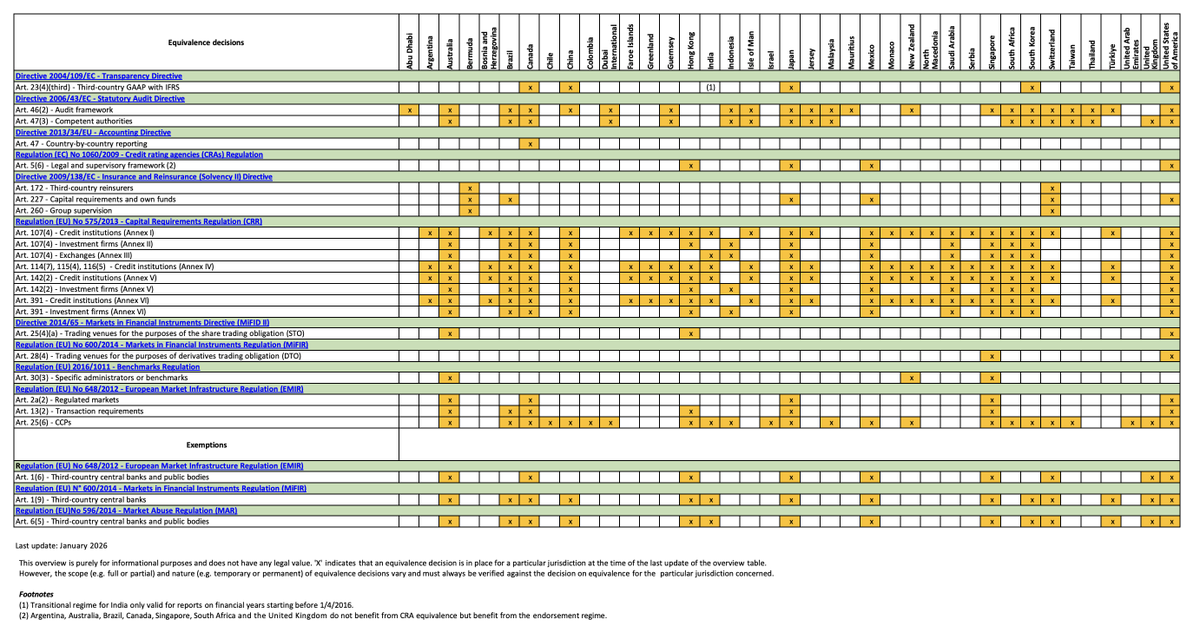
The concept is known as equivalence. Under this framework, the EU would recognize the regulatory standards a company already follows in its home jurisdiction, eliminating the need for a separate EU-issued coin.
Why Most Stablecoins Skip Europe
MiCA is the EU's comprehensive regulatory framework for crypto assets, and one of the first of its kind worldwide. Its stablecoin provisions reached their final implementation deadline on July 1, making the EU an early test case for how major economies regulate tokenized money.
A significant gap remains in the rulebook: the EU currently has no mechanism to recognize a foreign issuer's home-country regulatory standards.
As a result, any firm seeking to serve EU users must first establish a licensed entity within the bloc. Patrick Hansen, Circle's head of EU policy, characterizes this as the difficult path to market entry.
By Hansen's estimate, approximately 99% of stablecoins are issued outside the EU, meaning the current rules cover only a marginal share of the global market. This leaves European crypto exchanges and traders with limited stablecoin options, as these tokens serve as the primary trading and settlement instruments across digital asset markets.
"Equivalence is emerging as a compelling alternative to the multi-issuance model, currently the only possible regulatory pathway for these global stablecoins under MiCA," Hansen stated.
How Equivalence Could Bring Tether Back
Tether is the world's largest stablecoin, with a live market capitalization of approximately $184 billion. Under MiCA, large-scale issuers are required to hold at least 60% of their reserve backing in licensed banks. Tether maintains the majority of its reserves in US government debt instruments. Rather than restructure its holdings, the company allowed USDT to be delisted by EU exchanges.
Equivalence would alter that dynamic. The EU could opt to accept Tether's home-jurisdiction rules in lieu of full MiCA compliance, potentially allowing USDT to re-enter the European market without a separate EU-specific token.
However, the question of whose home rules would qualify remains unresolved. Tether is currently headquartered in El Salvador. It has not yet obtained clearance under the new US stablecoin legislation and has instead developed a separate US-issued token rather than modifying USDT itself. A swift return to Europe therefore appears unlikely.
USD Coin (USDC) took a different approach. Circle secured a French license in 2024 and has maintained its EU presence under MiCA. Because Circle is already operating within the MiCA framework, the proposed equivalence change would primarily benefit its competitors.
An Established Tool Applied to a New Sector
Equivalence is not a novel concept. The EU already recognizes foreign regulatory regimes in sectors including insurance and banking. In January 2025, it approved UK clearing houses through this mechanism. However, the framework has never been applied to stablecoins. In practice, equivalence determinations in traditional finance have often required years of technical assessment and negotiation between jurisdictions.
Implementing equivalence for stablecoins would require amending MiCA itself. The most promising opportunity is the formal review process the EU initiated in May 2026.
The political landscape presents challenges. The majority of major stablecoins are pegged to the US dollar, a dynamic that has made EU regulators cautious. The European Central Bank is also conducting pilots for a digital euro, which would offer a state-backed alternative to private stablecoins.
For now, the door to equivalence-based stablecoin access remains closed. The upcoming review will determine whether the EU intends to open it.

