Tether CEO Slams BIS Over Push for Tokenized Bank Deposits
Key Takeaways
- •BIS General Manager Pablo Hernandez de Cos argued that stablecoins are not an effective substitute for fiat money, citing poor redeemability, supply issues, interoperability problems, and crime facilitation.
- •Tether CEO Paolo Ardoino countered that stablecoins are almost fully backed by U.S. Treasuries, whereas tokenized bank deposits are typically only about 10% collateralized by liquid assets.
- •Tether's USDT has a market capitalization of over $183 billion and is heavily used in some economies for both internal and foreign commerce, according to Ardoino.
- •The stablecoin debate has become a sticking point in U.S. passage of the CLARITY Act, with banks fearing deposit flight if crypto exchanges can issue rewards for such products.
- •The GENIUS Act, the first federal stablecoin framework, was signed into law earlier in 2025 amid banking-group lobbying to restrict non-bank issuance.
Tether CEO Slams BIS Over Push for Tokenized Bank Deposits
"The Emperor Has No Clothes": Ardoino Fires Back on Tokenized Deposits
The debate over competing representations of onchain fiat money and the advantages each offers to users is intensifying.
Paolo Ardoino, CEO of Tether, has publicly criticized recent remarks by Pablo Hernandez de Cos, General Manager of the Bank for International Settlements (BIS). De Cos argued that stablecoins are not an effective substitute for fiat money, citing a range of shortcomings: poor redeemability, supply issues, interoperability problems, and the facilitation of crime.
Instead, De Cos promoted tokenized bank deposits as a "more direct path to harness tokenisation while preserving the monetary system's foundations." The BIS, often described as the central bank for central banks, has been a consistent advocate of this approach, arguing that keeping tokenized money inside the regulated banking system preserves monetary and financial stability, and its Project Agorá has explored how wholesale tokenization could coexist with existing correspondent banking arrangements.
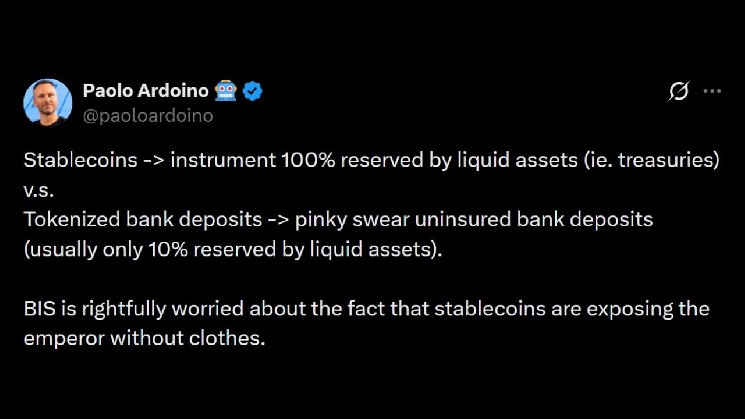
Ardoino countered that the BIS's concerns stem from the fact that stablecoins are naturally a higher form of money than tokenized deposits. Stablecoins, he noted, are almost fully backed by U.S. Treasuries, whereas tokenized deposits are typically only 10% collateralized by liquid assets — a reference to the fractional reserve structure that underpins commercial banking, in which banks hold only a portion of deposits in liquid form. Tether's own reserves are dominated by U.S. Treasury holdings, a position large enough that Ardoino has previously claimed USDT is a top-20 holder of U.S. Treasuries.
"BIS is rightfully worried about the fact that stablecoins are exposing the emperor without clothes. Why someone should choose to put his savings into a fractional reserve product while stablecoins are fully reserved?" Ardoino declared.
Stablecoins have grown sharply in popularity and adoption. Tether's $USDT, which boasts a market capitalization of over $183 billion at the time of writing, has become a relevant product in emerging markets. Ardoino himself pointed out that there are economies "heavily relying on $USDT, for both internal and foreign commerce."
The stablecoin question has also reached the upper echelons of U.S. politics, becoming a sticking point in the debate over passing the Digital Asset Market Clarity Act, known as the CLARITY ACT. Banks fear deposit flight if crypto exchanges are permitted to issue rewards for these products. The concern echoes what U.S. lawmakers weighed earlier in 2025 when the GENIUS Act, the first federal stablecoin framework, was signed into law, with banking groups lobbying to restrict non-bank issuance.
"What happens to financial system if people start realizing that stablecoins are safer and move their savings into the better asset class? We're in the Find Out phase," Ardoino concluded, hinting at the possibility of large-scale substitution of bank deposits for stablecoins. How regulators and central banks reconcile tokenized deposits with a stablecoin market that continues to expand remains one of the defining questions for the next phase of digital-money policy.
