Tether and Bitfinex identified as unnamed firms in US case against payments group Capstone
Key Takeaways
- •Tether and Bitfinex have been identified as the two unnamed crypto companies tied to a US forfeiture case in which federal prosecutors froze about $84.2 million held in Capstone's name over unlicensed money transmission allegations.
- •The civil forfeiture complaint, filed July 15 in the Eastern District of California, alleges Capstone's Wells Fargo account disbursed $337 million between March and December 2025, with nearly two-thirds going to hundreds of recipients mostly outside the United States.
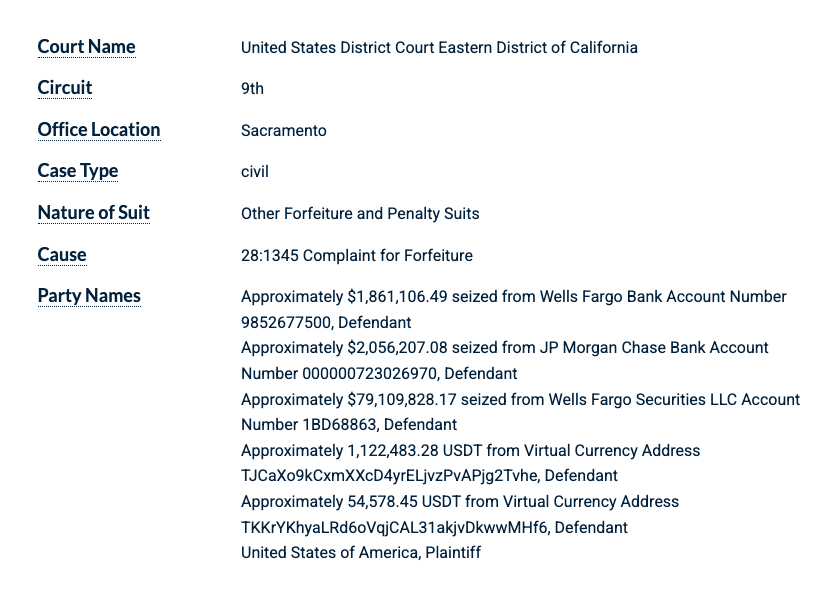
- •The seized property spans five pieces, including $79.11 million in a Wells Fargo Securities account and about 1.18 million USDT split across two wallets.
- •EQIBank, the Dominica-licensed digital bank through which Tether and Bitfinex reached Capstone, says about 80% of its monetary assets were frozen and now faces enhanced supervision from Dominica's regulator, which has warned of potential liquidation.
- •Capstone denies wrongdoing and plans to file a motion to dismiss, while Tether says its exposure amounts to less than 0.034% of the group's assets and both companies say they had no knowledge of the alleged conduct.
Tether and its sister exchange Bitfinex have been identified as the two unnamed crypto companies at the center of a US forfeiture case against payments group Capstone Ltd, according to people familiar with the matter who spoke to the Financial Times.
Federal prosecutors in California have frozen roughly $84.2 million held in Capstone's name, alleging that the payments group moved money without a license.
A Wells Fargo account disbursed $337 million, the complaint says
The civil forfeiture complaint, filed July 15 in the Eastern District of California, does not name either company, referring only to a crypto company, an affiliated exchange, and a bank in Dominica. That framing is standard in US civil forfeiture, where the action is brought against the property itself rather than against an owner or holder, and third parties with an interest in the funds must contest the seizure in court.
Prosecutors say Capstone's Wells Fargo business account, excluding Treasury purchases, disbursed $337 million between March and December 2025. Almost two-thirds of that sum appears to have gone to hundreds of recipients, mostly outside the United States, on behalf of the two crypto firms, the complaint alleges.
Court records show the seized property consists of five pieces. The largest is $79.11 million in a Wells Fargo Securities account, followed by $2.06 million at JPMorgan Chase, $1.86 million at Wells Fargo Bank, and about 1.18 million USDT, the dollar-pegged stablecoin issued by Tether, split between two wallets.
Capstone presented itself to banks as an IT services company, prosecutors allege. It was incorporated in Montana, the only US state that does not license money transmitters.
The complaint also links Capstone to a separate scheme in which fraudsters posing as FBI agents elderly victims into making payments that were converted into USDT within about a day. That strand of the fraud involves one account holding just over $2 million. There is nothing to suggest Tether, Bitfinex, or EQIBank knew about it.
Capstone, which denies any wrongdoing, plans to file a motion to dismiss, its lawyer said. How the court rules on that motion, whether Tether and Bitfinex formally enter the case, and how Dominica's regulator proceeds with EQIBank are the case's main open threads.
EQIBank says the seizure took 80% of its money
Tether and Bitfinex reached Capstone through EQIBank, a Dominica-licensed digital bank. Both companies said they are EQIBank clients, had no knowledge of the conduct alleged against Capstone, and retain limited assets there. Tether put its exposure at "less than 0.034% of the assets of the group," a spokesperson said. The setup shows how crypto firms can reach the traditional banking system through small offshore-licensed institutions, and how a single intermediary's legal troubles can put the bank itself under regulatory pressure.
According to a court motion filed June 29, EQIBank learned on April 2 that about 80% of its monetary assets, held through Capstone, had been frozen. Its officials spent roughly three hours on an April 16 call with Justice Department lawyers, with no US counsel present.
EQIBank was subsequently placed under enhanced supervision by Dominica's financial regulator, which warned of further action, including potential liquidation, the motion said. On July 16, District Judge Dale A. Drozd rejected the bank's attempt to recover the money.
Earlier this month, Cryptopolitan reported that two Thai businessmen filed a lawsuit against Tether for freezing 42.4 million USDT, allegedly at the verbal request of a US Homeland Security agent.

