Goldman Sachs Lifts Tesla Price Target to $378 as TSLA Extends Recovery From Summer Lows
Key Takeaways
- •Goldman Sachs raised its Tesla price target to $378 from $360 while keeping a Neutral rating, citing expected continued sales growth and long-term potential from robotaxi, full self-driving, and humanoid programs.
- •Tesla delivered 486,000 vehicles in the third quarter, outpacing production by 22,000 units, though the total fell below the prior-year quarter that was lifted by purchases ahead of the federal tax credit's expiry.
- •Analysts expect Tesla's upcoming earnings report to show revenue roughly unchanged at $27.9 billion, with annual revenue projected to grow 12.60% to $106.7 billion and then rise 13.54% to more than $121 billion.
- •Tesla faces headwinds from intensifying competition in China and free cash flow expected to stay negative as the company funds its large semiconductor plant in Texas.
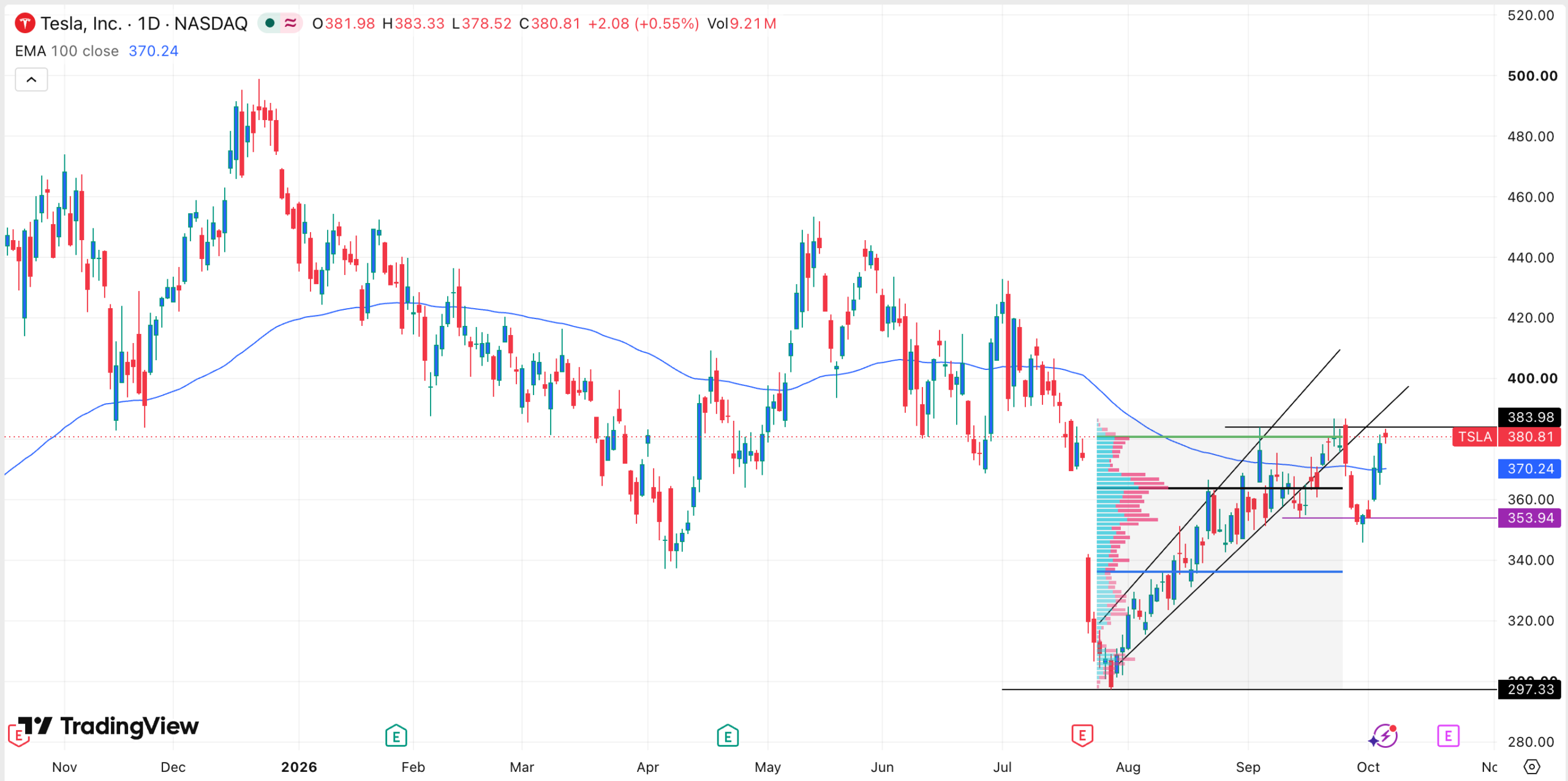
- •TSLA has rebounded about 28% from its July low of $297 to around $381, trading above its 100-day moving average and the $364 Point of Control level as bulls eye the $400 mark, which sits above Goldman's revised target.
Tesla (NASDAQ: TSLA) shares held near $379 on Oct. 6 after extending a recovery from the summer lows reached earlier this year. The rebound has been supported by stronger-than-expected third-quarter vehicle deliveries and renewed investor interest in the company's autonomous-driving and robotics businesses.
TSLA has rebounded since August, and Goldman Sachs, while stopping short of turning bullish, raised its outlook for the company. In a statement this week, the bank lifted its price target to $378, modestly above its earlier $360 target — a 5% increase that still leaves the new target just below the level at which shares traded on Oct. 6. Analyst Mark Delaney maintained a Neutral rating on the stock, saying that the company's sales will continue rising. He also argued that Tesla's other initiatives, including its robotaxis, full self-driving, and humanoid programs, may boost the business over the long term.
Broader Analyst Support
In addition to Goldman Sachs, several other firms hold a bullish view of the company. Wells Fargo analyst Colin Langan reiterated his buy rating, while Cantor Fitzgerald maintained its overweight rating. Goldman's Neutral stance, by comparison, sits on the more cautious end of that spectrum. Among the other top analysts with bullish outlooks on Tesla are those at JPMorgan, Royal Bank of Canada (RBC), and BMO.
Deliveries and Fuel Prices
Tesla's recent delivery report showed that the company delivered 486,000 vehicles last quarter after producing 464,000, meaning deliveries outpaced production by 22,000 units. The figure was lower than the number of vehicles sold in the same quarter last year, when results were lifted by a rush of purchases ahead of the expiry of the federal tax credit.
The company may also benefit from the ongoing US-Iran war, which has pushed gasoline and diesel prices higher. The average U.S. gasoline price has moved to $4.36, while diesel has jumped to $6.32 a gallon. With fuel costs elevated, many Americans may begin to embrace electric cars, which are cheaper to maintain.
Growth Outlook
Top analysts believe Tesla's business will continue in the coming years. The company's upcoming earnings report, due out later this month, is expected to show that revenue was largely unchanged at $27.9 billion, making the release the first detailed check of those expectations since the delivery report. The slow annual growth mostly reflects the strong performance Tesla recorded in Q3 2025, before the tax credit expired.
Despite the flat quarter, analysts expect annual revenue to reach $106.7 billion, up 12.60% from what the company generated last year. Revenue is then expected to jump by 13.54% to more than $121 billion. Earnings per share are expected to continue growing over this period, with the growth driven by the EV and energy businesses.
Headwinds From China and Cash Flow
The key challenge, however, is that Tesla's business in China continues to face intensifying competition. Indeed, most Chinese EV stocks, including popular names such as Nio, BYD, Li Auto, and XPeng, have all slumped by double digits in the past few months.
Another challenge is that the company's free cash flow — the cash remaining after operating costs and capital investments — is expected to remain negative as it continues to invest in its giant semiconductor plant in Texas.
Technical Picture
The daily chart shows that the TSLA stock price has rebounded roughly 28% from a July bottom of $297 to the current level of $381. Most recently, the stock formed a small hammer candle on September 30, a pattern that helps explain why shares have climbed over the past few days.
TSLA has also jumped above its 100-day moving average and above $364, the Point of Control (POC) level of the Fixed Range Volume profile — the price level where the heaviest trading volume took place within the measured range. In most cases, moving above that level indicates that bulls are gaining momentum. The Relative Strength Index (RSI) and the MACD indicators have continued rising as well, suggesting that the stock could extend its advance as bulls target the psychological level of $400, a mark that sits above Goldman's revised $378 target.
This article is for informational purposes only and does not constitute financial or investment advice. Analyst price targets, technical levels, and earnings estimates may change as market conditions evolve.
This article originally appeared on The Market Periodical.

