Tesla Stock Drops 4% as Q3 Profit Falls 43% Amid SpaceX Merger Talks
Key Takeaways
- •Tesla's third-quarter operating income declined 56% as expenses rose, compressing the operating margin to 2.6% even as revenue held nearly flat at $28.05 billion.
- •Automotive sales fell 3% year over year to $20.56 billion after pull-forward demand tied to the federal tax credit's expiration, and Tesla issued guidance pointing to fewer deliveries this year.
- •Service revenue grew 33% to $4.6 billion, the fastest-growing segment, while energy generation and storage revenue dropped 16% to $2.8 billion.
- •Elon Musk confirmed on October 20 that independent committees at Tesla and SpaceX are evaluating a potential merger, though no terms have been disclosed and regulatory, valuation, and governance hurdles remain.
- •The stock faces a resistance zone between $386 and $389, with a break below $370 potentially opening the way to the October 20 low of $363.64 and the October 16 low near $349.33.
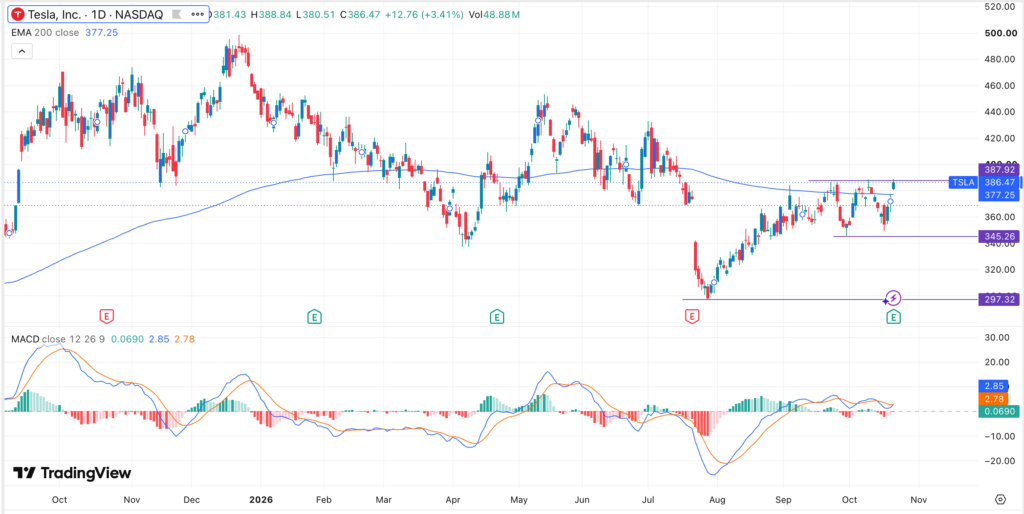
Tesla shares fell more than 4% in premarket trading on October 22 after the company released third-quarter results that missed expectations, with the stock retreating toward $370 after closing Wednesday's regular session near $386.63.
The electric-vehicle maker reported $28.05 billion in revenue for the quarter, largely unchanged from the same period last year. Operating income, however, declined 56% as expenses increased. Investors also assessed a potential merger with SpaceX, although neither company has announced a definitive agreement.
Soft Delivery Guidance Weighs on Shares
The decline followed the release of Tesla's third-quarter earnings report, which showed automotive sales fell 3% year over year to $20.56 billion. The annual drop coincided with weak deliveries, driven by a pull-forward in demand as many Americans rushed to purchase vehicles ahead of the expiry of the federal tax credit. Pull-forward demand of this kind pulls sales from future periods into the present, a dynamic that can weigh on the delivery comparisons that follow.
Energy generation and storage revenue was also in the red, falling 16% to $2.8 billion, down from more than $3.13 billion in the second quarter. The quarter's only bright spot was service revenue, which rose 33% to $4.6 billion, making it the fastest-growing segment Tesla reported this quarter and partially offsetting the vehicle-side declines. In total, Tesla generated $28 billion in revenue, largely flat compared with the year-ago period.
The results also showed narrowing margins. Operating margin dropped to 2.6%, while the adjusted EBITDA margin came in at 13.9%.
The figures reflect a company spreading itself across multiple fronts as it competes with rivals such as General Motors and Ford. Tesla recently launched its flying car, which uses some technologies developed by SpaceX, and has started mass production of its semi truck. Most significantly, the company is investing heavily in robotics through its Optimus program, with manufacturing underway in Nevada. Tesla aims for Optimus to lead an industry where companies such as Boston Robotics dominate. It is also devoting substantial resources to the Terafab project, a with SpaceX. Sustaining that range of programs on a 2.6% operating margin highlights the tension between expansion spending and profitability that ran through the quarter's results.
Adding to the pressure, Tesla issued soft guidance, indicating it expects to deliver fewer cars this year. The signal turns attention to how demand holds up without the federal incentive.
Uncertainty Over SpaceX Merger Discussions
Shares also faced uncertainty surrounding discussions of a potential SpaceX merger. Elon Musk confirmed on October 20 that both companies had established independent committees to evaluate a possible combination. According to TechCrunch, the committees comprise independent directors from Tesla and SpaceX.
Musk acknowledged the conflicts arising from his ownership interests in both companies, but cautioned that the proposed transaction might not proceed.
A merger would combine Tesla's automotive, energy, and robotics operations with SpaceX's launch, satellite, and computing businesses. The companies, however, operate under different regulatory requirements. SpaceX's U.S. government contracts and Tesla's Chinese operations could complicate approval, and the companies would also need to resolve questions around valuation, governance, and shareholder approval.
Tesla's earnings added another financial consideration: the results recorded a $142 million unrealized loss on the company's SpaceX equity investment. The accounting loss does not represent a completed sale of SpaceX shares. Meanwhile, no official merger terms, transaction valuation, or completion schedule have emerged. Until the committees conclude their evaluation, the review's progress — and any disclosure of terms — stands alongside delivery guidance as the key items to monitor.
Can the $389 Resistance Hold?
Tesla stock approached $389 on October 21 before reversing after the earnings release. Historical prices showed nearby highs of $386.70 on September 23 and $388.56 on October 9, while the October 21 session reached approximately $388.83. Together, these levels have established a potential resistance zone between $386 and $389.
Repeated tests of resistance do not, by themselves, confirm a triple-top reversal pattern; confirmation would require a sustained breakdown below the relevant support area.
A decline below $370 could bring the October 20 low of $363.64 into focus. Further selling might expose the October 16 low near $349.33. Conversely, a sustained recovery above $389 could weaken the bearish outlook and bring the psychological $400 level into consideration. The original bearish Moving Average Convergence Divergence and exponential moving-average claims remain unverified.
Tesla stock now faces pressure from weaker operating earnings and unresolved merger discussions. A recovery above $389 would strengthen the technical outlook, while deeper losses could expose the $350 area.
This article is for informational purposes only and does not constitute financial advice. Stock investments carry volatility and the potential for capital losses, and readers should conduct independent research before making investment decisions.
Source: The Market Periodical

