Tesla Stock in Bear Market as Bulls Point to Demand, Investment Plans and Analyst Targets
Key Takeaways
- •Tesla's stock has fallen from a year-to-date high of $499 to $327, placing it in a technical bear market.
- •Free cash flow turned negative due to major capital investments including a semiconductor plant with SpaceX and a planned $10 billion solar panel facility in Texas.
- •Tesla delivered 480,000 vehicles in the quarter, supporting a 26% revenue increase that brought total revenue to $28.3 billion.
- •The Model Y sold 180,000 units in China, outpacing competitors such as Li Auto and Xiaomi despite carrying a higher price point.
- •Analyst price targets range from $420 to $500, though some analysts have reduced targets over concerns about margin compression from sustained price cuts.
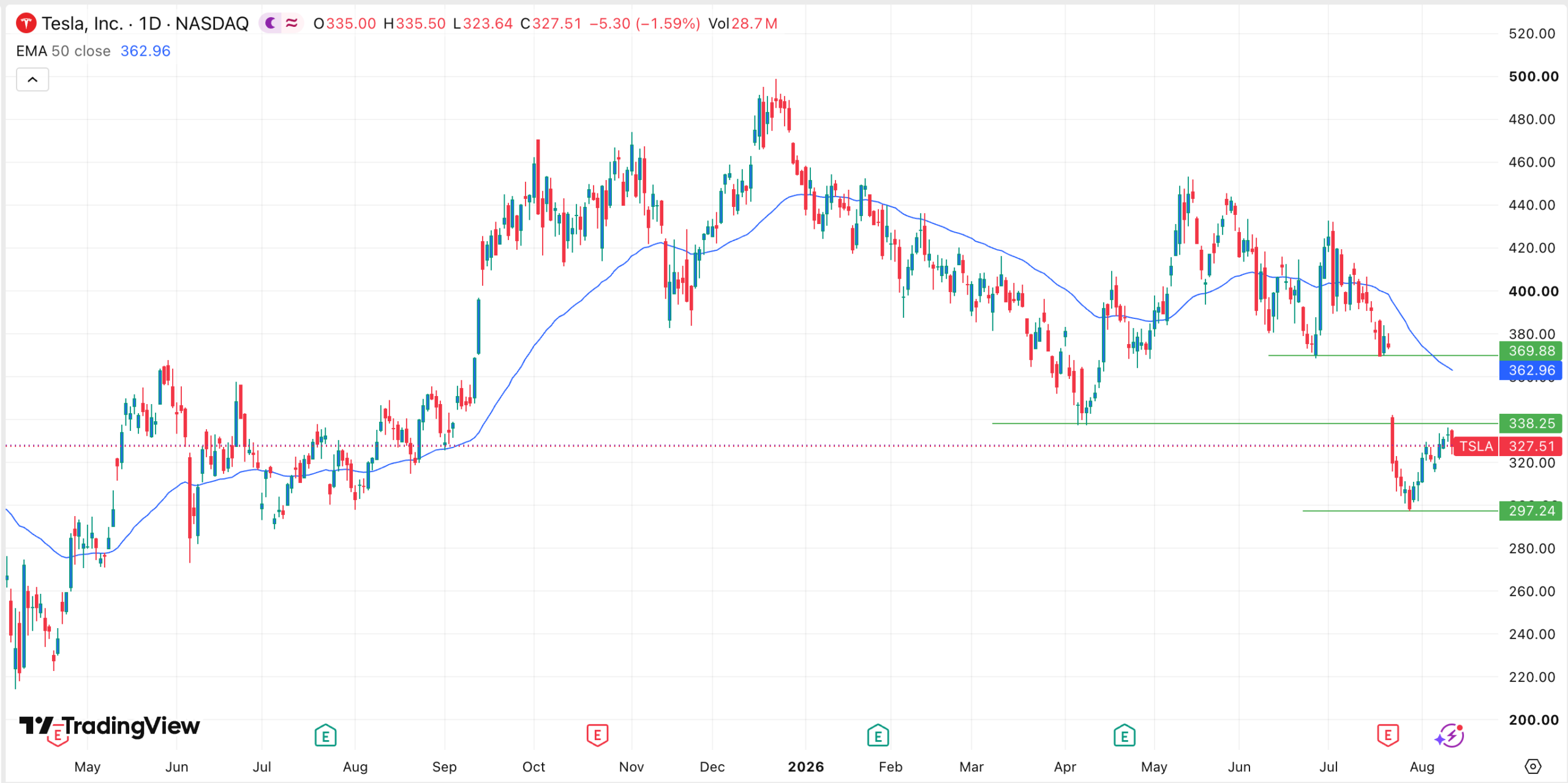
Tesla stock has fallen to $327 from a year-to-date high of $499, pushing it into a technical bear market. The decline extended after the company released financial results that showed free cash flow continued to narrow. The pullback also comes amid a broader cooling in EV demand growth across the industry, which has prompted several major automakers to adjust their electrification timelines. Even so, there are still reasons to think the stock could eventually recover.
Strong vehicle demand remains a key support
One of the main bullish factors for TSLA stock is that demand for Tesla vehicles continues to rise in important markets. A report released this week showed strong demand in China, where competition has intensified. China's BYD overtook Tesla as the world's largest EV maker by quarterly volume in late 2023, underscoring the competitive pressure Tesla faces in its second-largest market.
Tesla's Model Y sold 180,000 vehicles, outpacing comparable brands such as Li Auto's i6 and Xiaomi's SU7. That growth came despite the model's higher price, which ranges from 263,500 yuan to 313,500 yuan.
The company is also seeing strong demand in Europe, where it is increasing supply in Germany. Tesla has raised capacity in the country by about 20% and is now producing about 7,500 vehicles a week. To support that increase, the company is hiring about 1,000 employees.
Tesla is benefiting from this demand at a time when many manufacturers in the U.S. and Germany are shifting back to internal combustion engine, or ICE, vehicles. Recent delivery data showed Tesla delivered 480,000 vehicles in total and produced 450,000 during the quarter.
That growth supported revenue expansion, with the automotive segment generating more than $20 billion. Total revenue increased 26% to $28.3 billion.
Capital spending is weighing on free cash flow
Tesla's stock has dropped over the past few months because free cash flow has turned negative, largely due to heavy investment spending.
Together with SpaceX, Tesla is investing billions of dollars in a large semiconductor manufacturing plant that will produce chips for the two companies and other technology names. Tesla has also announced plans to spend $10 billion to build a solar panel manufacturing plant in Texas.
Those projects suggest that free cash flow will likely remain under pressure for some time. However, history suggests the investments may prove worthwhile over the long term. Tesla could also benefit from bringing chip production in-house. Demand for that business could rise if China decides to invade Taiwan. The push toward domestic chip production also aligns with broader U.S. industrial policy efforts, including the CHIPS and Science Act, which has channeled tens of billions in incentives toward building semiconductor capacity on American soil.
Analysts remain constructive on TSLA
Several prominent investors and analysts still expect Tesla stock to rebound. Cathie Wood has made Tesla the largest holding in her flagship ETFs.
Among analysts, Stephen Gengaro of Stifel has a price target of $491. Tom Narayan of Royal Bank of Canada has a target of $500. Baird, Deutsche Bank and Piper Sandler have targets of $475, $420 and $450, respectively.
These analysts point to Tesla's position in the automotive industry and its growing role in the energy sector, where its energy storage deployments have scaled rapidly. They see the negative free cash flow as a temporary issue. Not all analysts share this optimism, however, as some have lowered targets or expressed concern about margin compression from repeated price cuts deployed to sustain delivery volumes.
Technical picture shows a possible recovery zone
Tesla's daily chart shows the stock has been in a steep downtrend over the past few months. The sell-off accelerated after the company's latest earnings report, which highlighted rising costs.
The stock formed a fair value gap after earnings and is now trying to fill it. A move in that direction would be confirmed if TSLA rises above the key resistance level of $338, which was its lowest level on April 8.
If Tesla clears that point, the next level to watch would be $369.88, which marked the lowest point on June 26 and July 20.

