Tesla Demonstrates Rocket-Equipped Roadster, but the Flying Version Is Not Road-Approved
Key Takeaways
- •Tesla's Roadster demonstration relied on cold-gas thrusters—10 nozzles supplied by 600 liters of compressed air and built with technology borrowed from SpaceX—rather than burning rocket fuel.
- •Reservations cost $50,000 for the two-seat Performance model and $250,000 for the Thrust model, while production is slated for 2028 and no final purchase price has been announced.
- •Tesla lists the Roadster at a top speed above 230 mph, more than 300 miles of range, and 0-60 mph acceleration in under one second, with the on-stage run recording 0.81 seconds.
- •The flying version is not approved for public road use, and no FAA or road-safety clearance has been reported, while certifying a new aircraft type can take five to nine years.
- •A 2021 Joule study estimated hovering requires 500 to 900 watts per kilogram versus 150 to 350 in cruise, and Tesla's cold-gas approach may explain why the demo featured jumps and a flip rather than sustained flight.
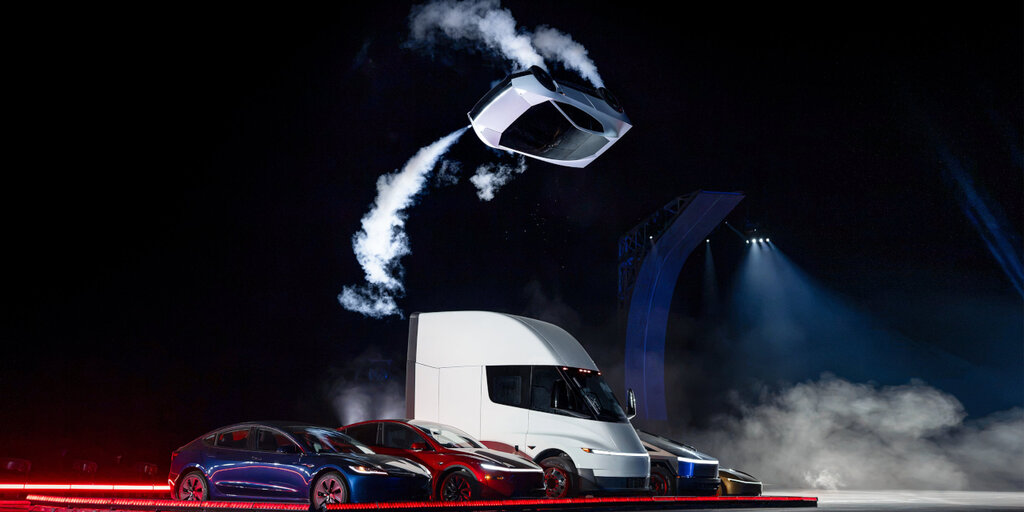
Tesla demonstrated a new Roadster on October 15 by driving it up an inverted ramp, launching it into the air, flipping it midair and landing it on its wheels. The maneuver used cold-gas thrusters developed with technology borrowed from SpaceX.
The livestreamed demonstration took place at a SpaceX test site in Texas. The car also hopped over a row of Teslas that included a Semi truck. The stunt attracted widespread attention on social media, particularly on X, where the announcement received more than 10 million views.
Tesla posted footage of the demonstration on X: https://x.com/Tesla/status/2110788059008819215?s=20
Sam Altman, a former friend and current critic of Elon Musk, also praised the vehicle on X, writing, “Wow the new roadster looks quite amazing, good job.” Altman reserved a Roadster in 2018 and waited 7.5 years to receive a refund. His post is available here: https://x.com/sama/status/2111131677351432197
Tesla has presented the Rocket as a single-seat version built around a full flight system, but it is available by invitation only. Reservations for the two-seat Performance model cost $50,000, while reservations for the Thrust model cost $250,000. Tesla’s reservation page requires $5,000 upfront, with the remaining balance due within 10 days. The company has not announced a final purchase price for any version. The structure means customers are committing reservation funds well ahead of the announced 2028 production start, before a final price exists.
Musk said production will begin in 2028. Tesla has also described the vehicle as “the best of the last human-driven cars.”
The system that allows the Roadster to leave the ground uses cold-gas thrusters. Rather than burning rocket fuel, the system forces compressed air through nozzles. Lars Moravy, Tesla’s vice president of vehicle engineering, said the car uses 10 thrusters connected to 600 liters of compressed air. He also said Tesla borrowed some technology from SpaceX for the system.
Tesla lists a top speed above 230 mph, more than 300 miles of range and acceleration from 0 to 60 mph in less than one second. The on-stage demonstration recorded 0.81 seconds, while Tesla lists the single-seat Rocket at less than 0.59 seconds.
Musk began promoting the possibility of a flying Roadster last October. During an appearance with Joe Rogan, he said the next Roadster could be capable of flight and would be “crazier than all the James Bond cars combined.”
Tesla’s website says the flying version is not approved for public road use. Asked whether the vehicle is street-legal, Musk said it “depends on your street.” No Federal Aviation Administration or road-safety approval for the flying version has been reported. Any change to that regulatory status would be a key indicator of whether the flying Roadster progresses from demonstration toward customer delivery.
Making such a vehicle legal would likely involve at least two regulatory systems. U.S. automakers self-certify that their vehicles meet federal safety standards, while aircraft require an FAA airworthiness certificate. The FAA says certifying a new aircraft type can take between five and nine years. That external review is the hurdle a self-certified car never faces, and it is the step standing between the demonstrated jumps and legal flight.
One relevant precedent is Alef Aeronautics. A precursor to the company’s Model A received an experimental airworthiness certificate from the FAA in June 2023. The certificate permits flight testing and was presented as a step toward obtaining a type certificate.
Minnesota’s Jetsons law allows residents to own a roadable aircraft but prohibits taking off and landing on public roads. The law followed a 2020 New Hampshire law that gave private citizens the right to own flying cars. Drivers of a vehicle that also qualifies as an aircraft may therefore need a special license. Even in states that permit ownership, the restrictions on where such a vehicle can take off and land shape how it could actually be used.
Hovering presents another technical challenge. A 2021 paper published in Joule estimated that an electric aircraft requires500 to 900 watts per kilogram to hover, compared with 150 to 350 watts per kilogram during cruise. In practical terms, a battery must release energy much faster during hovering than during ordinary flight.
Tesla’s cold-gas system avoids relying on the battery for that entire power demand, which may help explain why the demonstration showed jumps and a flip rather than a flight from one location to another.

