Tesla Q2 2026 Earnings: Record Deliveries Meet an AI Spending Test for TSLA Stock
Key Takeaways
- •Tesla's Q2 2026 revenue reached $28.24 billion, up from $22.50 billion a year earlier, supported by record vehicle deliveries, energy storage growth, and a 50% increase in services revenue.
- •Operating income declined to $398 million with operating margin falling to 1.4% from 4.1%, as operating expenses climbed 47% due to investments across AI, autonomy, battery manufacturing, and robotics programs.
- •Tesla reported negative free cash flow of $1.09 billion for the quarter, as capital expenditures of $5.79 billion outpaced operating cash flow of $4.70 billion.
- •Active FSD subscriptions grew 56% year over year to 1.48 million, while Tesla commenced Cybercab production in Texas and expanded Robotaxi service across multiple U.S. metropolitan areas.
- •Underlying automotive gross margin excluding regulatory credits improved to 16.3% from 15.0%, indicating stronger core vehicle economics despite lower reliance on credit revenue.
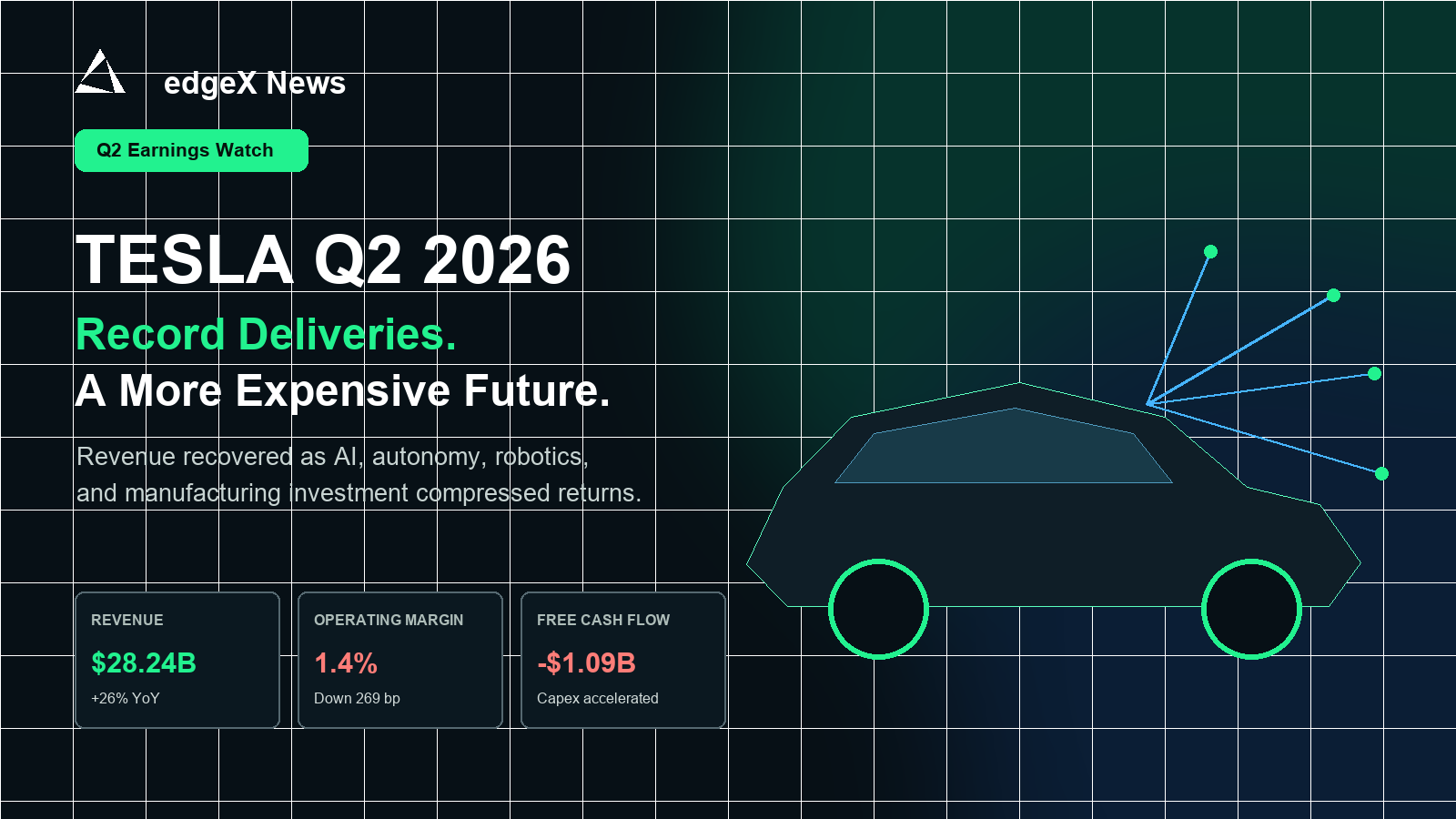
Tesla’s Revenue Rebound Came With a More Expensive Future
Tesla entered Q2 needing to prove that its core business could regain momentum while management funded a much larger technology agenda. The company delivered the first half of that argument. Revenue reached $28.24 billion, up from $22.50 billion a year earlier, and total vehicle deliveries rose to 480,126. Energy storage deployments also returned to growth, while services produced record profitability.
The second half was harder. Operating income dropped to $398 million even as gross profit increased. Research and development, selling and administrative costs, and capital investment all climbed as Tesla expanded AI compute, battery manufacturing, Cybercab, Robotaxi, Optimus, semiconductor work, and new energy capacity. The quarter therefore asks a more useful question than whether Tesla beat or missed a single consensus estimate: how much current profitability should investors be willing to exchange for a broader, more capital-intensive future?
The Q2 Numbers That Reset the TSLA Debate
Tesla's official shareholder update and Form 10-Q show a business with stronger volume but much thinner operating leverage. The contrast is visible across the income statement and cash-flow statement.
| Q2 Metric | Q2 2026 | Q2 2025 | Investor Read |
|---|---|---|---|
| Total revenue | $28.24B | $22.50B | Broad recovery across automotive, energy, and services |
| Total automotive revenue | $20.52B | $16.66B | Record deliveries restored vehicle growth |
| Energy generation and storage revenue | $3.14B | $2.79B | Storage is becoming a larger second engine |
| Services and other revenue | $4.58B | $3.05B | A 50% increase improved revenue diversification |
| Operating income | $398M | $923M | Higher costs outweighed the gross-profit increase |
| Operating margin | 1.4% | 4.1% | The central weakness in the quarter |
| Operating cash flow | $4.70B | $2.54B | Core cash generation strengthened |
| Capital expenditures | $5.79B | $2.39B | AI and manufacturing investment accelerated sharply |
| Free cash flow | -$1.09B | $146M | Investment exceeded operating cash generation |
| Vehicle deliveries | 480,126 | 384,122 | Record Q2 volume, up 25% year over year |
| Storage deployments | 13.5 GWh | 9.6 GWh | Deployment growth reached 41% |
Headline growth was real, but its quality was uneven. Total gross margin slipped to 16.8% from 17.2%. Automotive gross margin excluding regulatory credits improved to 16.3% from 15.0%, a constructive signal because regulatory-credit revenue fell to $146 million from $439 million. The vehicle business relied less on credits and generated better underlying gross margin, yet that improvement did not reach operating income because operating expenses rose 47%.
Record Deliveries Strengthened the Core Auto Case
Tesla produced 451,758 vehicles and delivered 480,126 during the quarter. Model 3 and Model Y deliveries rose 25% year over year, while global vehicle inventory declined to 15 days of supply from 24 days. Those figures support the view that demand and execution improved after a softer first quarter.
The mix still matters. Record deliveries do not automatically restore Tesla's historical earnings power if pricing, incentives, product costs, and regional competition remain demanding. Investors should distinguish a volume recovery from a full margin recovery. Q2 offered convincing evidence of the first and only partial evidence of the second.
Tesla also said battery-pack capacity remained the main near-term constraint on expanding vehicle production. That makes its investment in 4680 cells, lithium refining, cathode materials, and LFP capacity strategically important. It also means the company is spending heavily before investors can see the full revenue benefit.
Energy and Services Made Tesla Less Dependent on Cars
Energy storage was one of the quarter's cleanest growth signals. Deployments reached 13.5 GWh, the second-highest quarterly level in Tesla's history, supported by the Shanghai Megafactory and demand for grid-scale storage. Tesla expects its Texas Megafactory to begin producing Megapack 3 and Megablock in 2026.
Services and other revenue rose 50% to $4.58 billion. Tesla reported record services gross profit of $648 million and a 14% gross margin, with contributions across charging, maintenance, used vehicles, insurance, and other activities. These businesses do not yet remove the importance of automotive economics, but they make the company less one-dimensional and can support recurring relationships with a growing installed vehicle base.
The Margin Problem Is Really an Investment-Timing Problem
Research and development expense rose to $2.37 billion from $1.59 billion, while selling, general and administrative expense increased to $1.98 billion from $1.37 billion. Tesla is funding several ambitious programs at once: production of Cybercab, a wider Robotaxi rollout, FSD development, Optimus production lines, onsite AI compute, battery and materials plants, and early semiconductor manufacturing capability.
That spending can create value, but the timing mismatch is severe. Costs appear in the income statement and cash-flow statement now. The revenue and profit from autonomous fleets, humanoid robots, software subscriptions, or proprietary chips may arrive later, scale unevenly, or not meet management's targets. Q2 free cash flow of negative $1.09 billion made that mismatch visible.
Tesla retains substantial financial capacity. Cash, cash equivalents, and short-term investments totaled $43.52 billion at quarter-end. Still, a strong balance sheet does not make every investment productive. Investors will want milestones that connect spending to paid usage, fleet economics, manufacturing output, or software revenue.
Robotaxi, FSD, and Optimus Carry More of the Valuation
Tesla began Cybercab production in Texas and said Robotaxi service was live or ramping in several U.S. metropolitan areas. Active FSD subscriptions reached 1.48 million, up 56% year over year, and Tesla reported record North American attach rates. It also began installing first-generation Optimus production lines in Fremont and continued construction in Texas.
These advances matter because TSLA is rarely valued as an ordinary automaker. A large part of the investment case assumes Tesla can build scalable software, autonomous mobility, robotics, and energy platforms around its manufacturing base. The valuation opportunity is significant if those businesses produce recurring, high-margin revenue. The risk is equally significant if commercial deployment takes longer, requires more supervision, faces regulatory friction, or consumes more capital than expected.
Why TSLA Sold Off After the Report
The market focused on the gap between revenue growth and profit conversion. Reuters reported that Tesla missed analysts' profit forecasts and produced negative quarterly free cash flow for the first time in more than two years. CNBC reported that shares fell about 4% in extended trading after the release, and the next regular session brought a much sharper decline.
That reaction was not a rejection of every operating improvement. It was a repricing of execution risk. Record deliveries and stronger energy activity showed that demand could recover, but the 1.4% operating margin and $5.79 billion of quarterly capital spending raised the burden of proof for Tesla's AI and autonomy strategy. Readers should verify the current TSLA price through Nasdaq, a broker, or real-time market data because this article does not present a live quote.
Bull Case, Bear Case, and the More Likely Middle Path
The bull case is that Q2 marks a healthier base for Tesla's next phase. Vehicle deliveries recovered, underlying automotive gross margin improved despite lower regulatory credits, energy storage expanded, and services became more profitable. If Cybercab and Robotaxi scale while FSD subscriptions keep growing, Tesla could add software and fleet economics to a larger physical platform.
The bear case is that Tesla is funding too many capital-intensive projects before their commercial returns are proven. Operating expenses are rising, free cash flow is negative, and the core auto market remains competitive. If autonomy timelines slip or new factories operate below efficient utilization, investors may apply a lower multiple to both current earnings and distant optionality.
The middle path is a volatile transition. Tesla can grow vehicles, energy, and services while enduring periods in which investment outruns profit. In that outcome, TSLA remains highly sensitive to delivery data, regulatory progress, Robotaxi utilization, FSD adoption, capex guidance, and evidence that AI products can produce revenue rather than only technical demonstrations.
What Investors Should Watch Next
The next report should be read through four linked tests. First is automotive durability: deliveries, inventory, pricing, and automotive gross margin excluding credits. Second is cash discipline: operating cash flow, capital expenditures, and whether free cash flow remains negative. Third is diversification: energy deployments and services gross profit. Fourth is commercialization: paid Robotaxi miles, active FSD subscriptions, Cybercab production, and credible Optimus milestones.
Management’s outlook remains directional rather than a precise delivery or profit forecast. Tesla says it will prioritize factory utilization, maintain liquidity, and seek a future mix in which hardware profit is accompanied by faster growth in AI, software, and fleet-based profit. Investors should demand measurable progress because the market is already assigning value to that future.
The broader risk map includes tariffs, EV incentives, battery supply, regional competition, autonomous-driving regulation, product liability, and the challenge of executing many manufacturing ramps simultaneously. Q2 improved the growth narrative. It did not settle whether that growth can earn an attractive return on the capital now being committed.
Investors should also separate milestones from economics. Launching in another city, producing an initial Cybercab, or installing an Optimus line can demonstrate technical progress without proving attractive unit returns. The more revealing disclosures will be utilization, paid miles, subscription retention, manufacturing yield, service cost, and the amount of capital required for each increment of growth. Tesla's long-term opportunity is built on scale, but scale creates value only when revenue grows faster than the cost of operating and financing the platform. That is the bridge the next several quarters must begin to show.
Trade Tesla Stock Perpetual Futures on edgeX
edgeX gives traders 24/7 access to TSLA-linked perpetual futures through a decentralized, self-custodial trading venue. The contract is a leveraged derivative rather than Tesla common stock, so it does not provide voting rights or direct share ownership.
React Beyond Traditional Market Hours
Tesla news often arrives through earnings releases, delivery reports, regulatory decisions, product announcements, and comments outside the Nasdaq session. TSLA USDC perpetual futures allow eligible traders to take long or short exposure without waiting for the next opening bell.
Use Leverage With Defined Risk Controls
The TSLA USDC market supports leveraged exposure, which can increase both gains and losses. Traders should review the current leverage limit, funding rate, liquidity, margin requirements, and liquidation price directly on the product page before opening a position. A perpetual futures position should be sized around volatility and downside tolerance, not only directional conviction.
Keep Custody and Product Structure Separate
edgeX combines self-custodial access with an order-book trading experience. That changes the custody model, but it does not remove market, smart-contract, funding, or liquidation risk. Traders should understand how the derivative tracks TSLA, when funding applies, and how collateral behaves during sharp moves.
Frequently Asked Questions
Did Tesla have a strong Q2 2026?
It was strong on revenue, deliveries, operating cash flow, energy deployments, and services growth. It was weak on operating leverage and free cash flow. The most accurate reading is a volume recovery accompanied by a major increase in investment.
Why did operating income fall when revenue increased?
Gross profit increased, but operating expenses rose faster. Tesla spent more on research, administration, AI infrastructure, autonomy, robotics, batteries, and manufacturing expansion. Operating margin consequently fell to 1.4% from 4.1% a year earlier.
What was Tesla's Q2 2026 free cash flow?
Tesla reported operating cash flow of $4.70 billion and capital expenditures of $5.79 billion. Its non-GAAP free cash flow, defined as operating cash flow less capital expenditures, was negative $1.09 billion.
What is the most important TSLA metric after Q2?
No single metric is sufficient. Automotive gross margin excluding credits shows core vehicle economics, while free cash flow shows the cost of Tesla's investment cycle. FSD subscriptions and Robotaxi usage help indicate whether the spending is beginning to create software and fleet revenue.
Is the TSLA price in this article live?
No live share price is stated. Readers should check Nasdaq, their broker, or a real-time market-data service immediately before making an investment or trading decision.

