Tesla Megapack Wins Nvidia DSX Ready Status for AI Factories
Key Takeaways
- •Nvidia's DSX Ready program qualified Tesla, Hitachi Energy, and LG Energy Solution as battery suppliers, while LG Electronics, LiquidStack, and Vertiv received qualification for cooling distribution units, making Tesla's designation non.
- •The battery qualification evaluates grid-adaptive power conversion through tests covering dynamic power response, current limiting, low-voltage ride-through, islanded operation, black-start capability, and grid-to-island transitions, but does not establish site-level stability or approve entire data-center sites.
- •Tesla reported 13.5 gigawatt-hours of energy storage deployments in the second quarter of 2026, with deployments reaching 22.3 gigawatt-hours through June and energy generation and storage revenue up 13% year over year, driven mainly by higher Megapack deployments.
- •Tesla operates Megapack manufacturing capacity of 40 gigawatt-hours each in California and Shanghai, according to its 2025 annual update.
- •Nvidia separately agreed to buy $1.5 billion of SB Energy non-voting equity and partnered with SB Energy on the planned eight-gigawatt PORTS-Pike Technology Campus in Ohio, which OpenAI is expected to use under long-term leases starting in 2028.
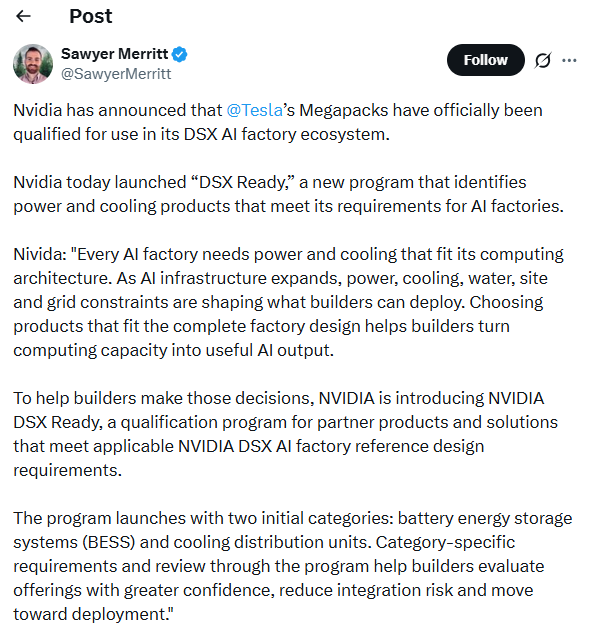
Nvidia qualified Tesla's Megapack battery energy storage system under its newly launched DSX Ready program on Sept. 21, linking Tesla's battery systems to the company's AI factory reference designs. The designation covers battery energy storage systems used around high-density computing infrastructure and places Tesla Energy inside Nvidia's effort to standardize power and cooling for AI data centers. Nvidia said expanding compute demand had increased pressure on power, cooling, water, sites, and grid connections. Qualification does not guarantee site approval or deployment contracts.
Tesla Megapack Joins Nvidia's DSX Ready Program
Nvidia said DSX Ready launched with battery energy storage systems and cooling distribution units, the hardware that circulates coolant through liquid-cooling loops — the two launch categories corresponding to the power and cooling pressures Nvidia cited. The company listed Tesla, Hitachi Energy, and LG Energy Solution among qualified battery suppliers, while LG Electronics, LiquidStack, and Vertiv received qualification for cooling distribution units, meaning Tesla holds the credential alongside other battery makers rather than as an exclusive designation. Nvidia said additional infrastructure and software categories would follow over time.
For battery suppliers, Nvidia requires partners to conduct qualification tests and submit supporting data for review. The process evaluates products within a defined technical boundary rather than approving an entire data-center site. Nvidia's DSX documentation said the battery qualification examines grid-adaptive power conversion performance, with tests covering dynamic power response, current limiting, low-voltage ride-through — the ability to keep equipment running through momentary voltage drops — and islanded operation, or running without a live grid connection. The requirements also examine black-start capability, meaning the ability to bring systems back online without external grid power, and transitions between grid-connected and islanded modes, and Nvidia requires telemetry, control data, and technical models supporting those tests.
However, Nvidia stated that passing the process does not establish site-level stability. Developers still assess transformers, switchgear, generators, and other site-specific systems separately.
Tesla Megapack Qualification Focuses on Power Conversion
That distinction limits what DSX Ready represents for Tesla Megapack deployments. Qualification places the product within Nvidia's component framework — a vetted starting point for equipment selection rather than a turnkey site approval — but project developers retain responsibility for site engineering.
Nvidia requires battery partners to document compliance across several industrial standards. Its checklist references IEEE, UL, NFPA, IEC, and cybersecurity frameworks. The company also requires raw time-series data, summary plots, and test configurations, and partners submit pass-or-fail statements tied directly to Nvidia's technical criteria.
Tesla markets Megapack as a utility-scale battery system integrating battery modules, inverters, and thermal systems. Its current ordering page lists two-hour and four-hour configurations. Tesla lists a two-hour unit at 1,927 kilowatts and 3,854 kilowatt-hours, while the four-hour configuration provides 979 kilowatts and 3,916 kilowatt-hours. Tesla also identifies data centers as a Megapack use case and says the system can support continuous operation during electricity disruptions, the kind of grid-independent performance the DSX battery tests are designed to evaluate.
Tesla Megapack Adds Another Data-Center Channel
The Nvidia qualification arrived as Tesla expanded its energy-storage business. Tesla reported 13.5 gigawatt-hours of energy storage deployments during the second quarter of 2026, and its second-quarter Form 10-Q said deployments reached 22.3 gigawatt-hours through June. Energy generation and storage revenue increased 13% year over year during the quarter, a rise Tesla attributed mainly to higher Megapack deployments, with lower average selling prices partly offsetting the effect, according to the filing.
Tesla operates Megapack manufacturing capacity in California and Shanghai, and its 2025 annual update listed 40 gigawatt-hours of installed capacity at each location. That project supports Tesla's effort to expand stationary-storage output beyond existing plants.
DSX Ready could provide Tesla with another procurement channel for Nvidia-based data-center projects, though Nvidia did not announce any guaranteed Megapack orders with the qualification.
Nvidia Expands AI Factory Power Strategy
The DSX Ready decision also fits Nvidia's wider push into physical AI infrastructure. Nvidia has increasingly tied compute expansion to power availability and data-center construction.
In August, Nvidia announced a partnership with SB Energy covering the PORTS-Pike Technology Campus in Ohio. Nvidia said the site would exclusively host its AI infrastructure, subject to limited exceptions. The initial arrangement covered 4.25 gigawatts of information-technology load, and Nvidia also received an option involving another 3.75 gigawatts as the campus expands. Nvidia said OpenAI would use the planned eight-gigawatt campus under long-term leases, with the first capacity expected to begin coming online in 2028.
Separately, SB Energy's Securities and Exchange Commission filing disclosed another Nvidia investment commitment: Nvidia agreed to buy $1.5 billion of new non-voting equity securities. That investment sits outside the Tesla Megapack qualification itself, but both developments show addressing electricity constraints alongside processor supply.
For Tesla, DSX Ready broadens Megapack's eligibility within Nvidia's reference-design ecosystem without guaranteeing deployment contracts, and builders still conduct site-level engineering before selecting qualified equipment. The next milestone is Nvidia's expansion of DSX Ready into more infrastructure categories, which the company said would roll out over time without giving a date.
This article is for informational purposes only and does not constitute financial or investment advice.

