Africa's Deep Tech Ambitions Face an Ecosystem Built on Software
Key Takeaways
- •Terra Industries closed a $52 million seed round in August, the largest in Africa, for its defence products including autonomous drones, sentry towers, and crewless ground vehicles linked by its ArtemisOS platform.
- •A 2021 study commissioned by the Nigerian Communications Commission found that 84% of hardware components used in Nigeria's telecommunications sector are imported, exposing local hardware makers to shipping costs, foreign exchange movements, customs procedures, and import duties.
- •African deep tech startups raised about $3 billion across 360 deals between 2013 and the first half of 2023, a total smaller than the $3.42 billion all African startups raised in 2025 alone, when fintech captured roughly 40% of the total.
- •Governments in Nigeria, Kenya, Egypt, and South Africa have directed recent policy attention toward artificial intelligence, while deep tech fields such as chip design, medical diagnostics, and electric mobility remain largely outside published national strategies.
- •Africa accounts for less than 1% of global semiconductor economic output and 0.6% of global data-centre capacity, constraining the continent's ability to build the underlying systems required for deep tech and AI.
Terra Industries, Nigerian defence technology startup, has become one of the most recognisable names in Africa's deep tech sector — and the visibility has been earned. Founded in 2024 by Nathan Nwachuku and Maxwell Maduka, the company designs and manufactures autonomous drones, sentry towers, and crewless ground vehicles, all connected through its proprietary ArtemisOS platform. In August, it closed a $52 million seed round, the largest in Africa — a striking figure for seed funding, one of the earliest stages of startup financing — offering a glimpse of what is possible when an ecosystem can carry more companies to that stage.
The United Nations Development Programme defines deep tech as technology built on scientific discoveries, engineering innovations, and advances in research, with intensive research and development at its core. The category includes companies developing drones and robotics, semiconductor and computing technologies, biotechnology, medical devices, and some forms of artificial intelligence.
Most businesses in Africa's tech ecosystem, by contrast, are built around using technology rather than developing it. A fintech company can launch a payments product without manufacturing the smartphones its customers use, just as a logistics startup can build software on cloud infrastructure or networks developed and operated by other companies. The underlying hardware and foundational systems already exist; these startups simply apply them to market problems.
Deep tech brings that technology inside the company. To turn engineering breakthroughs into commercially viable products, such companies may need to design and repeatedly test prototypes, source specialised components, work with researchers and engineers, and access laboratories or manufacturing facilities.
Building deep tech is an uphill climb
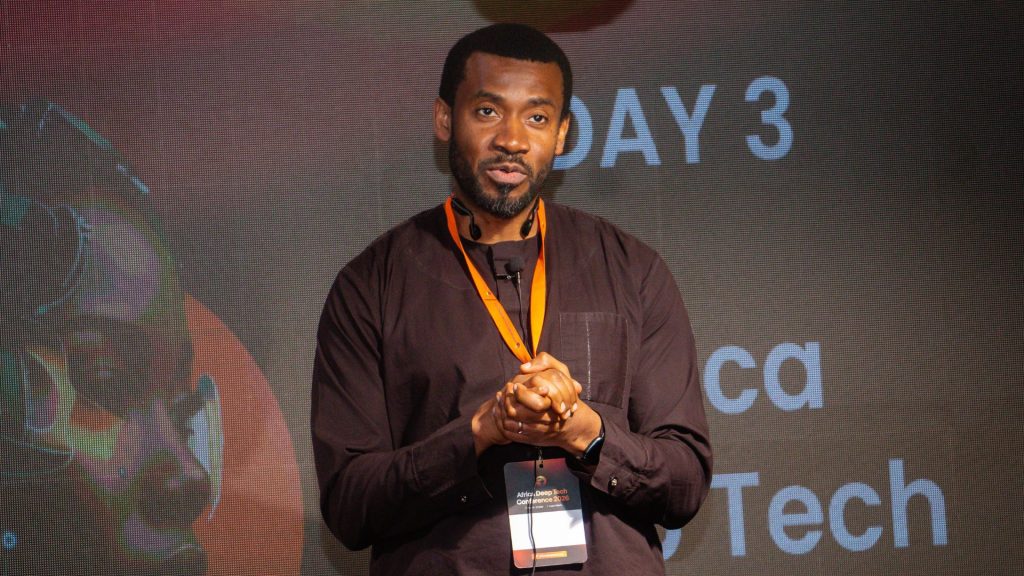
Chukwuemeka Afigbo, who convenes the Africa Deep Tech Foundation, a community focused on supporting deep tech builders and developing the ecosystem around them, said hardware companies in the community have raised concerns about the cost of bringing components into the country.
“The hardware folks would tell you there's a lot of support they need that they haven't necessarily seen. For example, like policies around the amount of money they pay to bring in components to build stuff in the country,” he told TechCabal in October.
The reliance on imports is measurable. A2021 baseline study]() commissioned by the Nigerian Communications Commission found that 84% of the hardware components used in Nigeria's telecommunications sector are imported, including printed circuit boards, semiconductors, connectors, antennas, and other electronic parts. For hardware companies building and testing products locally, components that cannot be sourced domestically must be brought in from abroad, exposing them to shipping costs, foreign exchange movements, customs procedures, and import duties.
Africa's capacity to produce some of the technologies underpinning the global economy remains limited. The continent accounts for less than 1% of global semiconductor economic output, according to the African Academy of Sciences, and its position in the semiconductor industry is concentrated on design or testing.
The same constraints are becoming visible in artificial intelligence. AI is now one of the biggest technology conversations in Africa, but many of the products available are built on infrastructure developed elsewhere. Building the underlying systems requires specialised chips, data centres, engineering talent, and research capacity — and Africa currently accounts for 0.6% of global data-centre capacity, the physical infrastructure on which AI systems run.
Funding is another constraint. In 2025, African startups raised $3.42 billion, with fintech accounting for $1.37 billion, or about 40% of the total, according to TechCabal Insights' State of Tech in Africa report. A Briter Intelligence mapping of the sector, meanwhile, found that African deep tech startups raised about $3 billion across 360 deals between 2013 and the first half of 2023 — a period of more than a decade, and a total still smaller than what all African startups raised in 2025 alone.
The economics of building deep tech help explain the disparity. Import costs and a thin research base can make a hardware company's path to revenue longer and its failures more expensive than those of a software company, and capital tends to follow businesses where there is a clear route to generating returns on investment.
Policy attention tilts toward AI
Governments across Africa are paying attention to advanced technology, but AI has received a disproportionate share of it. Nigeria's National Artificial Intelligence Strategy was published in September 2025; Kenya adopted a national AI strategy in 2025; Egypt updated its AI strategy; and South Africa has been developing an AI policy framework to guide its approach to AI governance, development, and adoption.
The attention is understandable — AI is growing and attracting capital — but an AI-heavy policy agenda risks overshadowing the distinct, physical demands of the broader deep tech sector. As Afigbo notes, government awareness remains in its early stages. Interest and scattered initiatives exist, yet public policy has yet to match the capital intensity and supply-chain requirements of building hard tech on the continent. For a sector whose needs run to components, laboratories, and manufacturing capacity, the signal to watch is whether policy attention extends beyond AI to those physical requirements.
“Yes, there is government awareness and interest, but still relatively nascent,” he said. “A lot of good things are happening, but we need 10 times more than that to happen. It's a journey.”
Building the conditions for deep tech
The Africa Deep Tech Foundation has grown from a small online community into a network of more than 5,000 people, with a core group of about 200 deep tech practitioners across Africa and the diaspora, according to Afigbo. He said it has organised incubation programmes and rallied support for early-stage founders. Other companies are also working on pieces of the ecosystem.
ChipMango, a semiconductor design and engineering talent development company, is training students and technical professionals in modern chip design across Africa. Signvrse uses AI-powered 3D avatars to translate speech into sign language in real time. NovFeed converts organic waste into high-protein fish feed to tackle food insecurity. Envisionit Deep AI automates radiology diagnostics in rural clinics. BasiGo and Spiro now manage large fleets of electric buses and motorcycles supported by battery-swapping networks. Together, they span chip design, accessibility, food production, medical diagnostics, and electric mobility — domains that sit largely outside the AI strategies governments have published so far.
For the ecosystem to support more companies on that journey, it needs to create conditions that make building deep tech easier: more capital, better access to manufacturing and specialised infrastructure, a deeper pool of engineering and research talent, and policies and infrastructure that treat deep tech as a broader field than AI by supporting the technologies underpinning the sector.
Terra's success makes the possibility of a thriving deep tech sector easier to see, showing that global investors are willing to back an African company building sophisticated physical technology. Ultimately, whether Terra remains an extraordinary outlier or becomes the vanguard of a broader movement depends on whether Africa's tech ecosystem can evolve fast enough to meet the heavy demands of deep tech.

