Tencent Q2 2026 Earnings: Games and Ads Grow as AI Spending Resets the Stock Debate
Key Takeaways
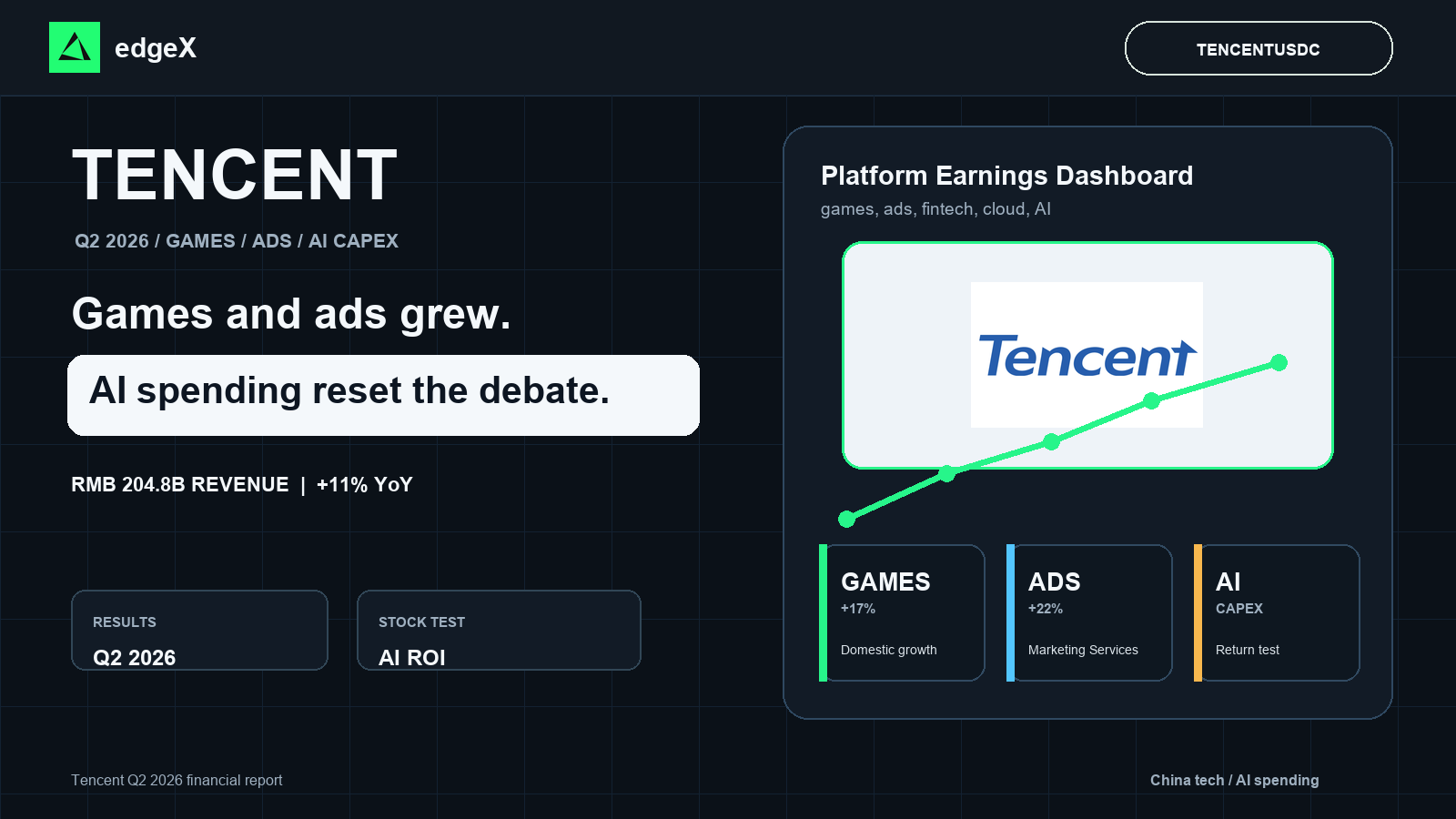
- •Tencent's Q2 2026 revenue reached RMB 204.8 billion, an 11% year-over-year increase, while non-IFRS net profit attributable to equity holders grew 9% to RMB 68.4 billion.
- •Marketing Services was the fastest-growing major segment, rising 22% to RMB 43.6 billion, driven by improved monetization across Weixin's ecosystem of over 1.3 billion monthly active users.
- •Domestic Games revenue increased 17% to RMB 47.3 billion, reinforcing the segment's role as Tencent's profit anchor following the post-2021 regulatory reset in China's game approval process.
- •FinTech and Business Services revenue grew 9% to RMB 60.3 billion, but investors are focused on whether cloud and enterprise AI demand can translate into profitable revenue rather than just higher usage.
- •Tencent's escalating AI infrastructure investment has become the defining debate for the stock, with the bull case resting on AI acting as a multiplier across existing business lines and the bear case warning of margin pressure if spending outpaces monetization.
Quick Answer
Tencent's Q2 2026 earnings showed a business still growing through games, advertising, payments and cloud, but with a more expensive AI investment cycle now sitting at the center of the stock debate. Revenue grew 11% to RMB 204.8 billion, gross profit rose 13%, and non-IFRS profit continued to increase. The stronger question for Tencent stock is whether AI infrastructure, model development and enterprise cloud demand can eventually widen the company's moat without absorbing too much of the margin improvement from games and ads.
Tencent's Q2 Report Was Strong, but the Market Is Asking a Harder Question
Tencent's second-quarter report did not look weak on the surface. Revenue grew at a double-digit rate, gross profit expanded faster than revenue, and non-IFRS profit continued to rise. Domestic games remained healthy, international gaming momentum added breadth, marketing services benefited from better ad technology and traffic monetization, and FinTech plus Business Services kept growing.
The reason the quarter still invited debate is that Tencent is now being valued as both a cash-generating platform and an AI infrastructure spender. Those two identities can support each other, but they do not always move at the same speed. Games, ads and payments produce visible earnings today. AI model development, GPU capacity, cloud infrastructure and enterprise tooling may create future advantages, but the costs appear before the payoff is fully proven.
For Tencent stock, that makes Q2 a quality-of-growth report rather than a simple beat-or-miss story. The numbers confirmed that the core engine remains powerful. The next question is whether management can use that engine to fund AI investment while keeping shareholder returns, margin discipline and product momentum intact.
The Q2 Numbers That Matter
Tencent announced results for the three and six months ended June 30, 2026 on August 12, 2026. The headline figures were strong enough to support the long-term platform argument, while also making the AI cost debate harder to ignore.
| Metric | Q2 2026 Result | Why It Matters |
|---|---|---|
| Revenue | RMB 204.8 billion | Up 11% year over year; shows broad platform growth |
| Gross profit | RMB 118.4 billion | Up 13%; grew faster than revenue |
| Non-IFRS operating profit | RMB 75.6 billion | Up 9%; a cleaner view of operating earnings momentum |
| Non-IFRS net profit attributable to equity holders | RMB 68.4 billion | Up 9%; confirms profit growth despite heavier investment |
| Domestic Games revenue | RMB 47.3 billion | Up 17%; core gaming franchises remained resilient |
| Marketing Services revenue | RMB 43.6 billion | Up 22%; ad technology and traffic monetization improved |
| FinTech and Business Services revenue | RMB 60.3 billion | Up 9%; payments, cloud and enterprise services continued expanding |
The most important pattern is not any single line. Tencent is growing in several places at once. That breadth matters because it lowers dependence on one product cycle. It also raises the operating challenge because the company must allocate capital across entertainment, social platforms, advertising systems, financial services, cloud and AI infrastructure at the same time.
Games Still Anchor the Tencent Earnings Story
Tencent's gaming business remains the clearest earnings anchor. Domestic Games revenue of RMB 47.3 billion grew 17% from a year earlier. That performance matters because domestic games have historically carried strong margins, deep user engagement and durable intellectual property. A healthier game pipeline can give Tencent more room to fund newer initiatives without leaning too heavily on lower-margin businesses.
Domestic Games Showed More Than One-Quarter Momentum
The key question is whether the domestic games rebound is cyclical or structural. A single quarter can benefit from releases, seasonal activity or promotional timing. A more durable improvement requires a portfolio that keeps players engaged, refreshes older franchises and turns new content into recurring spending without damaging user trust.
Tencent has advantages here. It operates a large distribution ecosystem, has deep experience in live operations, and can use social channels to reduce discovery friction. If domestic titles keep producing stable engagement and monetization, the gaming division can remain a profit engine rather than just a growth contributor.
International Games Add Breadth but Also Execution Risk
International games are strategically important because they reduce dependence on the Chinese market and give Tencent exposure to global franchises, studios and player communities. The upside is broader revenue diversity. The risk is that global publishing, localization, regulatory exposure and studio management can be uneven.
For shareholders, international gaming should be judged by durability, not only growth rate. Strong overseas revenue is most valuable when it comes with repeat engagement, disciplined acquisition costs and franchises that can survive beyond a launch cycle. Tencent's scale gives it a real advantage, but global gaming remains a competitive and hit-driven market.
Marketing Services Became a Key Margin Signal
Marketing Services revenue rose 22% to RMB 43.6 billion, making advertising one of the most important parts of the Q2 story. That growth suggests Tencent is improving how it monetizes attention across Weixin, video accounts, mini programs and other traffic surfaces.
Better Ad Tools Can Turn Traffic Into Higher-Value Revenue
Advertising growth is not only about more impressions. It is about better matching, better conversion, better merchant tools and better measurement. Tencent's ecosystem gives it a large base of social, content, payment and mini-program activity. When ad products become more effective, the same user attention can become more valuable.
This is where AI can support the core business instead of sitting outside it. Recommendation, creative tools, targeting, bidding and merchant analytics can all improve advertising returns. If Tencent can use AI to raise ad efficiency, then AI spending becomes tied to a visible revenue pool rather than a distant infrastructure promise.
The Risk Is That Ad Growth Becomes Too Dependent on Algorithmic Improvement
The risk is not that Tencent lacks traffic. The risk is that future growth becomes more dependent on continuous optimization while competition for advertiser budgets remains intense. Short-video platforms, e-commerce ecosystems and search players all compete for performance-marketing spend.
Tencent's advantage is the depth of its ecosystem. Its challenge is proving that marketers can keep improving return on investment inside that ecosystem. Q2 was encouraging, but investors should watch whether Marketing Services can sustain growth without requiring steadily higher incentives or traffic-acquisition costs.
FinTech and Business Services Keep Tencent Connected to the Real Economy
FinTech and Business Services revenue grew 9% to RMB 60.3 billion. This segment is important because it connects Tencent to payments, merchant services, cloud, enterprise software and business digitalization. It is less glamorous than games or advertising, but it can deepen Tencent's role in daily economic activity.
Payments Create Scale, but Cloud Carries the AI Question
Payments help Tencent remain embedded in consumer and merchant behavior. That scale can support merchant tools, financial services and transaction-linked data. Cloud and enterprise services are a different kind of opportunity. They can connect Tencent's AI capabilities to businesses that need computing, models, data tools and workflow automation.
The challenge is margin. Cloud infrastructure can be capital intensive, and AI workloads can raise depreciation and operating costs. For the segment to become a stronger stock catalyst, investors need evidence that cloud and enterprise AI demand is translating into profitable revenue, not only higher usage.
Enterprise AI Needs Proof of Willingness to Pay
The enterprise AI opportunity is real, but it is not automatic. Many companies are experimenting with models, agents and automation tools. Fewer have shown a willingness to pay at a scale that justifies the infrastructure required to serve them. Tencent has a strong domestic customer base and technical assets, yet it still needs to prove that AI services can produce repeatable commercial returns.
This is why Q2 should be read as an investment bridge. Tencent is preparing for a larger AI-enabled business-services opportunity, but the market will want customer adoption, pricing evidence, utilization and margin progress before assigning full value to that opportunity.
AI Spending Is the New Center of the Stock Debate
The strongest and weakest versions of Tencent's investment case now pass through AI. The strongest version is that Tencent uses AI to improve games, advertising, search-like discovery, customer service, cloud products and productivity tools across a huge user base. In that scenario, AI is not a separate bet. It is a multiplier across existing profit pools.
The weaker version is that AI becomes a spending race. If infrastructure, model training and inference costs rise faster than monetization, Tencent's core earnings strength could be partly absorbed by capex and depreciation. That does not mean the strategy is wrong, but it would make the stock more sensitive to quarterly margin signals.
Tencent Has More Ways to Monetize AI Than a Pure Cloud Vendor
Tencent is not only selling infrastructure. It can apply AI to games, advertising, content recommendation, enterprise tools, payments security, customer service and developer products. That diversity gives the company more chances to turn AI into revenue or efficiency.
The advantage is optionality. The drawback is measurement. Investors may find it difficult to separate AI-driven revenue from normal product improvement. Management commentary, segment margins, cloud demand and ad-performance metrics will therefore matter more than broad statements about AI adoption.
The Market Will Watch Capex Discipline
AI investment can be justified when it expands a moat or unlocks higher-value services. It becomes more concerning when spending rises without visible revenue conversion. Tencent's Q2 profit growth shows that the company can absorb investment for now, but the stock will be judged by whether that balance remains intact.
The market does not need Tencent to avoid AI spending. It needs confidence that the spending is disciplined, tied to product use cases and supported by businesses that can generate cash while the investment cycle unfolds.
What Tencent Stock Investors Should Watch Next
The next Tencent reports should be read through four checkpoints. First, games need to sustain engagement and monetization across both domestic and international portfolios. Second, Marketing Services must prove that ad growth is durable and not only a short-term lift from traffic mix or algorithm updates. Third, FinTech and Business Services need to show that cloud and enterprise AI can grow without dragging margins lower. Fourth, management needs to keep returning capital while funding the AI cycle.
The stock can work if those signals align. Tencent has a large user base, multiple monetization surfaces and a long history of turning digital behavior into cash flow. The problem is that the market already understands much of that quality. To rerate higher, Tencent likely needs to show that AI spending is making its existing businesses stronger and creating new enterprise revenue, not merely defending relevance.
Bull Case, Bear Case and Base Case After Q2
The bull case is that Tencent's best businesses keep compounding. Games remain profitable, Marketing Services keeps gaining from better ad technology, payments and merchant tools support ecosystem depth, and AI improves both user products and enterprise services. In that outcome, Q2's investment spending becomes the cost of building a stronger platform.
The bear case is that AI spending becomes heavier than expected while core growth slows. If games normalize, ad budgets soften, or cloud AI demand takes longer to monetize, Tencent could face a period where revenue still grows but incremental profit becomes harder to expand.
The base case is more balanced. Tencent continues to grow revenue and profit, but investors demand clearer proof of AI returns before applying a larger valuation premium. Under that path, the stock remains tied to execution: strong enough to deserve respect, but still required to prove that the next investment cycle can earn attractive returns.
Trade Tencent Perpetuals on edgeX
AI earnings, China technology sentiment, Hong Kong market risk and global liquidity increasingly move across time zones. edgeX gives eligible traders self-custodial access to crypto, tokenized-stock and real-world-asset perpetual markets through a decentralized trading venue. For traders following Tencent after its Q2 2026 earnings report, TENCENT/USDC perpetual futures offer a dedicated market for Tencent-linked exposure on edgeX.
Follow Tencent Price Action Around the Clock
Tencent's stock narrative can move with Hong Kong trading, U.S. ADR sentiment, China technology headlines, AI spending commentary and global risk appetite. A 24/7 perpetual market allows eligible traders to react when the thesis changes, not only when the traditional cash market is open.
Understand the Product Before Trading
Perpetual futures are derivatives, not direct ownership of the underlying shares or assets. They do not provide voting rights, dividends or shareholder claims. Funding, liquidity, fees, leverage, index methodology, contract specifications and regional availability can differ by market and should be verified directly on edgeX before placing an order.
Manage Leverage and Execution Risk
Leverage can magnify gains and losses and may lead to liquidation. Self-custody does not remove market, smart-contract, liquidity or execution risk. Traders should size positions carefully, understand funding and liquidation mechanics, and confirm whether a product is available in their jurisdiction.
Frequently Asked Questions
When did Tencent release its Q2 2026 earnings?
Tencent released its 2026 second-quarter results on August 12, 2026, covering the three and six months ended June 30, 2026.
What was Tencent's Q2 2026 revenue?
Tencent reported Q2 2026 revenue of RMB 204.8 billion, up 11% year over year.
What was Tencent's Q2 non-IFRS net profit?
Non-IFRS net profit attributable to equity holders was RMB 68.4 billion, up 9% from a year earlier.
Which businesses drove the Tencent Q2 story?
Domestic Games, Marketing Services, and FinTech and Business Services were central to the quarter. Domestic Games revenue rose 17%, Marketing Services revenue rose 22%, and FinTech and Business Services revenue rose 9%.
Why is AI spending important for Tencent stock?
AI can improve Tencent's games, advertising, cloud, enterprise tools and platform efficiency. The risk is that model development, infrastructure and inference costs rise before monetization is clear. Investors will watch whether AI spending improves margins and revenue quality over time.
Can readers trade Tencent exposure on edgeX?
Yes. edgeX lists TENCENT/USDC perpetual futures for eligible traders. This is a derivative contract, not direct ownership of Tencent shares, and traders should review the live product page, contract specifications, fees, funding and regional availability before placing an order.
Is the Tencent share price in this article live?
No. This article does not quote a live Tencent share price. Check HKEX, a broker or a real-time market-data service for the latest 0700.HK or TCEHY quote before making a trading decision.

