Bittensor's TAO Breaks Two-Month Technical Barrier as Enterprise Adoption and Grayscale Exposure Provide Support
Key Takeaways
- •TAO reclaimed its 50-day SMA on August 8 after trading below the indicator since mid-June, with the average near $203 now serving as initial support.
- •Five enterprise platforms collectively valued at over $22 billion are testing cybersecurity technology from Bittensor's RedTeam subnet, reaching more than 900 million accounts and processing over one billion weekly transactions.
- •TAO represents 29.15% of the Grayscale Decentralized AI Fund as of August 3, ranking as the fund's second-largest holding following a Q2 rebalance.
- •Key overhead resistance includes the 0.618 Fibonacci retracement near $225 and a confluence of the 100-day and 200-day SMAs clustered around $232–$233.
- •A daily close back below the 50-day SMA near $203 would weaken the breakout, with subsequent support zones at $195 and the $183–$187 range.
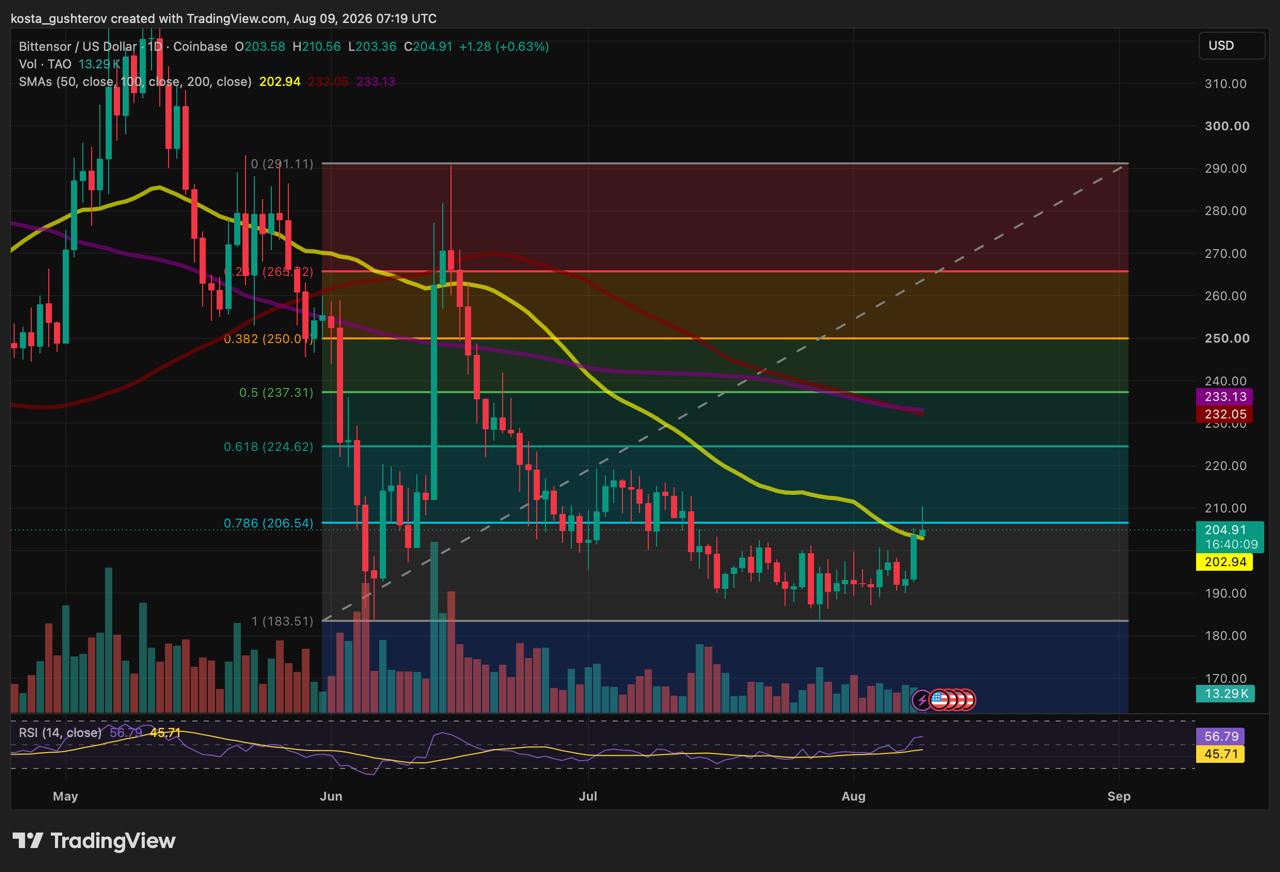
TAO was trading near $205 at the time of writing, having touched $210 earlier in the session. The daily close will determine whether the cryptocurrency can sustain its breakout above the 50-day simple moving average (SMA), a level that has capped price action for the better part of two months.
TAO is the native token of Bittensor, a decentralized network that coordinates machine intelligence across independently operated subnets—specialized modules where teams build and compete to deliver AI services, from model training to data validation. Token incentives align participants around computational contribution and validation quality, positioning Bittensor as one of the more prominent projects attempting to apply blockchain architecture to artificial intelligence workflows.
50-Day SMA as the Pivotal Level
TAO had traded below its 50-day SMA since mid-June before closing back above the average on August 8. The moving average currently sits near $203 and is now being tested as potential support. Just above, the 0.786 Fibonacci retracement around $206 serves as immediate resistance.
TAO traded through that Fibonacci level during the session but had slipped back below it at the time of writing, leaving price caught between two closely spaced levels with opposing roles: the 50-day SMA must hold beneath price, while $206 still needs to be decisively reclaimed.
A close above $206, followed by price holding that area on a subsequent pullback, would strengthen the $203–$206 band as a more convincing support zone. The next notable Fibonacci level lies at the 0.618 retracement near $225. Beyond that, TAO faces a confluence of resistance around $232–$233, where the 100-day SMA ($232) and the 200-day SMA ($233) are clustered.
Daily RSI has improved to approximately 57, above the neutral threshold but still well below overbought territory.
Enterprise Pilots Provide Fundamental Support
Recent developments within the Bittensor ecosystem add a fundamental dimension to the technical recovery.
The OpenTensor Foundation announced that five additional enterprise platforms, collectively representing more than $22 billion in value, are testing technology developed by Bittensor's RedTeam subnet—a subnet focused on cybersecurity threat detection and response.
Recently, 5 more enterprise platforms worth $22B+ combined have been testing @redteam's technology. They reach 900M+ accounts and handle 1B+ weekly transactions. RedTeam is set to unveil a new immune system built to anticipate cyber threats. Here's how Bittensor powers it: pic.twitter.com/9xUVIYGFQ4
— Openτensor Foundaτion (@opentensor) August 8, 2026 (source)
According to OpenTensor, these platforms collectively serve more than 900 million accounts and process over one billion transactions per week. The significance lies not solely in the scale of the companies involved, but in the fact that businesses are evaluating Bittensor-developed technology against real-world workloads.
This carries more weight for the network than a transient surge in social attention, though the evidence remains preliminary. Testing does not equate to production deployment, nor does it automatically generate sustained demand for TAO. The development becomes more material if these pilots progress into production use and produce measurable economic activity within the Bittensor ecosystem.
For now, the pilots reinforce the argument that Bittensor's subnet model is attracting interest beyond crypto-native trading circles. Whether these enterprise evaluations translate into durable on-chain activity will be a key variable for the network's fundamental trajectory.
Grayscale's Decentralized AI Fund
TAO remains a significant component of Grayscale's decentralized AI exposure. According to Grayscale's latest multi-asset fund rebalance, TAO accounted for 29.15% of the Grayscale Decentralized AI Fund as of August 3, ranking as the fund's second-largest holding.
The rebalance involved reducing the fund's NEAR position and reallocating proceeds across existing components, including TAO. This cements TAO's role as one of the primary vehicles through which Grayscale offers exposure to decentralized AI—a category that has drawn growing institutional and retail interest as investors look for ways to gain exposure to AI narratives through crypto assets.
However, the rebalance does not establish a causal link between Grayscale's purchases and TAO's recent rally. Without comparing the size of those acquisitions to TAO's broader trading volume, the price impact cannot be isolated with confidence.
The more substantive takeaway is institutional visibility. TAO remains prominently featured in a product specifically designed around crypto exposure to artificial intelligence, which can bolster the broader investment narrative even if the rebalance itself was a one-off event.
Downside Scenarios
On the downside, the 50-day SMA near $203 marks the first critical level. A daily close back below this moving average would weaken the breakout, particularly given that TAO spent nearly two months beneath it.
The next area to monitor sits around $195, a level where price consolidated repeatedly before the latest upward move. Below $195, the $183–$187 zone becomes relevant — this is where selling pressure stalled during both the June decline and the late-July selloff. The Fibonacci structure is anchored near $183.
A break below that zone would place TAO beneath the lows that have contained the broader correction since June.
Methodology and Disclaimer
This analysis uses the TAO/USD daily chart, along with 50-day, 100-day, and 200-day simple moving averages, Fibonacci retracement levels, and RSI. Fundamental context draws on Grayscale's Q2 2026 fund-rebalancing disclosure and OpenTensor Foundation updates.
This article is provided for informational and educational purposes only and does not constitute financial or investment advice. Cryptocurrency markets are highly volatile, and technical levels or fundamental developments can fail to produce the expected price reaction.

