Swift Network Receives 10-Year NCC Licence as Nigerians Weigh a Switch to the New Mobile Operator
Key Takeaways
- •The Nigerian Communications Commission granted Swift Telephone Network a 10-year Unified Access Service Licence running from October 2026 to September 2036, permitting voice, data and multimedia services under the converged UASL framework.
- •STN enters as a new challenger in a market of over 195 million telecom users where MTN Nigeria and Airtel Nigeria together account for nearly 87% of subscriptions as of July 2026.
- •The company is not a newcomer, having begun operations in Nigeria in 1998 with a calling service for the NUGA Games and obtained its first operational telecommunications licences from the NCC in 2005.
- •STN executives said the next phase will require partnerships, innovation and engagement with businesses, infrastructure providers and investors, noting that nationwide towers, fibre backhauls and power solutions demand billions of n in capital expenditure.
- •Subscriber reactions on X indicate Nigerians would consider switching to Swift Network if it offers cheaper and more reliable service, with mobile number portability available since 2013 lowering the barrier to changing carriers.
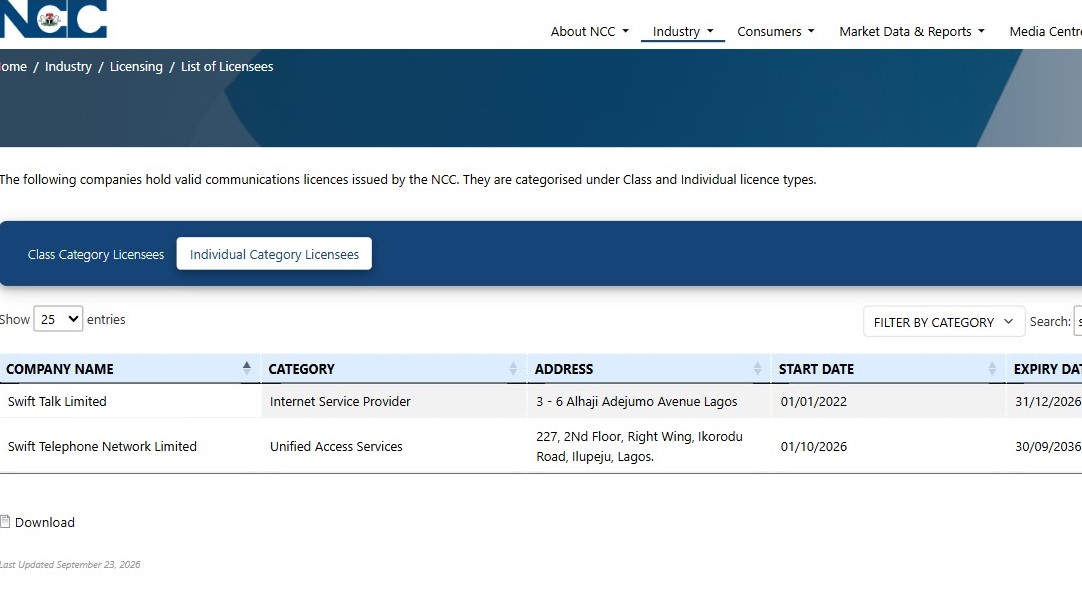
Swift Telephone Network Limited (STN) has received a regulatory licence from the Nigerian Communications Commission (NCC) to operate as a mobile network operator, joining the ranks of leading carriers such as MTN, Airtel, Globacom and T2mobile (9mobile).
According to information on the regulator's portal, Swift Network secured a 10-year Unified Access Service Licence (UASL), running from October 2026 to September 2036, issued under Section 32 of the Nigerian Communications Act 2003. The approval allows the operator to provide multiple services, including voice, data and multimedia, similar to the licences held by MTN Nigeria, Airtel Nigeria and Globacom. The UASL framework is the NCC's converged licensing regime, allowing a single authorisation to cover multiple service categories rather than a separate permit for each service type.
The entry places STN in direct competition with the leading telecom operators that control more than 195 million Nigerian telecom users. It also follows Lebara's official entry into the industry as a virtual operator, which came three years after the company received its licence.
Nigeria's mobile market has long been characterised by a small circle of players, with four operators handling the provision of voice and mobile data services to Nigerians. Against that backdrop, a fresh full-scale licence is a rarity, and it lands at a moment when subscriber frustration with the status quo is unusually visible. Subscribers have repeatedly clamoured for intensified competition, particularly when experiencing poor network quality, a drop in quality of experience, and a recent outcry over data depletion.
Swift Network is entering as a new challenger a market heavily dominated by MTN Nigeria and Airtel Nigeria. As of July 2026, the two operators account for nearly 87% of total telecom users — a figure that reflects their longevity, infrastructural strength and industry presence.
Nigerians, however, may care less about market statistics than about service quality. Following the announcement of its entry, users on X have been expressing their views on whether they would switch to Swift Network, provided it offers better service than current options.
An X user, Mahmud, backed the operator, noting that it could build a presence just as fintech giants managed to dominate commercial banks. “Whatever it is Opay and Moniepoint have done in the banking sector, if they did something similar in the telecoms, they’ll carry the chunk of the users. Cheaper, strong, reliable connections,” he said.
Tchigo said a stable network is all he needs to make the switch. “If they can guarantee a stable network, then that’s a sign to switch; there’s no point in cheap data if the network is going to be half as messy as these other ones.”
For OJ, the answer was direct: “Cheap data and strong network, I will port immediately.”
Another user, Abdlusahmad, held a mixed opinion. “STN should try, but chances of superseding MTN & Airtel in Nigeria would be extremely low despite the incumbent’s service instability across various areas.”
Israel, meanwhile, took a different view, weighing the infrastructure-oriented nature of the sector. “Telecoms is a different sector entirely, and the realities there are way different from the financial sector. Telecoms are infrastructure-heavy, and what impacts service quality is more often than not beyond your control.”
For most Nigerians, the size of a brand or its customer base is not what counts; what matters is what an operator offers and how reliable its network proves in daily use. And since the NCC introduced Mobile Number Portability in 2013, switching has not required giving up a phone number — lowering one practical barrier between subscribers and a new carrier.
STN is not new to the telecom market. The company, whose official website is began operations in Nigeria in 1998 with a calling service supporting the NUGA Games, later expanding into voicemail and digital landline services before securing its first operational telecommunications licences from the NCC in 2005.
Announcing the development on Thursday, Chief Executive Officer Oluwole Adetuyi said what makes the milestone more meaningful is STN's journey. From its origins in telephony, he noted, the company has continued to adapt, evolve and build toward a broader telecommunications future.
“This UASL is not just a licence. It is a new chapter. It represents where we started, what we have endured, how we have evolved, and where we are going. We are building in Nigeria, for Nigeria,” he added.
Also speaking via his LinkedIn account, Victor Okorie, Business Development Manager of STN, said that following the licence approval, “the next phase will require partnerships, innovation, execution and a strong commitment to building locally while connecting globally.” He indicated that the next phase would involve engaging businesses, technology companies, infrastructure providers, investors, entrepreneurs and other stakeholders across the industry.
Lebara's three-year gap between receiving its licence and entering the market is a reminder that authorisation is only the first step. The milestones to watch for Swift Network are the ones its executives flagged: partnership announcements, infrastructure commitments and, eventually, details of a commercial service launch.
Swift Network nonetheless faces a steep hurdle to climb. Beyond competition, building nationwide cell towers, fibre-optic backhauls and power solutions requires billions of naira in capital expenditure. T2mobile (9mobile) and 90% of virtual operators, once tipped as alternative operators, have to maintain market share against the dominant players in the Nigerian telecom sector. For Swift Network, the licence provides the legal footing to compete; whether Nigerians actually switch will be settled by what they experience on their phones.

