Former Super Micro Contractor Pleads Guilty in $2.5 Billion Nvidia AI Server Diversion Scheme
Key Takeaways
- •Ting-Wei "Willy" Sun, a former Super Micro contractor, pleaded guilty on October 8 in a Manhattan federal court to illegally shipping Nvidia AI servers to China.
- •Sun was charged in March alongside Super Micro co-founder Yih-Shyan "Wally" Liaw and Taiwan-based sales manager Ruei-Tsang "Steven" Chang, though the allegations against both men remain unproven and Super Micro has not been charged.
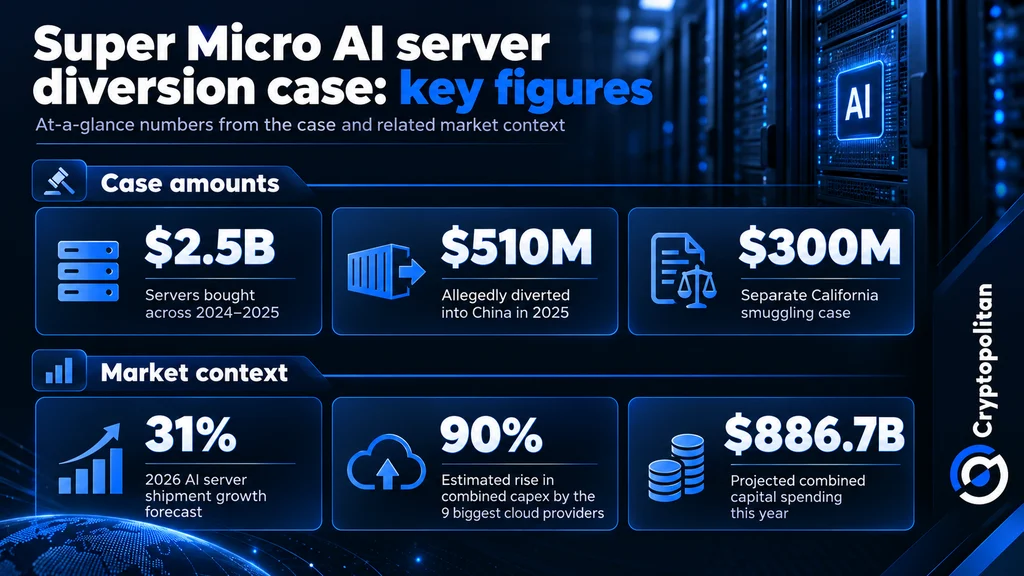
- •Prosecutors allege a Southeast Asian intermediary purchased nearly $2.5 billion worth of servers across 2024 and 2025, with at least $510 million covertly shipped to China using falsified paperwork, repackaging, and staged dummy equipment.
- •The Bureau of Industry and Security introduced case-by-case licensing in January for Nvidia's H200 and AMD's MI325X chips, while TrendForce projects AI-server shipments will grow nearly 31% this year amid rising cloud capital spending.
- •A separate, unconnected case announced October 1 accuses California businessman Greg Lui of smuggling more than $300 million in restricted servers to China through other countries.
Ting-Wei “Willy” Sun, a former contractor for server maker Super Micro, pleaded guilty in a Manhattan federal court on October 8 to illegally shipping Nvidia artificial intelligence servers to China, according to Reuters. The plea highlights the difficulty Washington faces in policing restricted technologies once they pass through third countries, and it comes amid intensifying scrutiny of AI hardware diverted from US buyers to Chinese customers.
From March Indictment to Guilty Plea
The Justice Department charged Sun in March alongside Super Micro co-founder Yih-Shyan “Wally” Liaw and Ruei-Tsang “Steven” Chang, a sales manager based in Taiwan. The case is before US District Judge Edgardo Ramos.
Sun has admitted guilt, while the allegations against Liaw and Chang remain unproven. In the federal system, sentencing follows a guilty plea at a later date, after a presentence investigation. Super Micro itself has not been charged. In a March statement, the company said it had placed both employees on administrative leave, terminated its contract with Sun, and was cooperating with the investigation.
How Prosecutors Say the Servers Reached China
Prosecutors allege the operation relied on a Southeast Asian intermediary to disguise the identity of buyers in China. The intermediary purchased nearly $2.5 billion worth of servers across 2024 and 2025, and at least $510 million of those machines were covertly shipped to China within a matter of weeks in 2025.
To conceal the shipments, participants allegedly falsified paperwork, repackaged servers, and staged dummy equipment to deceive inspectors.
FBI official James Barnacle said the defendants allegedly “fabricated documents, staged bogus equipment to pass audit inventories, and used a pass-through company” to hide their activities.
Why Overseas Buyers Are Hard to Verify
A shipment’s destination does not always reveal its final recipient. Under guidance issued by the Bureau of Industry and Security (BIS) in May 2026, licensing requirements can apply to overseas buyers depending on where their headquarters or ultimate parent company is located. An earlier BIS advisory warned about red flags including suspicious intermediaries, sudden surges in orders, concealed ownership, and data centers lacking the proper infrastructure — indicators that make it harder to distinguish genuine customers from intermediaries shielding restricted end users.
The Sales the Controls Are Built to Allow
The US government seeks to protect sensitive technology without denying legitimate customers access to it. To that end, the BIS introduced case-by-case licensing in January for Nvidia’s H200, AMD’s MI325X, and other comparable chips, as the agency announced.
Demand remains strong. TrendForce projects that AI-server shipments will grow nearly 31% this year, while capital spending by the nine leading cloud providers is on track to rise roughly 90%, surpassing $886.7 billion. That boom raises the commercial stakes of export restrictions. A September analysis by the Center for Strategic and International Studies (CSIS) cautioned that lost sales in China would erode US chipmakers’ revenues and research and development budgets, and noted that China’s central role in global semiconductor supply chains further complicates enforcement. Tighter curbs could also push Chinese manufacturers toward domestic alternatives, costing US firms future revenue. CSIS argues Washington should pair targeted restrictions with investment in research, talent, and advanced manufacturing. BCG research indicates the American and Chinese AI ecosystems are already diverging.
A Separate California Smuggling Case
Super Micro is not the only company to surface in cases involving AI server shipments to China. Cryptopolitan previously reported on a separate matter involving California businessman Greg Lui. On October 1, the Department of Justice said he allegedly smuggled more than $300 million worth of restricted servers to China through other countries, according to a department press release. Those allegations have not been established in court.
Although the two cases are not connected, they expose the same weakness in US export controls: tracking the movement of servers is far easier than determining who ultimately ends up with the hardware.

