Sui Records 40.6 Million TPS Through More Than 10,000 Off-Chain Tunnels
Key Takeaways
- •Sui logged 40,614,180 transactions per second in a Singapore stress test, exceeding its previous July record of 6.09 million TPS by more than six times.
- •The throughput was generated through more than 10,000 off-chain tunnels that operate like Lightning Network payment channels, meaning the figure does not represent Sui's native mainnet capacity.
- •CertiK independently confirmed the test results, but its verification materials covering execution records and proof of completion have yet to be published.
- •Mysten Labs co-founder Adeniyi Abiodun said autonomous AI agents could use the demonstrated capacity, with each tunnel requiring no more than two on-chain transactions to keep costs low.
- •McKinsey estimates the payments industry generates about $2.6 trillion in annual revenue, while agentic AI could put roughly $75 billion of that revenue at risk by 2030.
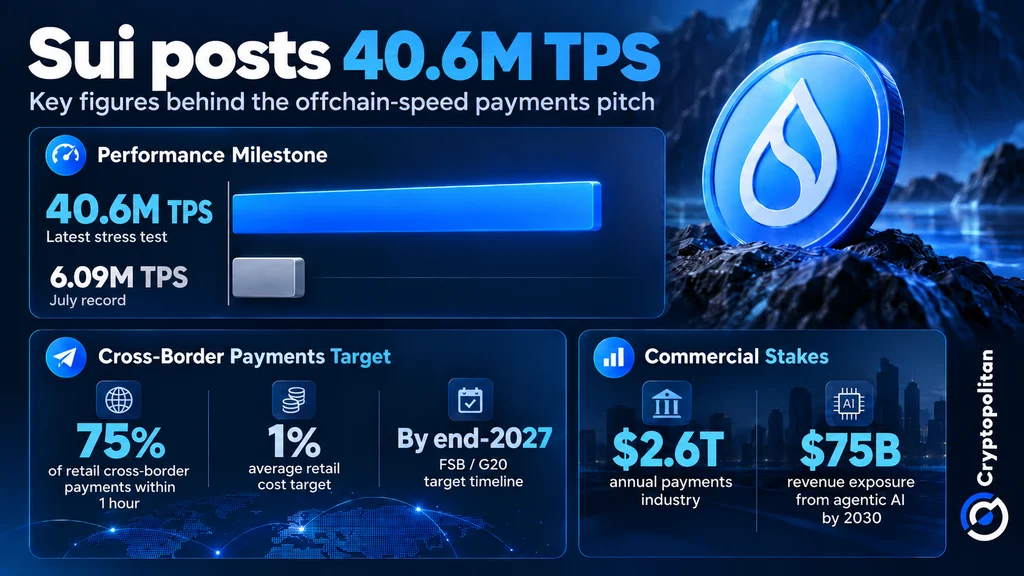
Sui recorded 40,614,180 transactions per second (TPS) during a live stress test held Wednesday in Singapore, exceeding its previous July record of 6.09 million TPS by more than six times. The result was achieved through more than 10,000 off-chain tunnels rather than transactions processed directly on the Sui mainnet, a distinction that is central to the network’s plans for AI-driven payments.
Why the 40.6 million TPS figure is not native throughput
Sui’s programmable tunnels operate similarly to payment channels on the Lightning Network. Transactions occur off-chain, while the channels’ opening and closing states are settled on-chain. The tunnels can support payments, messaging, games and other activities, with each closed tunnel co-signed and verified on-chain.
The 40.6 million TPS figure therefore does not represent native capacity of the Sui blockchain, nor the traffic the chain handles in everyday operation — it is a peak result generated under deliberately high test load. Native throughput is tracked separately by Chainspect.
CertiK independently confirmed the results of the event, with the relevant proof expected to be provided later. Yuannan Yang, the company’s security engineering director, said in Sui’s announcement: “Transparent and independently verifiable performance measurements will become increasingly important.”
As previously reported by Cryptopolitan, CertiK will examine the records showing how the execution occurred, proof that the operation was completed successfully and the supporting documentation. Cryptopolitan also reported on CertiK’s planned verification in an earlier article.
Sui’s focus on AI-agent payments
Adeniyi Abiodun, co-founder and chief product officer of Mysten Labs, said autonomous AI agents could use the capacity demonstrated by the test. In a statement from the Sui Foundation, he said: “No market in the world needs 6 million transactions per second, let alone 40 million: people just don’t move that fast. Agents do.”
Cost is also central to the argument. Each tunnel requires no more than two on-chain transactions, allowing thousands of intermediate exchanges to occur at a low cost.
The broader payments market is substantial. According to McKinsey, the payments industry generates approximately $2.6 trillion in annual revenue. McKinsey also estimates that agentic AI could put about $75 billion in revenue at risk by 2030.
The cross-border settlement challenge
Processing millions of transactions in a controlled test is different from moving money across borders. The Financial Stability Board’s targets call for 75% of cross-border retail payments to arrive within one hour and for average costs to fall to 1% or less by 2027. However, the FSB’s 2025 progress report found little improvement globally and warned that the targets are unlikely to be met.
Banks and payment networks are also testing faster settlement methods. Lloyds and Visa tested round-the-clock cross-border settlement using stablecoins, while Swift is developing blockchain-based payment infrastructure. The Bank for International Settlements has separately emphasized the importance of trust and settlement finality, particularly when transaction speed increases.
Sui’s test demonstrated the volume of traffic its off-chain tunnels can accommodate. The immediate checkpoint is the publication of CertiK’s verification materials, covering the records showing how the execution occurred, proof that the operation was completed successfully and the supporting documentation. The remaining question is whether that capacity can reduce payment costs, accelerate cross-border transfers and support consistent business adoption. For now, the 40.6 million TPS result is a technical achievement, while its effect on everyday payments remains unproven.

