Sudan's Emergency Response Rooms Lead 2026 Nobel Peace Prize Polymarket Odds at 13.4%
Key Takeaways
- •Sudan's Emergency Response Rooms led Polymarket's listed 2026 Nobel Peace Prize contracts with a 13.4% Yes price in the October 5 snapshot, against an 86.6% No price.
- •Save the Children held the second-highest price at 8%, followed by Mykola Kuleba at 6.5%, the International Court of Justice at 6.3%, the Committee to Protect Journalists at 5.6%, and Yulia Navalnaya at 4.7%.
- •A long-shot Trump contract traded at 1% while attracting more than $5.7 million in volume within the market's total $26.7 million turnover.
- •The ERR contract itself recorded $67,11 in volume with a 24-hour change of -1.8 percentage points, and settlement follows the Norwegian Nobel Committee's first official announcement expected on October 9.
- •The 13.4% figure is a market-implied probability shaped by trading conditions, not a poll or committee signal, since the committee seals its nomination records for 50 years.
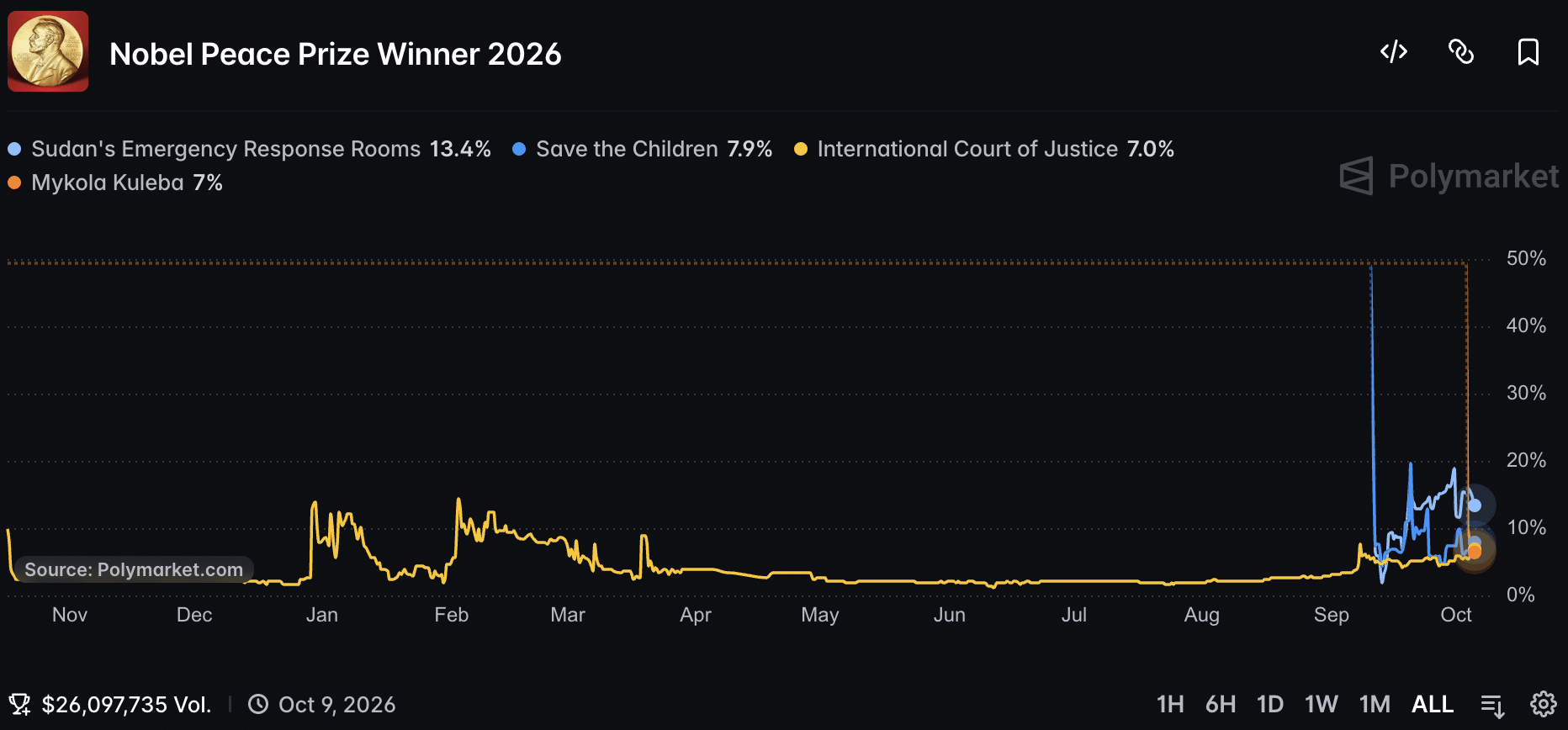
Sudan's Emergency Response Rooms held the highest Yes price among listed contracts on Polymarket's 2026 Nobel Peace Prize market, trading at 13.4% in a snapshot taken on October 5.
The reading placed the volunteer network at the top of the market's listed outcomes ahead of the October 9 announcement. The Emergency Response Rooms are volunteer community networks that organize humanitarian aid for civilians in Sudan, and the market's listed field blends such civil-society groups with institutions and individual names. The figure is a market price — not a projection of a likely winner and not a signal from the Norwegian Nobel Committee.
The corresponding No price stood at 86.6%. Polymarket's market summary described the Emergency Response Rooms (ERR) price as fluctuating roughly between 13% and 17% in the run-up to the announcement; those figures reflect different points in time, while 13.4% is the price recorded in the timestamped snapshot.
Save the Children ranked second at 8%, while President Trump traded at just 1% — a long-shot contract that had drawn more than $5.7 million in volume, a sizable share of the market's total $26.7 million turnover.
What the 13.4% Price Means
A Polymarket price represents an implied probability derived from trading in that contract. It is neither a poll nor a committee forecast. The Norwegian Nobel Committee keeps its nomination records sealed for 50 years, so markets and outside observers are pricing an outcome whose full candidate pool is never publicly confirmed in real time. At 13.4%, the Yes price indicates how the market valued the ERR outcome at the moment of the snapshot; it does not guarantee the result will occur.
The ERR contract was open at the time, with $67,611 in market volume and a 24-hour change of -1.8 percentage points. Across the full event, Polymarket recorded $26,089,225 in total volume and $1,602,120 in liquidity, though those event-wide figures do not mean the same amount was available to trade on the ERR outcome specifically.
Under the market rules, settlement follows the Norwegian Nobel Committee's first official announcement. The event was open when the data was retrieved and carried an April 1, 2027 end date. As with other Polymarket political-outcome prices, the displayed probability is a market snapshot shaped by trading conditions rather than an official forecast.
A Leading Price, Not a Dominant Favorite
The remaining listed Yes prices show how widely the market's pricing was spread. Save the Children stood at 7.9%, Mykola Kuleba at 6.5%, the International Court of Justice at 6.3%, the Committee to Protect Journalists at 5.6%, and Yulia Navalnaya at 4.7%.
That distribution put Sudan's Emergency Response Rooms at the top of the listed outcomes, but the 13.4% Yes price still left the contract well below an even chance. The spread resembles other Polymarket markets with competing political outcomes, where the highest-priced contract can lead without commanding a majority of the market's implied probability. The committee has recognized humanitarian organizations before — it awarded the 2020 prize to the World Food Programme — which is one reason traders weigh civil-society groups alongside individual nominees.
Attention on the Trump contract has also surfaced on social media. On July 2, 2026, Hunter Biden posted on X:
I am officially nominating Donald J. Trump (@realDonaldTrump) for the Nobel Peace Prize. No President in History has ended the same war so many times. Our Dear Leader has ended the war with Iran at least 38 times by CNN's count. No President has ever done this before. And he…
— Hunter Biden (@HunterBiden) July 2, 2026
Market Pricing Not Nobel Committee Guidance
The Norwegian Nobel Committee determines and announces the prize winner. The Polymarket snapshot provides no official shortlist, no confirmation of a nomination, and no endorsement from the committee, so the ERRs' position on the market should not be read as evidence of inside information or formal recognition.
The market is useful as a view of how traders price a set of possible outcomes, not as a substitute for information from the institution making the decision. Prediction-market odds on AI safety talks among frontier labs offer a separate example of why contract prices should be distinguished from confirmed real-world outcomes.
The October 5 figure is a timestamped reading, and prices can move as orders and trading activity shift. The next concrete checkpoint is the committee's October 9 announcement, the trigger named in the contract's settlement rules. It is neither a guarantee, a poll result, nor an official Nobel signal. This is informational market analysis, not financial or betting advice.
Source: 99Bitcoins — Nobel Peace Prize Polymarket Odds as Sudan Emergency Rooms Lead at 13.4%

