Strategy Stock Leads Nasdaq-100 With 47.7% Monthly Gain as Bitcoin Exposure Fuels Rally
Key Takeaways
- •Strategy shares gained 47.7% over the past month, making the company the Nasdaq-100's strongest performer, while Meta's 21.9% advance was the nearest comparison.
- •The company's concentrated Bitcoin holdings, accumulated since it adopted a Bitcoin-focused treasury strategy in 2020, provide shareholders equity-based exposure to Bitcoin's performance.
- •The Nasdaq-100 rose 0.72% while the S&P 500 slipped 0.08% over the week, with healthcare and technology gaining as utilities and financial services declined, pointing to selective growth demand rather than broad participation.
- •SpaceX's projected Nasdaq-100 weighting is set to rise from 1.28% to 2.82% at the September 21 rebalance, with passive funds tracking the index's $1.7 trillion in assets estimated to buy $15.5 billion to $22 billion during the closing auction.
- •The 10-year Treasury yield climbed to 5.01% from 4.96%, while commodities weakened as WTI crude fell 0.50% to $99.49 and Comex gold declined 1.22% to $4,325.30.
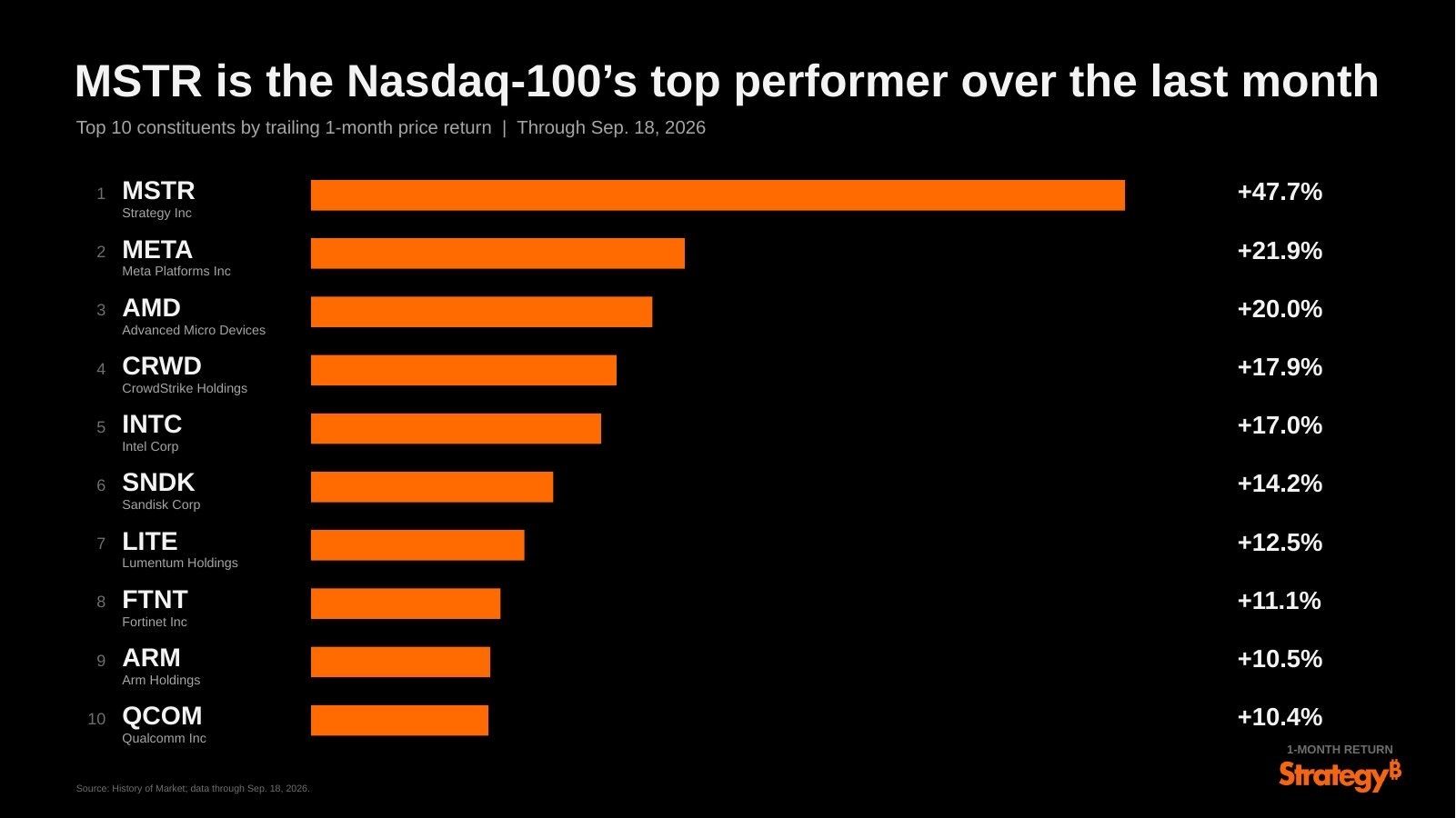
Strategy stock has become the Nasdaq-100's strongest performer over the past month, gaining 47.7% and more than doubling Meta's 21.9% advance over the same period. The move has placed MSTR, the ticker of the software company formerly known as MicroStrategy, at the center of a rotation toward Bitcoin-linked equities.
The rally came as investors sought out companies with direct digital asset exposure. Strategy's corporate model, built around concentrated Bitcoin holdings accumulated since it adopted a Bitcoin-focused treasury strategy in 2020, gives shareholders an equity route to Bitcoin's performance and a risk profile distinct from diversified technology companies — one that can amplify gains when Bitcoin-linked sentiment strengthens.
The gains stand apart from a mixed week for the broader market. The Nasdaq-100, a benchmark of 100 large non-financial companies listed on the Nasdaq exchange, rose 0.72%, while the S&P 500 slipped 0.08%. Value stocks fell 1.28% and small-cap stocks declined 1.38%. Healthcare gained 1.56% and technology advanced 1.03%, while utilities dropped 2.95% and financial services lost 2.29%. Taken together, the figures point to selective demand for growth rather than broad market participation.
Bitcoin Exposure Drives the Performance Gap
Strategy's 47.7% monthly gain separates it from most Nasdaq-100 constituents, with Meta's 21.9% rise serving as the nearest comparison. The spread highlights stronger demand for Bitcoin-linked equity exposure during the period and turned MSTR into a liquidity magnet as capital rotated out of traditional sectors.
Bitcoin-linked equities tend to attract capital when investors prefer listed exposure over direct token ownership. That channel carries digital asset sentiment into traditional equity benchmarks, producing markets in which thematic demand can outrun broad sector performance.
The ranking does not mean the rest of the index weakened. Healthcare and technology both posted gains, albeit smaller ones. The divergence instead shows how concentrated narratives can dominate short-term index performance.
The outperformance also ties Strategy closely to Bitcoin sentiment and liquidity conditions, leaving the stock sensitive to shifts in digital asset prices and to investor appetite for thematic equities.
Nasdaq-100 Rebalance to Lift SpaceX Weighting
Attention now turns to the index's September 21 rebalance. SpaceX shares rose 2.6% to $154.81 and climbed more than 4% for the week, and company's projected Nasdaq-100 weighting is set to rise from 1.28% to 2.82%. The change follows greater free float availability after lockup expirations. With $1.7 trillion in assets tracking the index, passive funds may need to buy an estimated $15.5 billion to $22 billion during the closing auction. MSTR itself entered the index in December 2024, so the stock already sits inside the index-tracking portfolios whose positioning around the rebalance is now in focus.
Index changes can create forced demand without altering a company's underlying operations. The buying reflects fund mandates rather than a revised view of future earnings, and prices can react sharply near rebalancing dates as passive and active investors adjust positions together. Such flows can distort short-term rankings and spill over to other constituents as funds reposition.
History offers a note of caution: SpaceX fell nearly 6% around its July index inclusion despite $4.3 billion in passive inflows, a reminder that index-driven buying does not guarantee sustained price gains.
Higher Yields, Weaker Commodities Shape the Backdrop
Market breadth also reflects higher borrowing costs. The 10-year Treasury yield rose to 5.01% from 4.96%, a move that can pressure companies dependent on distant future earnings.
Commodities weakened over the period. West Texas Intermediate crude fell 0.50% to $99.49, and Comex gold declined 1.22% to $4,325.30. The declines accompanied softer performance across utilities, financials and smaller companies.
Growth stocks still drew selective buying. Zscaler gained 19.76% for the week, while Tenable and Qualys also advanced, indicating that investors continued to target technology names despite broader market pressure.
Strategy therefore sits within two overlapping flows. Bitcoin exposure underpins company-specific demand, while Nasdaq-100 positioning shapes the wider capital backdrop. MSTR's next phase of performance will depend on both forces as index allocations change and digital asset sentiment develops.
This article is based on reporting from Blockonomi.

