Strategy Q2 2026 Earnings: MSTR Stock Becomes a Bitcoin Treasury Stress Test
Key Takeaways
- •Strategy's Q2 2026 net loss of $8.22 billion was largely attributable to unrealized bitcoin mark-to-market losses under the ASU 2023-08 fair-value accounting standard, not operational deterioration.
- •As of July 26, 2026, the company held 843,775 bitcoin valued at $54.77 billion against a cost basis of $63.69 billion, meaning the treasury was underwater at the cited bitcoin price.
- •The company's average cost per bitcoin was approximately $75,476, a key benchmark since BTC traded below that level during the reporting period.
- •Strategy maintains a $3.75 billion USD reserve to support dividends and interest coverage, and has authorized a $1.0 billion common stock buyback program, though no repurchases have been executed.
- •The Q2 results tested the resilience of the corporate bitcoin treasury model under stress, with investor focus shifting toward the sustainability of the company's financing structure during periods of bitcoin price weakness.
Why This Earnings Report Matters Now
Strategy's Q2 report is not a normal earnings story. Most companies report revenue, margins, guidance, and cost control. Strategy reports those items too, but they sit in the shadow of a much larger question: how should public-market investors value a company built around bitcoin accumulation, preferred equity, convertible debt, buyback optionality, and a software business that no longer drives the equity narrative?
The Numbers That Changed the Debate
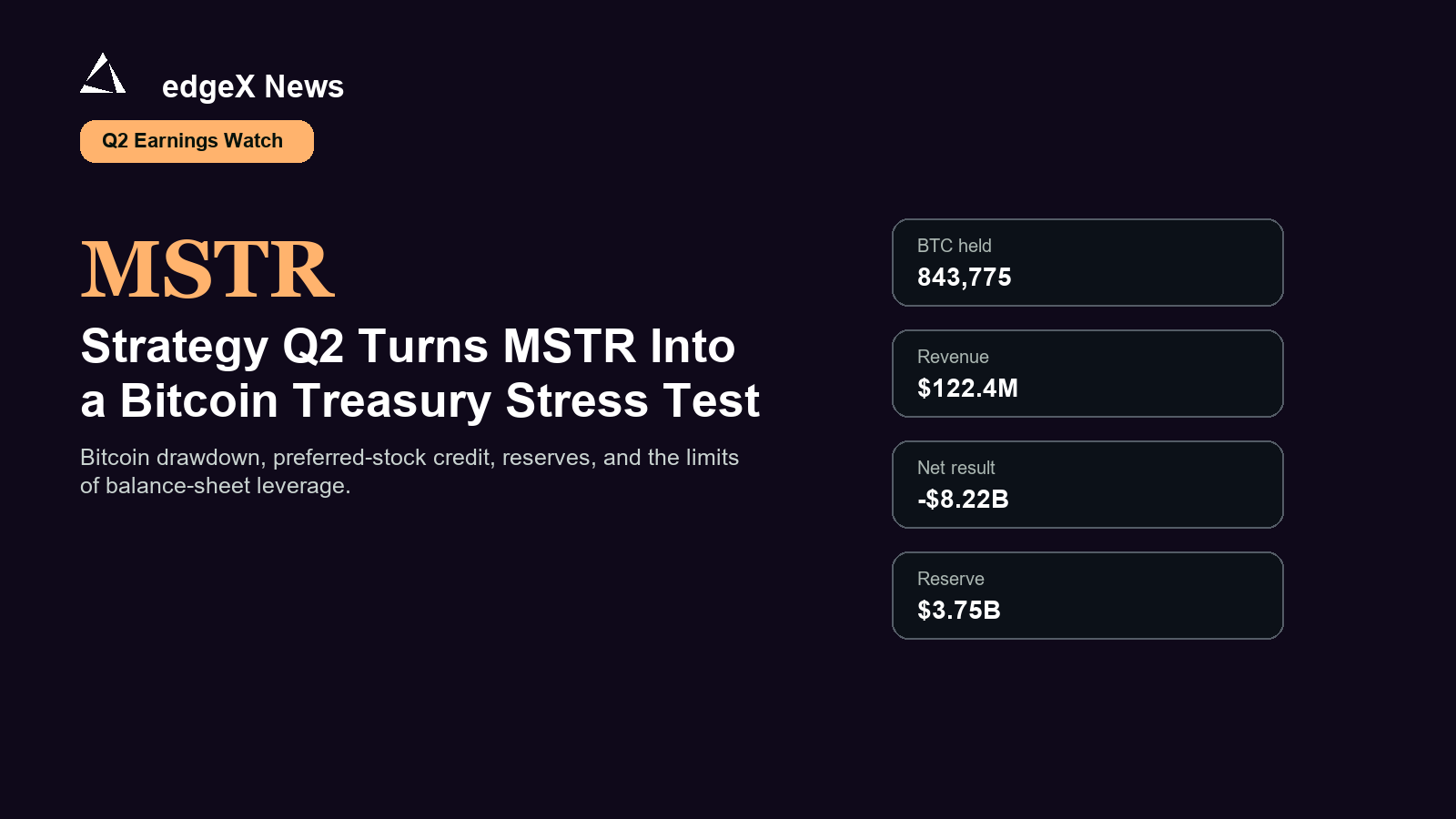
The company's July 30 release gives investors the latest official snapshot. Strategy reported Q2 revenue of $122.4 million and a net loss of $8.22 billion. The loss was dominated by unrealized digital-asset losses during a period when bitcoin traded below the company's average cost basis. As of July 26, Strategy held 843,775 bitcoin, with an original cost basis of $63.69 billion and market value of $54.77 billion based on its cited bitcoin price.
| Metric / Issue | Q2 2026 Context | Investor Read |
|---|---|---|
| Revenue | $122.4 million | Software revenue is no longer the main valuation driver |
| Net loss | $8.22 billion | Mostly reflects bitcoin mark-to-market pressure |
| Bitcoin holdings | 843,775 BTC as of July 26, 2026 | Core asset base and primary equity narrative |
| Average cost per BTC | About $75,476 | Important when BTC trades below cost basis |
| USD reserve | $3.75 billion | Supports dividends and interest coverage |
| MSTR buyback program | $1.0 billion established, no repurchases to date | Signals management may act if common shares look undervalued |
The table makes the point plainly: MSTR is not being valued like a traditional software company. Revenue growth matters, but it is small beside bitcoin holdings, financing costs, preferred dividends, and capital-market mechanics. The stock is a leveraged interpretation of bitcoin, but not a clean one. Senior claims, preferred securities, dilution, reserves, and repurchase policy all sit between the common shareholder and the bitcoin stack.
The Investor Narrative After Earnings
The Q2 report sharpened the central debate around Strategy. Bulls see a company with unique access to capital markets and a disciplined framework for increasing bitcoin exposure per share. Bears see a complex financing structure whose common equity can be pressured when bitcoin falls, credit instruments trade below par, or investors lose confidence in the premium assigned to the treasury model.
That is why reported earnings are only the first layer of the analysis. The company can post a large accounting loss while still arguing that its long-term bitcoin accumulation strategy remains intact. Investors do not have to accept or reject that claim mechanically. They have to ask whether the capital structure gives common shareholders attractive upside after accounting for senior claims, preferred dividends, dilution risk, and the market premium or discount applied to MSTR itself.
What the market is really testing
The market is testing the durability of the bitcoin treasury model during stress. It is easy to admire the structure when bitcoin rises. The harder test comes when bitcoin declines and the company must keep preferred dividends, reserves, and investor trust intact. Q2 gave investors a clearer look at that stress case.
The reserve matters because it buys time. A treasury strategy built on long-duration conviction needs liquidity to survive periods when bitcoin trades below average cost and capital markets become less forgiving. The larger question is whether time works for common shareholders or simply preserves a structure whose upside depends on bitcoin recovering enough to restore the premium.
What could change the next quarter
The next quarter will turn on bitcoin price direction, BTC per-share metrics, preferred-stock trading levels, the USD reserve, any use of the MSTR repurchase authorization, and the pace of future capital issuance. Investors should also watch how management communicates the difference between accounting losses and treasury-strategy KPIs.
A cleaner setup would come from bitcoin stabilization, stronger preferred-stock pricing, and evidence that the company can manage obligations without issuing common equity at unattractive terms. A weaker setup would be persistent bitcoin pressure combined with lower confidence in the instruments Strategy uses to finance accumulation.
Stock Reaction: Momentum Is Useful, But Not the Whole Story
MSTR can move sharply because it sits at the intersection of crypto sentiment, equity risk, credit structure, and capital-markets storytelling. A reported loss does not automatically invalidate the strategy, but it does force investors to separate mark-to-market accounting from common-shareholder economics. That separation is where the analysis becomes difficult.
For traders, the earnings report matters because it updates the map of stress points. The numbers show where the bitcoin stack sits, how much cash support exists, and how management might respond if the stock trades below internal value measures. Those details shape volatility even when the market's main focus is still the bitcoin price.
The Bull Case, the Bear Case, and the Middle Path
The bull case is that Strategy has built a capital-markets machine around bitcoin at a scale no other public company can easily match. If bitcoin rises and the company maintains access to financing, the common stock can keep functioning as a high-beta treasury vehicle. Bulls also argue that the company's investor base understands the volatility and is willing to underwrite accounting noise in exchange for bitcoin accumulation.
The bear case is that complexity becomes a cost. Preferred dividends, issuance programs, monetization tools, reserve management, and common-share valuation all interact. If bitcoin stays below cost basis or capital markets become less friendly, investors may demand a wider discount for that complexity. A large bitcoin stack is powerful, but it does not eliminate financing risk.
The middle path is a stock that remains highly tradable but increasingly sensitive to capital-structure details. MSTR may still offer amplified exposure to bitcoin, but the amplification is no longer a simple multiple. It runs through instruments, reserves, issuance choices, and management's judgment. That makes the earnings report useful even for traders who mostly care about BTC price direction.
Valuation Lens After the Report
Strategy's valuation cannot be reduced to bitcoin holdings divided by shares outstanding. That number matters, but it is only the starting point. Investors also have to account for debt, preferred equity, cash reserves, potential dilution, management's ability to raise capital, and the premium or discount the market assigns to the company's treasury strategy.
The stock can trade above the value of its bitcoin holdings when investors believe management can keep increasing bitcoin exposure per share on favorable terms. It can trade under pressure when the market worries that financing becomes expensive or dilutive. Q2 matters because it showed the stress side of the model. The reported loss reminded investors that accounting volatility is real, but the deeper valuation question is whether the capital structure still works when bitcoin is below the company's average cost.
What Investors Should Watch Next
Watch bitcoin relative to Strategy's average cost, the health of STRC and other preferred instruments, reserve coverage, capital raised through at-the-market programs, any bitcoin sales under the monetization program, and management's willingness to repurchase MSTR if the common equity trades below intrinsic value. The stock is a dashboard, not a single metric.
Investors should also watch language around BTC yield and BTC per share. Those are management's preferred ways of explaining value creation, but they are not substitutes for risk analysis. The common stock can benefit from bitcoin accumulation only if financing choices do not transfer too much upside away from common shareholders.
Risk Map for the Next Trading Window
The obvious risk is bitcoin price. A falling BTC price can pressure reported equity, investor sentiment, and the perceived value of the treasury strategy. The less obvious risk is financing confidence. Strategy's model depends on capital markets accepting its instruments and trusting management's framework. If that confidence weakens, common-share volatility can rise even before any operational issue appears.
There is also communication risk. Strategy uses nontraditional metrics because traditional earnings do not capture the way management wants investors to evaluate the company. Those metrics can be useful, but they can also confuse readers who are not comfortable with treasury-accounting distinctions. A publish-ready investor article therefore has to be clear: MSTR is not simply bitcoin in equity form. It is bitcoin plus a capital structure, a management strategy, and a market premium that can expand or contract.
The final risk is path dependency. If bitcoin recovers quickly, Q2 may look like a painful but survivable mark-to-market episode. If bitcoin remains weak for longer, the same balance sheet can invite harder questions about liquidity, preferred obligations, and the terms of future financing. For MSTR, time is valuable only if the capital structure can carry the strategy through the drawdown.
Trade MicroStrategy Stocks Perpetual Futures on edgeX
TradFi is going on-chain. edgeX now lets traders access MicroStrategy stock perpetual futures on a fully decentralized exchange - no account verification, no centralized custodian, and no compromise on performance.
The DEX Advantage for Stock Traders
Most traders who want exposure to stocks are still pushed toward TradFi platforms: brokerage accounts, KYC requirements, and limited trading hours. edgeX breaks that mold. Built on the EDGE chain and settled on Ethereum via Arbitrum, edgeX combines on-chain infrastructure with institutional-grade execution speed of up to 200,000 orders per second and sub-10ms matching latency.
Self-custody is built into every trade. Assets remain under the user's control, backed by private keys the user holds. USDC on the platform is designed around 1:1 dollar redemption, with Circle Ventures among the platform's backers.
Trade MSTR Perpetuals with an Edge
MicroStrategy stock perpetual futures on edgeX offer up to 10x leverage, with a maximum position size of 1,200 MSTR, giving traders meaningful exposure without locking up excessive capital. Liquidity is deep: $10 million within a 1 basis point spread, with sub-0.1 basis point slippage on trades over $0.1 million.
Through the current TradFi Trading Season promotion, traders can earn 110% fee rebates plus a share of a 200,000 USDC prize pool.
Why edgeX Stands Out
The case for decentralized exchange trading is straightforward: no KYC friction, full self-custody, deep liquidity, high leverage, and trading fee rewards returned to the community. For anyone seeking exposure to high-profile stocks like MSTR without the constraints of traditional finance, edgeX offers a different route to express a market view.
Frequently Asked Questions
Is this a calendar Q2 2026 earnings article?
Yes. Strategy released Q2 2026 financial results on July 30, 2026 for the three-month period ended June 30, 2026.
What is the most important number in the report?
Bitcoin holdings and net bitcoin per share are more important than software revenue for the current equity debate. Revenue matters, but the stock trades primarily around bitcoin treasury economics.
Should readers treat the latest share price in this article as live market data?
No. This article does not state a live stock price. Readers should verify the current share price through Nasdaq, NYSE, a broker, or a real-time market-data page before making any trading decision.
How does edgeX fit into this earnings story?
edgeX gives traders a 24/7 perpetual futures venue for expressing a view on selected stock-linked markets without using a traditional brokerage account. The trading product is different from owning common shares, so readers should understand leverage, funding, liquidation, and custody mechanics before trading.

