No Bitcoin Sales This Week as Strategy Lifts USD Reserve to $4.8 Billion
Key Takeaways
- •Strategy sold no Bitcoin for the first time in three weeks, keeping its holdings at 840,447 BTC, a stack acquired for $63.36 billion.
- •The company raised $333.7 million by selling MSTR shares, using the funds to cover $52.4 million in STRC dividends and buy back 1,388,720 STRC shares for $132.2 million.
- •A $150 million injection lifted Strategy's USD reserve to $4.8 billion, extending its dividend and interest coverage period by 41 days to 2.8 years.
- •Strategy has not bought any Bitcoin since June, when it introduced a capital framework authorizing up to $1.25 billion in BTC sales.
- •MSCI's revived consultation could remove Strategy and Metaplanet from its Global Investable Market Indexes, with a decision expected around October 16 and potential passive selling of $2 billion to $2.8 billion.
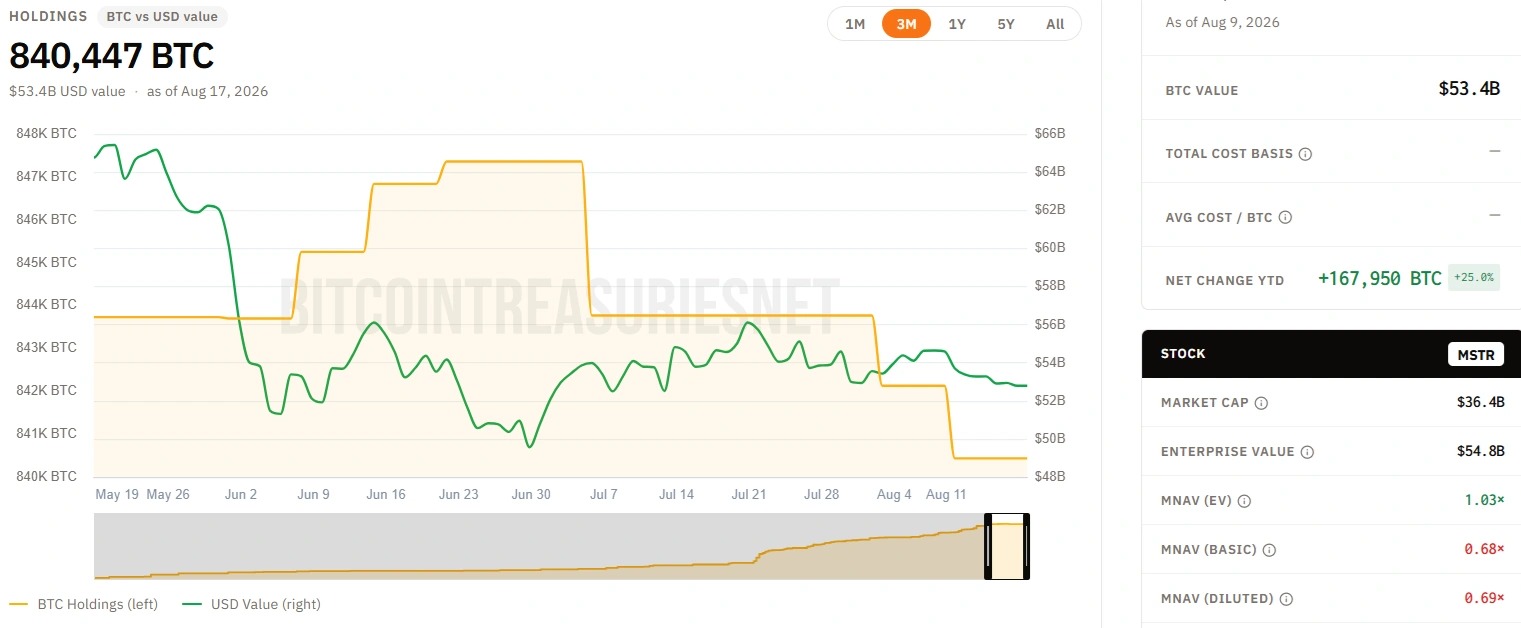
Strategy (NASDAQ: MSTR) reported no fresh Bitcoin sales this week, with the main changes to the Saylor-led firm's books coming from common stock sales that raised $333.7 million. The company directed those proceeds toward dividend payments, a repurchase of its own STRC preferred shares, and a buildup of its USD reserve to $4.8 billion.
The firm's Bitcoin reserve remained unchanged at 840,447 tokens, consistent with figures reported in earlier Cryptopolitan coverage.
No Bitcoin sold this week
An SEC filing submitted on Monday, August 17, showed that Strategy did not sell any BTC for the first time in three weeks. According to the company's press release, the firm covered $52.4 million in STRC dividend obligations and a $132.2 million buyback of 1,388,720 STRC shares by selling 3,458,866 MSTR shares for $333.7 million. The remaining funds raised during the week went toward topping up the dollar reserve by $150 million.
Strategy currently controls an 840,447 BTC stack — the largest corporate Bitcoin holding among publicly listed companies — that it acquired for $63.36 billion, according to BitcoinTreasuries.net. Its USD stash now stands at $4.8 billion — enough to cover up to 2.8 years of dividend payments.
The pause hands Michael Saylor fresh ammunition in his debate with skeptics who have pointed to Strategy's recent disposals as evidence that the firm has become a seller. The company has not bought a single Bitcoin token since unveiling a capital framework in June that authorizes up to $1.25 billion in BTC sales.
In a July 31 post cited by Cryptopolitan, Saylor wrote that Strategy "never had a 'never sell' policy," adding that the firm will return to adding to its holdings in due time. In the week prior, Strategy had sold 1,690 Bitcoin for $108.6 million.
Why Strategy is building a cash reserve
The destinations of this week's cash signal the firm's current priorities, with the largest single allocation — $150 million — directed at lifting the dollar reserve to $4.8 billion. That injection extended the firm's "USD Duration," the length of time it can fund preferred dividends and debt interest, by 41 days to 2.8 years. Preferred shares pay fixed dividends rather than discretionary ones, which is why the company frames its cash buffer as a measure of how long those payouts stay covered.
About $653 million remains available under the preferred-stock repurchase authorization, while the separate $1 billion program to buy back MSTR common stock has not been touched. No STRF, STRK, or STRD shares — the other preferred-stock classes Strategy has issued alongside STRC to raise fixed-dividend capital — were sold or repurchased during the week.
MSCI decision looms
The capital maneuvering unfolds against a threat to Strategy's index status. MSCI has revived a consultation that could strip Strategy and Japan's Metaplanet — a company that has followed a similar Bitcoin-treasury playbook — from its Global Investable Market Indexes under a new "non-operating companies" screen, as Cryptopolitan reported. Feedback closes September 30, a decision is expected around October 16, and any removal would take effect at the November 2026 index review — potentially forcing $2 billion to $2.8 billion in passive selling.
Strategy has pushed back publicly. In an August 14 post on X, the company said index providers "should measure markets, not decide which assets companies are allowed to own," adding that "Bitcoin doesn't need MSCI. Neither does Strategy."

