Strategy Becomes Largest Holding in Tom Lee's $4.5B GRNY ETF
Key Takeaways
- •MSTR rose from GRNY's lowest-ranked holding in mid-August to its largest position by September 3, with its weight climbing from 1.22% to 3.02% over successive weekly snapshots.
- •GRNY's official holdings page listed MSTR at 2.98%, worth roughly $135 million of the fund's $4.533 billion in assets, and only five basis points above Robinhood.
- •Bloomberg analyst Eric Balchunas noted the exposure increase came before MSTR rallied roughly 46%, but the timing does not prove GRNY's buying caused the rally.
- •Because GRNY is an actively managed ETF disclosing holdings daily, the position change could be tracked week by week, unlike most mutual funds that disclose quarterly.
- •GRNY shareholders hold indirect equity exposure to Strategy rather than Bitcoin itself, and the under-3% position means the fund remains a diversified large-cap strategy rather than a crypto fund.
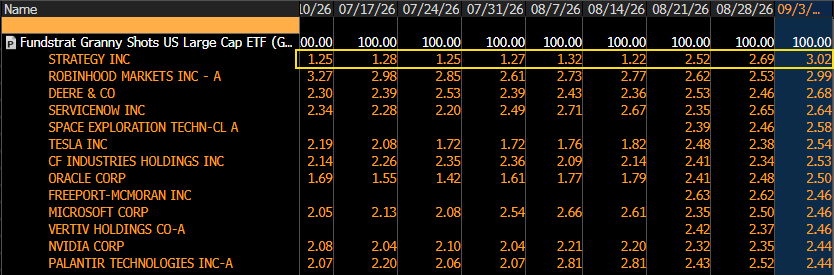
Strategy (MSTR) has become the largest reported holding in the Fundstrat Granny Shots US Large Cap ETF (GRNY), the roughly $4.5 billion fund associated with Fundstrat co-founder Tom Lee, following a sharp portfolio adjustment in August.
Bloomberg ETF analyst Eric Balchunas highlighted the change after a portfolio-tracking tool showed MSTR moving from GRNY's lowest-ranked holding in mid-August to first place by September 3. Its reported weight climbed from 1.22% on August 14 to 2.52% on August 21, 2.69% on August 28 and 3.02% on September 3. The final reading placed Strategy narrowly ahead of Robinhood, which stood at 2.99% in the same snapshot. That level of visibility is itself notable: actively managed ETFs like GRNY publish portfolio holdings daily, unlike most traditional mutual funds, which disclose quarterly — which is why the position change could be tracked week by week.
Balchunas noted that the increase occurred before MSTR subsequently rallied by roughly 46%. His post did not specify the exact share prices or the start and end dates behind that figure, so the percentage should be treated as his measurement rather than an independently defined performance period. The timing also does not establish that GRNY's purchases caused the rally; it shows the fund increased its exposure before the advance became visible in MSTR's market price.
Official data shows a slightly lower weight
The 3.02% figure reflects the September 3 portfolio snapshot shared by Balchunas. When checked later, GRNY's official holdings page listed MSTR at 2.98% and Robinhood at 2.93%, meaning Strategy remained the fund's largest holding, albeit with a slightly lower reported weight.
The shift from 3.02% to 2.98% does not by itself indicate that GRNY sold MSTR shares. Portfolio weights also move when share prices change, when investors add or withdraw money from the ETF, or when other holdings gain or lose value. Confirming an actual purchase or sale would require corresponding share-count data from comparable reporting dates.
The position's scale
GRNY's reported total assets stand at $4.533 billion. With MSTR's official weight at 2.98%, the position's indicative value is roughly $135 million based on the reported figures. That estimate is approximate, since total assets, security prices and portfolio weights fluctuate throughout the trading day. It is useful for illustrating the position's scale, not for determining GRNY's exact cost basis. For context on MSTR's market standing, the stock was added to the Nasdaq 100 index in December 2024 and remains one of the most heavily traded US equities, which is part of why ETF position changes in the name attract analyst attention.
Still less than 3% of the fund
Calling MSTR the ETF's top holding can make the position sound dominant. In practice, GRNY remains broadly diversified: Strategy's 2.98% weight was only five basis points above Robinhood's 2.93%.
The official fund page describes GRNY as an actively managed large-cap equity ETF built around Fundstrat's thematic research, targeting companies exposed to themes such as millennials, cybersecurity, energy, automation and changes in monetary policy.
Strategy can fit that framework because its large Bitcoin reserve makes the stock sensitive to digital-asset adoption and monetary conditions. The company still operates a software business, but its balance sheet and financing decisions have made the stock behave partly as a leveraged corporate route to Bitcoin exposure. That exposure continues to evolve as Strategy raises capital and acquires more BTC; its latest purchase activity and financing structure are covered in Coindoo's report on Strategy's Bitcoin accumulation.
GRNY shareholders do not own Bitcoin
Buying GRNY is not equivalent to buying Bitcoin or a spot Bitcoin ETF. The fund owns shares in Strategy, while Strategy owns Bitcoin alongside its software business, cash, debt and preferred-stock obligations.
A GRNY investor owns shares in a diversified equity ETF that allocates a small portion of its portfolio to MSTR. What the investor cannot claim is ownership of Strategy's Bitcoin or the right to redeem GRNY shares for BTC.
This additional corporate layer changes the risk profile. MSTR can outperform Bitcoin when investors reward its capital-raising model, but it can also underperform when its valuation premium contracts or financing concerns outweigh movements in BTC. GRNY adds yet another layer, since MSTR accounts for only about 3% of the fund — a large move in Strategy can influence the ETF without determining its entire return.
Tom Lee leads GRNY but does not manage it alone
The headline connection to Tom Lee deserves precise framing. Lee is Fundstrat's chief investment officer and GRNY's lead portfolio manager, but an SEC filing identifies Lee and Ken Xuan as jointly responsible for the fund's day-to-day management.
Balchunas also noted GRNY's connection to Ether. That link comes through Lee's separate role as chairman of BitMine Immersion Technologies, an Ethereum treasury company. It does not mean GRNY holds ETH, and MSTR does not provide exposure to BitMine's Ether reserve. Lee has separately discussed the circumstances under which BitMine might sell ETH, as covered in Coondoo's analysis of BitMine's treasury strategy. That role provides context for his involvement across crypto-linked public companies, but it should not be treated as part of GRNY's MSTR position.
What the next holdings update will show
The immediate question is no longer whether GRNY increased its Strategy exposure; the August weight history establishes that it did. What remains unclear is whether the managers intend to keep MSTR near the top of the portfolio after its reported rally.
Future holdings disclosures can answer that more reliably than portfolio weights alone. A stable or rising share count would indicate GRNY maintained its exposure, while a lower weight without fewer shares could simply reflect stronger performance elsewhere in the fund.
Strategy's move into first place gives GRNY a larger connection to Bitcoin than it had in mid-August. At less than 3% of assets, however, the position remains one component of a diversified active-equity strategy rather than a transformation of GRNY into a crypto fund.
This article is provided for informational purposes only and does not constitute investment advice.
