MSTR Stock Faces MSCI Exclusion Risk as Strategy Buys $370 Million in Bitcoin
Key Takeaways
- •MSCI opened a consultation on excluding companies it views as predominantly non-operating, and a simulation indicated Strategy could be removed from the MSCI ACWI IMI.
- •Strategy said MSCI’s proposal is misguided and conflicts with U.S. GAAP, SEC guidance, and established securities laws.
- •The company estimated that MSCI-tracking funds hold about 3% of MSTR shares, which it said equals roughly 60% of one day’s average trading volume.
- •JPMorgan previously estimated an MSCI exclusion could trigger about $2.8 billion in outflows, with a larger amount possible if other index providers follow similar rules.
- •Strategy bought 4,603 BTC for $369.7 million between Aug. 24 and Aug. 30, its first Bitcoin purchase since June 22.
Strategy has pushed back against an MSCI proposal that could classify the company as ineligible for major global equity indexes, while also resuming Bitcoin purchases after a five-week pause. The debate matters for MSTR because index membership can influence who is allowed to hold the stock, especially passive funds that track benchmark providers such as MSCI.
MSCI opened a consultation on Aug. 3 covering the treatment of companies it considers predominantly non-operating. Under a simulation using May 2026 data, Strategy, Metaplanet, and Yellow Cake would have been removed from the MSCI ACWI IMI.
Strategy formally opposed the proposal, calling it misguided and inconsistent with established accounting principles. The dispute comes as the company has returned to Bitcoin accumulation after several weeks focused on liquidity and capital management, underscoring how closely the firm’s stock remains tied to both index methodology and its balance-sheet strategy.
Strategy Pushes Back Against MSCI Proposal
Strategy responded to MSCI’s proposed “non-operating company” exclusion, describing it as misguided and inconsistent with established securities laws and accounting principles.
“Strategy reports its BTC business as an operating segment and BTC gains and losses as operating expenses. The proposal is misguided, flawed, and conflicts with securities laws and accounting principles,” the firm added.
The company argued that MSCI’s proposal specifically targets Digital Asset Treasury (DAT) companies. Strategy said the proposal effectively revives an earlier plan that MSCI withdrew after facing criticism. According to Strategy, the proposal would remove two major DAT companies from MSCI indices and prevent future DAT companies from being included.
Strategy also challenged MSCI’s classification of Bitcoin as a “non-operating” asset. The company said its Bitcoin business is reported as an operating segment under U.S. GAAP and SEC guidance.
Strategy added that funds tracking MSCI indices represent approximately 3% of MSTR’s outstanding shares. That is roughly 60% of one day’s average trading volume, which the company said limits the potential impact on the stock.
How Could MSTR Stock Be Affected If MSCI Removes It?
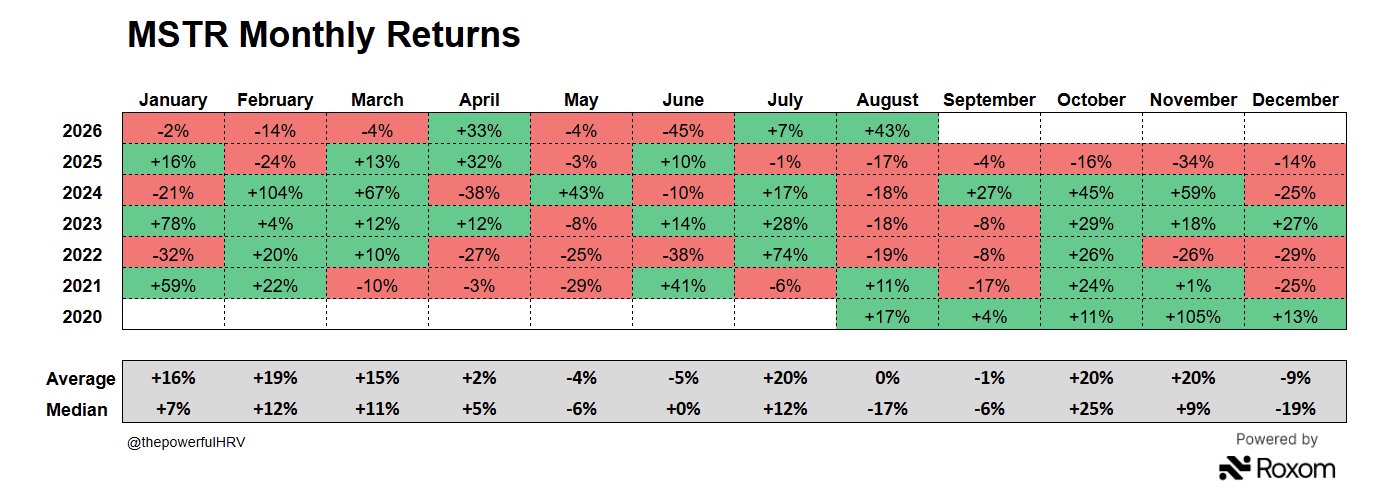
For most of 2026, MSTR stock has been under strong selling pressure. Since the beginning of 2026, the stock has been trading at a 25% discount, despite a strong 40% recovery in August.
MSTR ended August with a 43% return, most of which came in the last two weeks. It was the stock’s best-performing month since November 2024.
Investors are closely watching the possibility that Strategy could be removed from the MSCI index. Such a move could trigger significant outflows from passive investment funds, which is why the consultation has drawn attention beyond Strategy’s own shareholder base.
In November 2025, JPMorgan estimated that an MSCI exclusion could result in approximately $2.8 billion in outflows from MSCI-linked funds. The total could rise to around $8.8 billion if other major index providers, including FTSE Russell and S&P, adopt similar rules.
Passive funds tracking these indexes would be required to sell their MSTR holdings, which could create short-term downward pressure on the stock price.
Strategy Resumes Bitcoin Purchases
According to its latest filing on Aug. 31, Michael Saylor’s Strategy purchased 4,603 BTC for $369.7 million between Aug. 24 and Aug. 30. The company paid an average of approximately $80,318 per Bitcoin, marking its first BTC purchase since June 22.
Between June 22 and the latest purchase, Strategy had sold approximately 6,916 BTC for $432.5 million at an average price near $62,500.
Meanwhile, Strategy repurchased 1.55 million STRC shares for $151.8 million and increased its USD cash reserves by $29 million to $1.61 billion. The company now has more than four years of dividend coverage on its balance sheet, giving added context to why capital allocation and liquidity have remained central to its recent filings.
This article is for informational purposes only and does not constitute financial advice. Equity and cryptocurrency markets can experience sharp price movements.
