STONK falls 26% as competition for reflection-token markets intensifies
Key Takeaways
- •STONK fell more than 26% to $0.22 on Monday, one day after reaching a record price above $0.30, before rebounding from a local low near $0.20.
- •About 60% of StonkFun's revenue is used to buy and burn STONK on the open market, with roughly 15% of the total supply burned as of September 14.
- •More than 41% of STONK's trading volume is concentrated on Meteora, and its largest liquidity pair holds only $2.8 million, leaving the token vulnerable to slippage.
- •The leading STONK trader recorded net earnings of $3.8 million after selling $30 million worth of the token, while influencers realized profits of up to $78,000.
- •StonkFun generated $7.39 million in weekly revenue, surpassing Robinhood, as competition grows from PumpFun and BNB Chain's FourMeme, which recently launched reflection tokens through 4Stock.
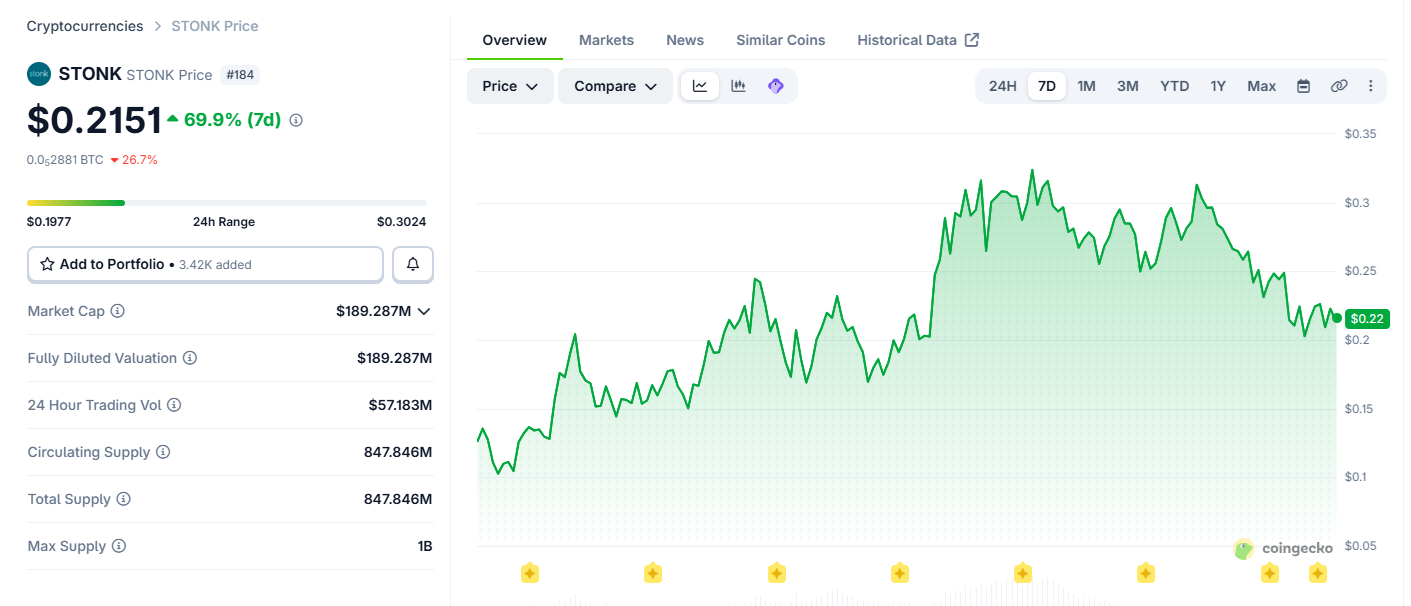
STONK, the native token of the StonkFun platform, fell 26% just one day after reaching a record price above $0.30. The token is used to distribute StonkFun’s earnings and serves as a gauge for the broader reflection-token trend.
STONK dropped to $0.22 on Monday during the Asian trading session, losing more than 26% before rebounding from a local low near $0.20. The move has raised questions about whether StonkFun’s recent uptrend can be sustained.
STONK is also a revenue-sharing token. Fees generated by StonkFun are used for regular token burns, with approximately 15% of the total supply burned as of September 14. About 60% of the platform’s revenue is used to buy STONK on the open market and burn it, while the remainder is retained by the platform. Current information on the token and its revenue model is available through CoinGecko and StonkFun.
STONK’s value therefore depends partly on activity on the StonkFun platform and the emergence of highly appealing “runner” tokens among newly launched reflection assets. As Cryptopolitan previously reported, the reflection-token trend expanded in September, primarily around the Solana ecosystem.
Why STONK is vulnerable
More than 41% of STONK’s trading volume is concentrated on Meteora. The largest liquidity pair has only $2.8 million in available liquidity, leaving the token vulnerable to slippage. STONK also has limited activity in perpetual futures markets and remains a relatively new asset, conditions that can contribute to sharp price movements.
Although STONK encourages trading by allowing participants to share in platform revenue, early buyers and whales have also created selling pressure. The leading STONK trader recorded net earnings of $3.8 million after selling $30 million worth of the token. That trader also bought STONK again near the recent local lows. Additional selling has come from influencers who realized profits of as much as $78,000.
Data from Bubblemaps shows relatively small clusters of connected STONK wallets. Even so, early buyers could continue to create selling pressure, and the token may remain volatile while it is still in a period of price discovery.
StonkFun tokens remain high-risk
StonkFun’s main appeal is the possibility of short-term gains from its top-performing “runner” tokens. The platform also attracts users with incentives to hold tokens and receive dividends, as well as exposure to reflected assets.
As of September 14, ZCAT remained the platform’s most notable token, reflecting ZCash (ZEC). ZCAT also rose ahead of the wider market following mentions by influencer Ansem. Other prominent StonkFun tokens began declining alongside STONK, losing more than 30% of their value in one day.
For StonkFun assets, the tradeoff is between the prospect of high passive income and the possibility of losses exceeding 50% within hours. Accelerating “vampire attacks” and competing platforms are additional sources of risk. Some Solana traffic and liquidity could shift to Robinhood, while PumpFun has also attempted to introduce reflection-token mechanics, drawing some activity away from StonkFun.
Despite the recent setbacks, StonkFun surpassed Robinhood in weekly revenue, generating $7.39 million over the past week. The reflection-token model has changed meme trading by creating demand for rewards attached to tokens.
The model may persist, but competition among reflection-token platforms is only beginning. BNB Chain recently added reflection tokens to its meme platform, FourMeme, launching stock-based tokens with 4Stock. As of September 2026, reflection tokens rely mainly on existing Solana infrastructure for their rewards, while much of the underlying stock ownership comes through partnerships with XStocks, described as the leading tokenization platform on Solana.

