Stock Market Today: Dow, S&P 500, Nasdaq Fall as US Strikes Iran and Rate-Hike Bets Jump
Key Takeaways
- •The US military struck Iranian rocket launchers that were preparing to send mines into the Strait of Hormuz, breaking weeks of relative calm and lifting Brent crude above $90 per barrel.
- •Traders raised the probability of a 25-basis-point Fed rate hike at the September meeting to 62%, up from roughly 40% a week earlier, after hawkish Jackson Hole comments from Fed Chairman Kevin Warsh.
- •The Dow fell 0.62%, the S&P 500 declined 0.44%, and the Nasdaq dropped 0.42% on Monday, though all three major indexes were on track for monthly gains.
- •Tim Cook stepped down as Apple CEO, with hardware engineering chief John Ternus taking over and Cook remaining as executive chair.
- •Rising analyst profit estimates and fewer estimate cuts across the S&P 500 are seen as a potential next positive catalyst for stocks heading into the fall.
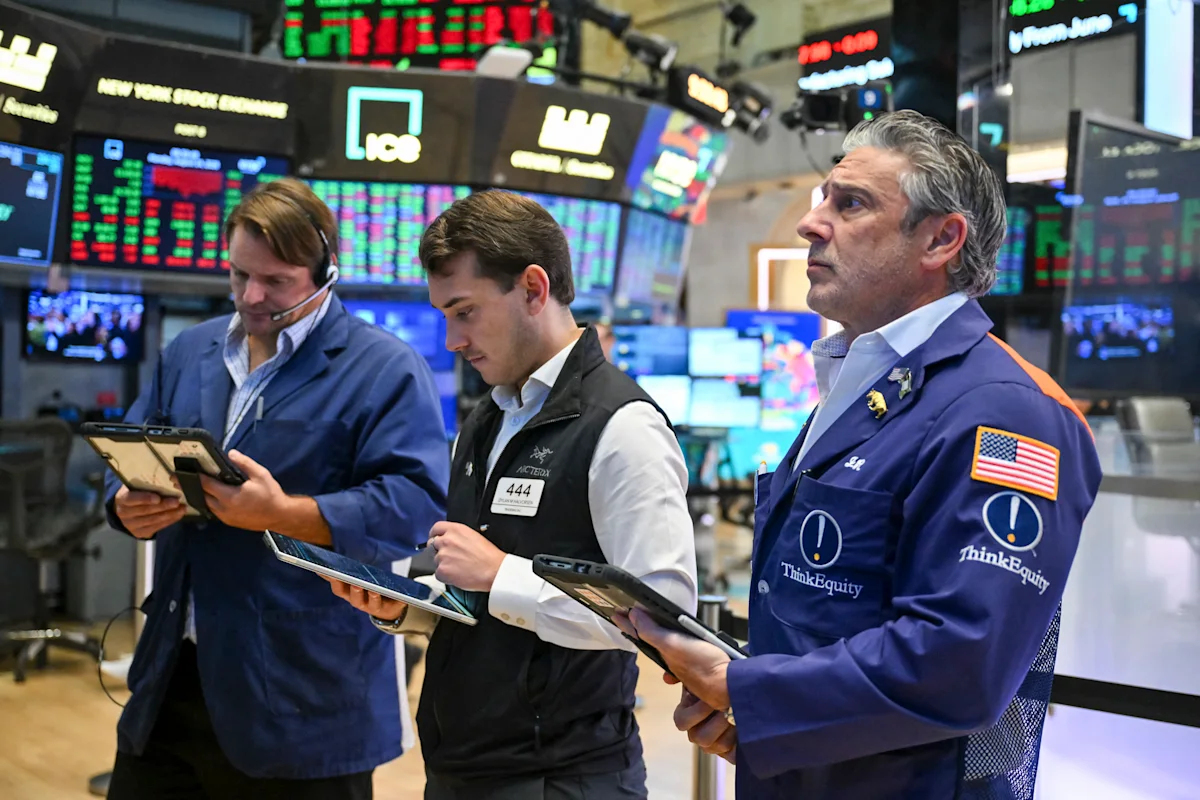
Stock Market Today: Dow, S&P 500, Nasdaq Fall as US Strikes Iran and Rate-Hike Bets Jump
Market snapshot: CL=F +3.29% | ^DJI -0.62% | ^GSPC -0.44% | ^IXIC -0.42%
US stocks declined on Monday after the US attacked Iran for the first time in weeks, fueling a rise in oil prices and increased bets that the Federal Reserve would raise interest rates at its September meeting.
The Dow Jones Industrial Average (^DJI) fell 0.5%, while the S&P 500 (^GSPC) declined by 0.3%. The tech-heavy Nasdaq Composite (^IXIC) dropped 0.2%, though all three major indexes were on track to post gains for the month.
US stocks fall after the opening bell as Iran war tensions flare
US stocks fell after the opening bell on Monday after the US and Iran exchanged fire for the first time in roughly a month, sending oil prices higher and re-stoking inflation fears just as bets rise for a coming rate hike by the Federal Reserve.
The Dow Jones Industrial Average (^DJI) slipped by 0.5%, while the S&P 500 (^GSPC) declined by 0.4%. The tech-heavy Nasdaq Composite (^IXIC) fell by 0.3%. The Dow stood at 53,229.39, down 330.60 (-0.62%), as of 10:03:33 AM EDT, market open.
Renewed hostilities in the Middle East put pressure on stocks after the US struck Iranian rocket launchers that were preparing to send mines into the Strait of Hormuz. The strait is one of the world's most important oil chokepoints, and any disruption to shipping there ripples through global energy prices. Oil prices jumped on worries that the conflict could escalate again, with Brent crude futures (BZ=F) rising over $90 per barrel.
The ongoing war in Iran has been a key factor keeping inflation concerns alive, because higher energy costs can feed through to consumer prices and complicate the Fed's inflation fight. On Friday, Fed Chairman Kevin Warsh delivered a speech in Jackson Hole, Wyo., stating that inflation was running too hot and that the central bank has "work to do." Over the weekend, traders lifted their bets that the Fed would raise rates by 25 basis points at its next meeting to 62%, up from roughly 40% a week ago.
With second quarter earnings largely in the rearview after Nvidia's (NVDA) bombastic report last week, attention has turned back toward the macro economy, with investors fresh off Fed Chairman Kevin Warsh's speech — more hawkish than maybe expected — in Jackson Hole. While conflict between the US and Iran appeared to calm after the initial exchange of strikes over Sunday and Monday, signs of further flare-ups could rekindle worries about higher energy prices, feeding through to above-target inflation.
Investors looking for answers will get two reads on the economy in the next two weeks, with the Labor Department's monthly jobs report on Friday and the CPI numbers next week. Monday brought a relatively quiet day for economic data.
After an 'extraordinary' earnings season, here's the next big positive for stocks
After a banner second quarter earnings season helped push stocks to new highs this summer, there is a new combination at play that could aid the bull run going into the fall — provided oil prices don't explode above $100 a barrel and a hawkish Fed Chairman Kevin Warsh doesn't begin a rate-hiking cycle, Yahoo Finance's Brian Sozzi writes.
The next stock catalyst is the one-two punch of rising analyst profit estimates and fewer estimate cuts. Earnings are bucking the seasonal revision trend and continuing to inflect upward, Evercore ISI strategist Julian Emanuel pointed out in a new note. What's more, estimates for the median stock in the S&P 500 (^GSPC) have risen across top-line growth, bottom-line earnings, and free cash flow returns.
"We are living in extraordinary times," Emanuel wrote.
It's Tim Cook's last day as Apple CEO. Investors are $4 trillion richer because of him.
Yahoo Finance's Dan Howley reports: Apple's (AAPL) Tim Cook is stepping down as CEO today, turning over the role to senior vice president of hardware engineering John Ternus. Cook will stay on at Apple as its executive chair and "assist with certain aspects of the company, including engaging with policymakers around the world," the company said in a statement.
During his time as CEO, Cook oversaw the launch of a variety of new products, including the Apple Watch, AirPods, and, more recently, the MacBook Neo. He's also been instrumental in increasing Apple's Services segment revenue to more than $100 billion, the company's second-largest business behind the iPhone.
Steve Jobs hired Cook in 1998 and promoted him to executive vice president of worldwide sales in 2002, before appointing him to COO in 2005. He later took over as CEO from Jobs in 2011.
Wall Street's summer calm is colliding with the year's most volatile stretch
Wall Street has gone quiet. The calendar says that's about to change.
The CBOE Volatility Index (^VIX) fell to 14.13 on Friday, its lowest level of 2026. That's a long way from the spring, when volatility briefly exploded higher with Iran war headlines before spending the summer grinding back down.
That calm tends to fade right around now. The VIX has historically started climbing around this time of year. Its median level since 1990 sits around 16.5 in late August, rises toward 18 by mid-September, and reaches roughly 19 in early October.
That doesn't mean stocks are destined to fall. The VIX measures the 30-day volatility implied by S&P 500 options, or roughly how much movement options traders are pricing into the market. It says nothing about which direction the movement will take. That distinction can get lost whenever the VIX starts rising. Stocks can rally even with elevated volatility, and they can drift lower even with subdued volatility. What changes this time of year is the range of possible outcomes. It tends to get wider.
Good morning. Here's what's happening today.
Economic data: Dallas Fed manufacturing activity, August (1.6 expected, 1.3 previously)
Earnings calendar: No notable earnings.
It's a light day for earnings and economic data, but Apple investors take heed: Today, Tim Cook hands over the keys to new CEO John Ternus, who is expected to shepherd the iPhone maker in the AI age.
Catch up on some top stories from over the weekend:
- Americans feel they have lost their agency
- 'More than I expected to pay': Rents are rising at the fastest rate in over a year
- Trump reignites trade wars as Americans' opinions of tariffs continue to drop
- Why do we feel 'crummy' in a good economy? Our paychecks aren't keeping up.
- Wall Street is turning Nvidia's AI chips into a new futures market
- Retailers feel the sting as cautious consumers weigh their options
Oil jumps as US military hits Iranian launchers
Bloomberg reports: Oil surged after fresh fighting flared up in the Strait of Hormuz, highlighting risks to flows from the Middle East after months of conflict. Brent for November rose above $90 a barrel, while West Texas Intermediate was near $86.
The US military struck Iranian rocket launchers preparing to send mines into the waterway on Sunday, according to Captain Tim Hawkins, a spokesperson for US Central Command, ending weeks of relative calm.
Crude is wrapping up a volatile month in which Brent futures have swung in a range of almost $17 a barrel. Prices have been buffeted by stop-start efforts to bring an end to the fighting, as well as a pledge by Washington that it will try to force Tehran to capitulate by ramping up efforts to isolate and cripple Iran's economy. Still, analysts have been underwhelmed by the US actions.
Even without a peace deal between Washington and Tehran, about 6 million to 8 million barrels a day of crude are moving through Hormuz, according to traders monitoring cargoes. Separately, Iran's semi-official Mehr news agency reported that vessel traffic along a route approved by the Islamic Republic "is taking place on a limited basis," with ships said to be paying tolls.
