Major US Stock Indices Decline as Treasury Yields Reach Historic Peaks Despite Strong Micron Report
Key Takeaways
- •The Dow fell about 0.5%, roughly 328 points, while the S&P 500 and Nasdaq each lost around 0.3% as rising Treasury yields outweighed positive corporate news.
- •The 10-year Treasury yield climbed to 5.33% on Thursday, its highest reading in multiple decades, with the 10-, 20-, and 30-year yields all hitting 24-year highs.
- •September's S&P Global Manufacturing PMI came in at 55.9, below the preliminary estimate of 57, while ISM data showed a significant jump in manufacturing input prices that could compress margins and reignite inflation worries.
- •Micron surpassed fourth-quarter expectations with revenue of $54.23 billion and adjusted EPS of $33.42, and issued first-quarter guidance above consensus, yet its shares barely moved.
- •First-time unemployment claims fell for a fourth consecutive week and announced job cuts declined in September, ahead of Friday's monthly jobs report that may shape rate expectations.
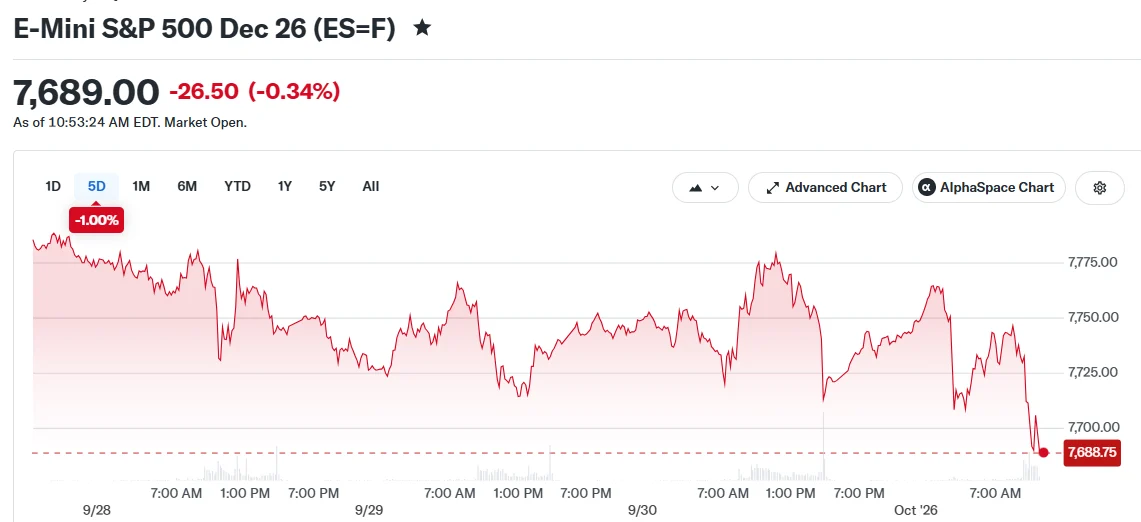
U.S. stocks closed lower on Thursday as a relentless climb in Treasury yields dominated market sentiment, outweighing positive corporate news from memory chip manufacturer Micron. The retreat marked a cautious start to October's trading.
The Dow Jones Industrial Average shed approximately 0.5% during the session. The S&P 500 declined 0.3%, while the Nasdaq Composite registered a similar 0.3% loss. All three major benchmarks had traded in positive territory during the early hours, but those advances evaporated as fixed-income market pressures intensified through the morning session.
Treasury Yields Continue Their March Higher
The benchmark 10-year Treasury yield extended its climb on Thursday, pushing toward the 5.3% threshold — the highest reading in multiple decades for the closely watched rate.
As noted by Bull Theory on X:
$550 billion has been wiped out from US stocks in the last 45 minutes. Reasons: 1. US 10-year, 20-year, and 30-year Treasury yields all just hit a new 24-year high. 2. US Manufacturing PMI also came in below expectations. pic.twitter.com/38Fnouv1ja
— Bull Theory (@BullTheoryio), October 1, 2026
The yield advance followed a particularly challenging three-month period for fixed-income investors, with bond markets having just concluded one of their worst performances in recent history as October began — a reflection of the inverse relationship between bond prices and yields. Elevated yields increase borrowing costs throughout the economy while simultaneously diminishing the relative appeal of equities versus bonds, as investors can secure higher returns from lower-risk instruments. The 10 rate in particular functions as a reference point across the financial system, influencing everything from mortgage pricing to the discount rates investors use to value future corporate earnings.
Rate-sensitive market segments bore the brunt of Thursday's selling pressure. Materials, real estate, and financial services companies posted some of the session's steepest declines, while energy and technology were the sole sectors maintaining positive ground. At one point during morning trading, fewer than one-third of S&P 500 constituents were advancing.
Disappointing Manufacturing Metrics Add to Concerns
A pair of manufacturing sector reports released Thursday painted a picture of decelerating momentum paired with accelerating price pressures. The S&P Global Manufacturing Purchasing Managers Index registered 55.9 for September, falling short of the preliminary estimate of 57 — though still above the 50 mark that separates expansion from contraction in the sector. Separately, the Institute for Supply Management documented a significant jump in manufacturing input prices during September. Escalating costs for raw materials can compress corporate margins and reignite inflation worries.
The data releases followed a challenging conclusion to the third quarter, in which the Dow registered declines for both September and the full three-month period, though the Nasdaq managed quarterly gains.
Micron Delivers Strong Results, But Shares Stay Flat
Micron announced fourth-quarter financial results that surpassed analyst projections and elevated its first-quarter guidance above market expectations. As one of the world's largest memory chipmakers, Micron's results also serve as a gauge for demand across the data center, PC, and smartphone markets that consume its products.
MICRON $MU Q4'26 EARNINGS HIGHLIGHTS Revenue: $54.23B (Est. $51.07B) ; +379% YoY Adj. EPS: $33.42 (Est. $31.61) Adj. Gross Margin: 87.0% (Est. 86.1%) Q1 FY27 Guide: Revenue: $61.5B ± $1.5B (Est. $57.02B) Adj. EPS: $38.15 ± $1.00 (Est. $35.40) … pic.twitter.com/DvLalHRPYe
— Wall St Engine (@wallstengine), September 30, 2026
Surprisingly, Micron shares barely budged despite the encouraging news, as market participants appeared preoccupied with bond market dynamics rather than company-specific developments. Performance among other semiconductor and technology names varied widely: one prominent chipmaker registered modest gains following a strong September performance, while another semiconductor company retreated after climbing 30% the previous month.
Labor Market Shows Continued Resilience
Employment data pointed to continued labor market strength. First-time unemployment benefit applications decreased for a fourth consecutive week in the most recent reporting period. An additional workforce report from Challenger, Gray & Christmas revealed that corporations announced fewer position eliminations in September, though businesses have not accelerated their hiring activity.
These employment indicators arrive ahead of Friday's comprehensive monthly jobs report, which will provide broader insights into hiring trends and unemployment dynamics — figures that routinely shape expectations for the path of interest rates.
Nike is scheduled to announce quarterly results following Thursday's market close. The athletic apparel giant's shares have been hovering near decade-low levels, placing additional scrutiny on the company's performance update.
As late-morning trading progressed, the 10-year Treasury yield stood at 5.33%, while the 2-year yield retreated to 4.852%. The Dow was lower by approximately 328 points, with the S&P 500 declining 0.36% and the Nasdaq dropping 0.31%.
Source: Blockonomi

