Weekly Recap: S&P 500 and Nasdaq Post Weekly Gains as Treasury Yields Hit Multi-Decade Highs
Key Takeaways
- •The Dow finished Friday up 0.9% at 51,829, and all three major indexes ended the week in positive territory, led by the Nasdaq's 2% gain.
- •The 10-year Treasury yield closed at 5.18%, a fresh 19-year high, while the 30-year yield settled at 5.5% for the first time in 22 years.
- •Fed funds futures show roughly a 64% to 66% probability of an October rate hike, with markets pricing three additional quarter-point increases by the end of 2027.
- •WTI crude fell 2.33% to $92.41 a barrel and Brent dropped 2.14% to $104.32 as U.S. and Iranian negotiators discussed a deal to reopen the Strait of Hormuz.
- •Treasury Secretary Scott Bessent said the U.S. and China agreed to a two-month extension of their trade truce during President Xi Jinping's visit to the United States.
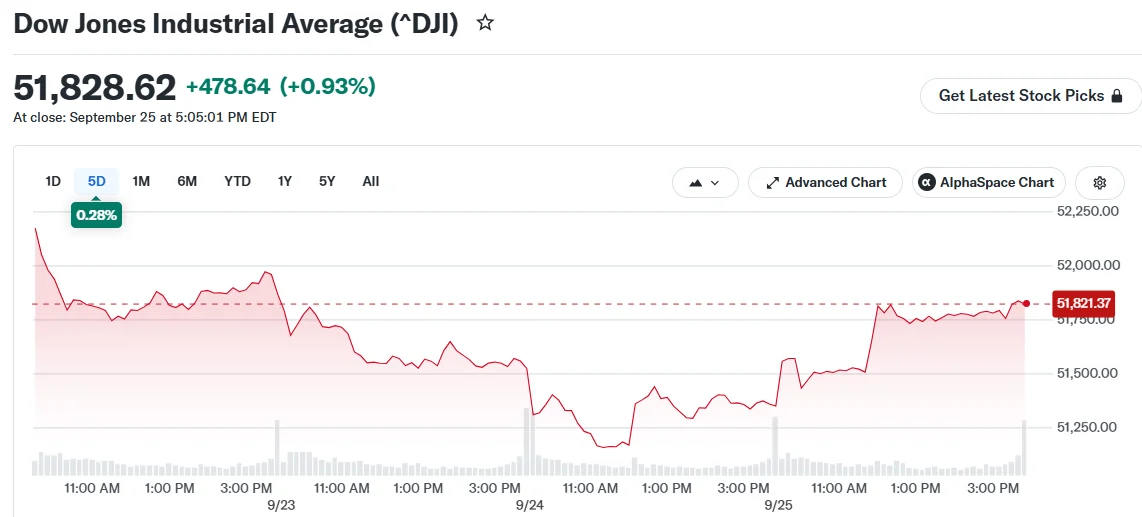
U.S. stocks closed higher on Friday, wrapping up a choppy week on Wall Street in which all three major indexes finished in positive territory despite a midweek selloff. The gains came even as Treasury yields surged to levels not seen in decades, with the Friday session capping several days of swings driven by shifting rate expectations and geopolitical headlines.
The Dow Jones Industrial Average climbed 479 points, or 0.9%, to end at 51,829, while the S&P 500 and Nasdaq Composite each rose about 0.5%, according to reporting from The Wall Street Journal. For the week, the Dow added 0.3%, the S&P 500 gained 1.2%, and the Nasdaq rose 2%, a finish that came despite a midweek pullback.
Akamai Technologies, the cloud computing and cybersecurity company, was among the standout gainers on Friday. Its shares rose 3% after the company announced a multiyear deal with artificial intelligence firm Anthropic. Meta Platforms, the parent company of Facebook, Instagram and WhatsApp, also had a strong week, with the stock jumping nearly 13% on excitement around its new artificial intelligence agent, called Muse.
Bond Market Volatility Weighs on Sentiment
The bond market saw sharp swings over the week. The 10-year Treasury yield reached its highest level since 2007, touching 5.228% before easing back. It closed Friday at 5.18%, still a fresh 19-year high. The 30-year yield settled at 5.5%, having broken above that mark for the first time in 22 years. The two-year yield edged slightly lower, ending the session at 4.862%.
Long-dated yields have climbed as markets reassessed the policy path, pushing benchmark borrowing costs to milestones last reached before the global financial crisis. The 10-year yield in particular serves as a reference rate across the economy, so its climb filters through to rates on mortgages, corporate bonds, and consumer credit — one reason the move is being watched well beyond bond trading floors.
The last time US Treasury yields were this high, total US national debt stood at just $8.9 trillion. Today, US debt stands at $40.1 trillion. That's +$31.2 trillion more, or over 4.5 TIMES higher. This means every 1 percentage point in the average cost of servicing the debt now… pic.twitter.com/xnKNXeMGuR
— The Kobeissi Letter (@KobeissiLetter) September 25, 2026 (via X)
The arithmetic matters for fiscal policy: the same 1 percentage point move in the average cost of servicing the debt now applies to a balance more than four times larger than it did in 2007.
Rising yields have been driven by several factors. These include hawkish comments from Federal Reserve officials, high energy prices tied to the conflict in the Middle East, and a stronger-than-expected purchasing managers report.
Fed funds futures currently show a roughly 64% to 66% chance of a rate hike in October. Markets are also pricing in three more quarter-point hikes by the end of 2027.
Oil Prices Drop on Hormuz Optimism
Oil prices fell during the week on reports that U.S. and Iranian negotiators were discussing a deal to reopen the Strait of Hormuz, a critical chokepoint for global energy shipments. Iran has reportedly asked the U.S. to return to a memorandum of understanding from June. Energy markets have been jolted by the conflict in the Middle East, which had kept prices elevated before this week's pullback. Because energy prices feed into the inflation readings that shape Fed expectations, oil's direction is closely tied to the rate outlook that drove the bond market's swings this week.
West Texas Intermediate crude dropped 2.33% to settle at $92.41 a barrel. Brent crude, the international benchmark, fell 2.14% to $104.32 a barrel.
U.S.-China Trade Talks in Focus
Traders were also watching developments between the U.S. and China this week. Trade talks continued during Chinese President Xi Jinping's visit to the U.S., and Treasury Secretary Scott Bessent said the two countries agreed to extend their trade truce by two months, and more details on the negotiations are expected soon. The truce extension marks a temporary de-escalation in tensions between the world's two largest economies.
Consumer Sentiment
Consumer sentiment data also arrived on Friday. The University of Michigan's September reading weakened but was not as low as first estimated. The survey, which is closely watched for signals on household price expectations, showed that consumers' inflation outlooks rose, including for the long term, adding another factor for the Federal Reserve to weigh in its coming decisions.
Outlook
Some analysts note that continued high yields could eventually weigh on stock prices and growth. Others say the economy has so far remained resilient despite the pressure.
Investors will continue watching bond yields, oil prices, and trade developments in the days ahead for further direction. The Federal Reserve's October decision and the promised details of the trade truce extension stand out as the nearest markers on the calendar.
Source: CoinCentral

