Week 38 Stocks Market Watch: First Fed Hike in Three Years Split the Tape
Key Takeaways
- •The Federal Reserve unanimously raised rates by 25 basis points to 3.75%–4.00% on September 16, the first increase in more than three years, with projections leaving another 2026 hike in view and December hike odds near 90%.
- •U.S. index performance diverged as the Nasdaq gained 0.7% for the week while the Dow fell 1.7%, the S&P 500 slipped 0.1%, and cyclical sectors extended multi-week downtrends alongside $31.44 billion in weekly equity-fund outflows.
- •Treasury yields repriced sharply, with the 2-year yield at a 52-week high near 4.74% and the 10-year near 5%, flattening the curve to its narrowest 2s/10s gap since March 2025.
- •South Korea's KOSPI jumped 2.66% to 6,894.23 on Friday after a seventh straight session of foreign outflows totaling about 2.28 trillion won, led by Samsung Electronics and SK hynix on Nasdaq strength and softer Brent crude.
- •China's September activity data showed industrial production up 5.2% year over year against retail sales growth of just 0.4% and a 7.2% decline in fixed-asset investment, leaving demand confirmation unresolved heading into the Trump–Xi summit.
Quick Answer
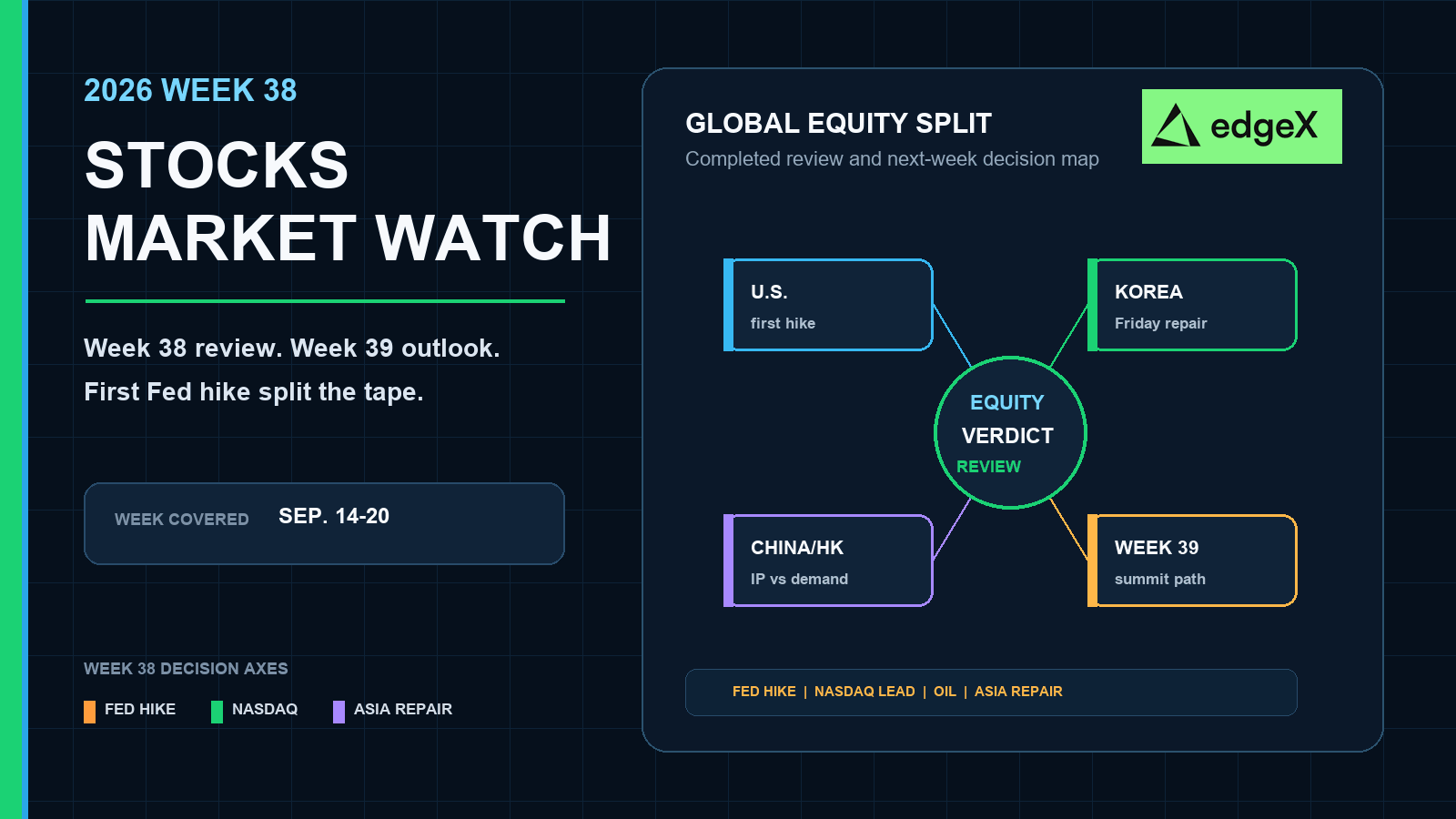
Week 38 confirmed that a fully priced first hike can still rearrange leadership. The Fed delivered 25 bp to 3.75%–4.00%, flagged more tightening, and left the 2-year yield at a 52-week high near 4.74% while the Nasdaq still posted a weekly gain. The Dow’s 1.7% decline and another week of equity-fund outflows showed that rate-sensitive and cyclical groups paid the cost of capital reset. Korea absorbed hawkish Fed follow-through with heavy foreign selling into Thursday, then rebound on Friday as chips tracked Nasdaq strength and softer Brent. Mainland China kept the harder confirmation problem: strong industrial output against weak retail sales and a deeper investment slump. Hong Kong participated in Friday’s risk repair near 24,751 without reversing the prior week’s lower base. Week 39 therefore starts with policy digestion and a U.S.–China summit window, not an open rerating: yields, oil, Korean flows, and Chinese demand will decide whether Nasdaq leadership becomes global breadth.
Week 38 Put the First Fed Hike, Oil Near $100, and Asia Repair on the Same Tape
Week 38 shifted attention from whether the Fed would hike to how equities would live with a restart of tightening. Investors entered with hike odds already elevated after Week 37’s CPI, PPI, and oil shock. They left with a delivered 25 bp move, a still-hawkish SEP path, a Nasdaq weekly gain, and unfinished breadth as the Dow, Russell 2000, and several cyclical sectors stayed under pressure. U.S. equities sold Wednesday’s decision, repaired Thursday, then faded Friday as yields bounced again. Asia followed the same sequence: Korea and Hong Kong weakened into the hawkish package, then used softer crude and a U.S. tech rebound to repair into the weekend.
U.S. indexes finished mixed after the first hike in three years
Investrade’s Friday wrap put closes at 7,650 on the S&P 500 (+0.16%), 51,680 on the Dow (−0.19%), 26,522 on the Nasdaq (+0.39%), and 2,860 on the Russell 2000 (−0.50%). The same review locked the weekly scoreboard: S&P 500 −0.1%, Dow −1.7%, Nasdaq +0.7%. Trading Economics’ Monday summary rounded the same week as Dow −1.69%, S&P −0.08%, and Nasdaq +0.72%.
The package left the Dow on a third straight losing week and the Nasdaq as the only major average with a clear weekly advance. Transports, small caps, Industrials, and Consumer Discretionary were described as down five straight weeks, so Nasdaq resilience did not equal broad participation. Early-week AI-lab caution and Wednesday’s hawkish delivery hit rate-sensitive and cyclical groups harder than the largest technology weights.
Korea repaired Thursday’s Fed flush while China and Hong Kong traded a demand split
The KOSPI closed September 18 at 6,894.23, up 2.66%, after Thursday’s near-flat finish at 6,715.41. Seoul Economic Daily tied Thursday’s heavy foreign selling—about 2.28 trillion won for a seventh straight session—to the Fed’s first hike and the signal of more tightening. Friday’s rebound was chip-led: Samsung Electronics rose about 3.0% and SK hynix about 5.6% as Nasdaq strength, softer Brent, and talk that new U.S. industrial-capacity tariffs may wait until after the Trump–Xi meeting reduced near-term trade risk.
Hong Kong finished Friday at 24,751, up 0.60%, with technology names leading after Wall Street’s overnight repair and Brent falling below $104. That still left the Hang Seng slightly below the Week 37 area near 24,806. Mainland China did not get a clean equity confirmation from the September 15 activity package. Industrial production accelerated to 5.2% year over year, but retail sales slowed to 0.4% and January–August fixed-asset investment fell 7.2%, with property investment near −19.9%. The Shanghai Composite Friday area near 3,912 (+0.94% on the day) showed session repair without converting the activity split into a verified broad demand rally.
Week 38 Global Equity Dashboard
| Market | Completed Week 38 evidence | What the result means |
|---|---|---|
| S&P 500 | −0.1% for the week; Friday close 7,650 after +0.16% | First hike absorbed without restoring breadth |
| Nasdaq Composite | +0.7% for the week; Friday +0.39% to 26,522 | AI/tech duration still found buyers after the hawkish flush |
| Dow Jones Industrial Average | −1.7% for the week; Friday close 51,680 | Cyclical and rate-sensitive damage outweighed Nasdaq leadership |
| KOSPI | Friday close 6,894.23, +2.66% day, after Thursday 6,715.41 | Foreign selling into the Fed met a chip-led Friday repair, not a full reclaim of 6,909.91 |
| Mainland China | IP +5.2%, retail +0.4%, FAI −7.2%; Shanghai Friday area ~3,912 | Factory strength without consumption/investment confirmation kept demand open |
| Hang Seng | Friday close 24,751, +0.60% day, versus Week 37 area ~24,806 | Offshore risk appetite improved with oil and U.S. tech, but the weekly base stayed soft |
The Fed Restarted Tightening and Markets Repriced the Path, Not Just the Print
The September 16 decision was the week’s decisive policy event for stocks. The Committee raised the funds range by 25 bp to 3.75%–4.00% on a unanimous vote and published a SEP package that left most participants penciling in another 2026 hike. Chair Kevin Warsh’s first major tightening delivery mattered as much as the print: after arriving with a roadmap associated with lower borrowing costs, he oversaw the first increase in more than three years and left markets expecting more could follow.
That message showed up immediately in rates. By Friday the 10-year sat at 4.995%, the 2-year at 4.741%, and the curve had flattened toward its narrowest 2s/10s gap since March 2025. Investrade’s wrap put December hike odds near 90% and October odds near 55%. A delivered, widely expected move still raised the terminal-path debate. The Bank of England’s hold at 3.75% and the Bank of Japan’s 25 bp rise to 1.25% added a synchronized global-tightening backdrop even as the yen sold off initially on patient dissent from two BOJ members.
Growth data did not give the Fed an easy off-ramp
August retail sales rebounded 1.2% to $773.9 billion, beating consensus and reversing July’s decline. That resilient demand print arrived on the same day as the hike and reinforced Warsh’s inflation fight. August industrial production was unchanged against a +0.3% consensus, so factories were softer than shoppers. The mix kept equities in a familiar bind: demand firm enough to support earnings, while oil near $100, record diesel at $6.29 a gallon, and a 52-week high in the 2-year keep the discount rate elevated.
Fund flows and leadership confirmed selective risk appetite
Lipper data cited in Friday’s wrap showed $31.44 billion of equity-fund outflows, the fourth consecutive week of redemptions. Nasdaq’s weekly gain therefore coexisted with distribution and multi-week downtrends in transports, industrials, discretionary, and small caps. Warren Buffett’s September 18 step-down as Berkshire Hathaway chairman, with Howard Buffett succeeding under the established plan, added a succession headline without changing the week’s rate-and-oil drivers.
Asia Needed Flow Repair and Demand Confirmation After the Hawkish Handoff
China’s midweek activity package clarified the regional equity problem more than it solved it. Strong industrial production raised confidence that manufacturing supply is still expanding, while soft retail sales and a deeper fixed-asset investment decline kept household demand and property transmission unresolved. Equities could firm Friday on global risk appetite without proving that mainland earnings revisions are turning on domestic consumption. That helps explain Hong Kong’s limited weekly repair: the Hang Seng participated in the oil-and-tech bounce to 24,751 but remained slightly below the prior area near 24,806.
Korea’s Thursday flush and Friday reclaim showed the Fed-to-chip channel
Thursday’s foreign selling into 6,715.41 left the KOSPI as the clearest regional stress marker after the hike. Friday’s jump to 6,894.23, led by Samsung and SK hynix, showed that U.S. tech repair, softer crude, and summit-related tariff patience can reopen Korean risk appetite quickly. The rebound did not fully reclaim Week 37’s 6,909.91 close, so Korea ended repaired but not vindicated. Memory names again tracked the Nasdaq handoff.
What Week 38 Changed for Global Stock Selection
The first hike rearranged leadership more than it collapsed indexes. Nasdaq proved that AI-linked duration can survive a hawkish restart if real yields stabilize after the initial flush. The Dow, Russell 2000, and several cyclical sectors showed that the cost of capital still bites where earnings duration is shorter or oil sensitivity is higher. Regional selection remained a choice among U.S. tech leadership, Korean memory beta after foreign selling, mainland China’s factory-versus-demand split, and Hong Kong liquidity around the summit week. A healthy global advance would need U.S. gains beyond the Nasdaq, Korean breadth above the midweek flush, and Chinese consumption or policy support rather than only industrial output. Week 38 met only part of it.
Week 39 Outlook: Summit Diplomacy, Hike Digestion, and Asia Confirmation Must Broaden the Signal
Week 39 runs from September 21 through September 27. It tests whether Week 38’s first-hike digestion stabilizes into broader equity participation or whether another leg higher in real yields and oil keeps leadership thin. The base case is selective consolidation after a delivered hike: Nasdaq leadership can persist if credit holds, while Asia needs Friday’s repair to survive the Trump–Xi meeting window without a fresh tariff or crude shock.
The U.S. calendar is lighter on formal FOMC drama and heavier on follow-through. Markets will weigh October 28 and December 9 hike odds after Warsh’s hawkish first move, alongside oil, diesel, and the near-5% 10-year. A calm digestion with contained real yields would let quality growth stabilize and could reopen cyclical breadth. Another yield spike or a renewed crude push above Week 38’s Friday settles would keep the Dow and small caps under pressure. Korea’s foreign-flow streak and chip leadership test whether Friday’s reclaim toward 6,894 holds. China activity and Hong Kong liquidity will show whether strong IP can attract capital into the summit week, or whether weak retail and investment keep upside capped.
Treat the week as a sequence: summit headlines set the trade-risk backdrop, U.S. yields and oil show whether the first hike is digested, and Asia closes show whether Friday’s repair was a flush reverse or broader confirmation. The constructive case is stable credit, contained oil, ended Korean outflows, and firmer Chinese demand around the Trump–Xi meeting. The downside is a hawkish repricing toward more than one additional hike, sticky diesel and crude, another KOSPI foreign-selling leg, and no consumption repair in China. Confirmation needs better U.S. breadth, steadier Korean flows, Hang Seng follow-through above the mid-24,700s, and gains beyond the largest tech weights.
U.S. hike digestion will decide whether Nasdaq leadership becomes index breadth
A delivered hike is not automatically equity-negative if the 2-year stops making new highs and oil stays below a fresh spike. Nasdaq’s weekly gain already showed that AI earnings duration can coexist with tightening if the path is not disorderly. A second wave of terminal-rate repricing while diesel stays at record levels would extend Week 38’s Dow and small-cap damage. One quiet data week will not erase the SEP’s extra-hike signal; it will decide whether that signal is priced.
Korea needs the foreign-selling streak to end and China needs demand, not only IP
Korean equities need cooler foreign selling after seven straight outflow sessions into Thursday, plus memory and equipment breadth that holds the Friday reclaim. Contained oil would help directly. Mainland China and Hong Kong need consumption, property stabilization, or explicit policy support around the summit window, not only another factory beat. Better retail or investment evidence would support onshore benchmarks and could stabilize the Hang Seng after the soft base near 24,751.
Week 39 Decision Map
| Week 39 setup | U.S. stocks | South Korean stocks | Mainland China and Hong Kong |
|---|---|---|---|
| Stable yields, contained oil, calm summit tone | Nasdaq leadership can broaden into cyclicals if credit holds | Chip rebound holds above midweek 6,715 if foreign selling cools | Hong Kong liquidity improves; mainland still needs retail/FAI repair |
| Higher real yields and another diesel/oil push | Tech may outperform on relative duration while Dow/small caps stay weak | Memory keeps relative strength, but flows and energy costs limit upside | Cost-push and trade anxiety keep China/HK fragile despite strong IP |
| Fresh tariff shock around the Trump–Xi window | Export-sensitive industrials and multinationals underperform | KOSPI stays exposed through chips and trade-capacity headlines | Hang Seng and onshore risk appetite weaken even if factories stay firm |
| Better Korean flows and firmer China demand | Semicap and industrial suppliers gain confirmation beyond mega-cap AI | Leadership broadens beyond Samsung and SK hynix | CSI/Shanghai and Hang Seng get stronger earnings and liquidity support |
The constructive Week 39 scenario needs orderly Fed digestion, contained energy prices, Korean flow repair after Thursday’s flush, and clearer Chinese demand around the summit. Failure would turn Week 38’s Nasdaq resilience into another narrow advance under a higher policy bar. Closes, breadth, currencies, and yields will show if the Friday repair held.
Trade Stocks Without the TradFi Gatekeeping
The stock market moves fast. Your trading infrastructure should too.
As RWA markets mature and stock-linked perpetual markets attract more attention, traders are examining alternatives to conventional brokerage access and custody models.
edgeX Exchange offers a decentralized perpetual-futures venue where eligible users can trade stock-linked markets while retaining control of their assets. The platform combines self-custody, an order-book trading experience, USDC settlement, and mobile access.
- Self-custody: users retain control of their private keys.
- Order-book execution: the platform is designed for high-speed trading and deep liquidity.
- No traditional brokerage onboarding: access does not depend on a conventional securities account.
- USDC settlement: positions use a familiar dollar-linked settlement asset.
- Mobile access: edgeX is available on iOS and Android.
Stock-linked perpetuals carry leverage, liquidity, smart-contract, oracle, and market risks and do not represent ownership of the underlying shares. Availability may vary by jurisdiction. Explore markets on edgeX.
Frequently Asked Questions
What defined the stock market in Week 38?
The Fed’s first hike in more than three years defined the week. A unanimous 25 bp rise to 3.75%–4.00%, a hawkish SEP path, yields near 5% on the 10-year, and oil still above $100 split leadership: Nasdaq finished higher for the week while the Dow and S&P finished lower. Korea and Hong Kong repaired into Friday after midweek stress, and China’s activity package stayed split between strong industrial production and weak retail/investment.
How did U.S. stocks perform in Week 38?
The Nasdaq rose about 0.7%, the S&P 500 slipped 0.1%, and the Dow fell 1.7%. Friday closes were 26,522 on the Nasdaq, 7,650 on the S&P 500, 51,680 on the Dow, and 2,860 on the Russell 2000. Breadth stayed thin, with several cyclical sectors extending multi-week downtrends.
Why did the KOSPI rebound on Friday after the hawkish Fed?
Thursday’s foreign selling into 6,715.41 reflected the hike and the signal of more tightening. Friday’s jump to 6,894.23 was led by Samsung and SK hynix as Nasdaq strength, softer Brent, and summit-related tariff patience improved risk appetite. The rebound repaired the flush without fully reclaiming the prior week’s 6,909.91 close.
What happened in Chinese and Hong Kong equities?
China’s August industrial production rose 5.2% y/y, but retail sales slowed to 0.4% and January–August fixed-asset investment fell 7.2%. The Hang Seng closed September 18 at 24,751, up 0.60% on the day, slightly below the Week 37 area near 24,806. The Shanghai Composite’s Friday area near 3,912 showed session strength without converting the demand split into a verified broad weekly recovery.
What is the base case for stocks in Week 39?
The base case is selective consolidation after a delivered hike. Nasdaq leadership can persist if yields and oil stay orderly, but U.S. breadth, Korean foreign flows, and Chinese demand around the Trump–Xi meeting must improve before a synchronized global rally becomes credible.
What would invalidate the constructive Week 39 outlook?
A renewed terminal-rate repricing, another oil or diesel spike, a fresh tariff shock around the summit, resumed Korean foreign selling after Thursday’s flush, and no improvement in Chinese retail or investment would keep leadership narrow and expose the unfinished breadth problem left by Week 38.

