Week 37 Stocks Market Watch: CPI, Oracle AI, and Oil Raised the Rate Bar
Key Takeaways
- •Oracle's fiscal first-quarter results showed total revenue of $19.35 billion, up 30% year over year, with cloud infrastructure revenue surging 121% to $7.4 billion and remaining performance obligations climbing to $664 billion.
- •August U.S. producer prices rose 5.4% year over year, CPI advanced 3.4% annually, and WTI crude settled at $100.05 after an approximately 8% weekly gain, lifting September Fed-hike odds to roughly 90%.
- •U.S. benchmarks posted weekly declines of 0.8% for the S&P 500, 1.6% for the Dow, and 0.7% for the Nasdaq despite a Friday rebound that snapped a four-session losing streak.
- •Korea's KOSPI closed September 11 at 6,909.91, falling below 7,000 for the first time in months, as Samsung Electronics and SK Hynix dropped 3.9% and 3.4% under oil, foreign-flow, and currency pressure.
- •Lipper data cited in Friday's wrap showed $32.27 billion of net weekly equity-fund selling, the largest disposal since mid-December 2025, including record large-cap outflows of $40.44 billion.
Quick Answer
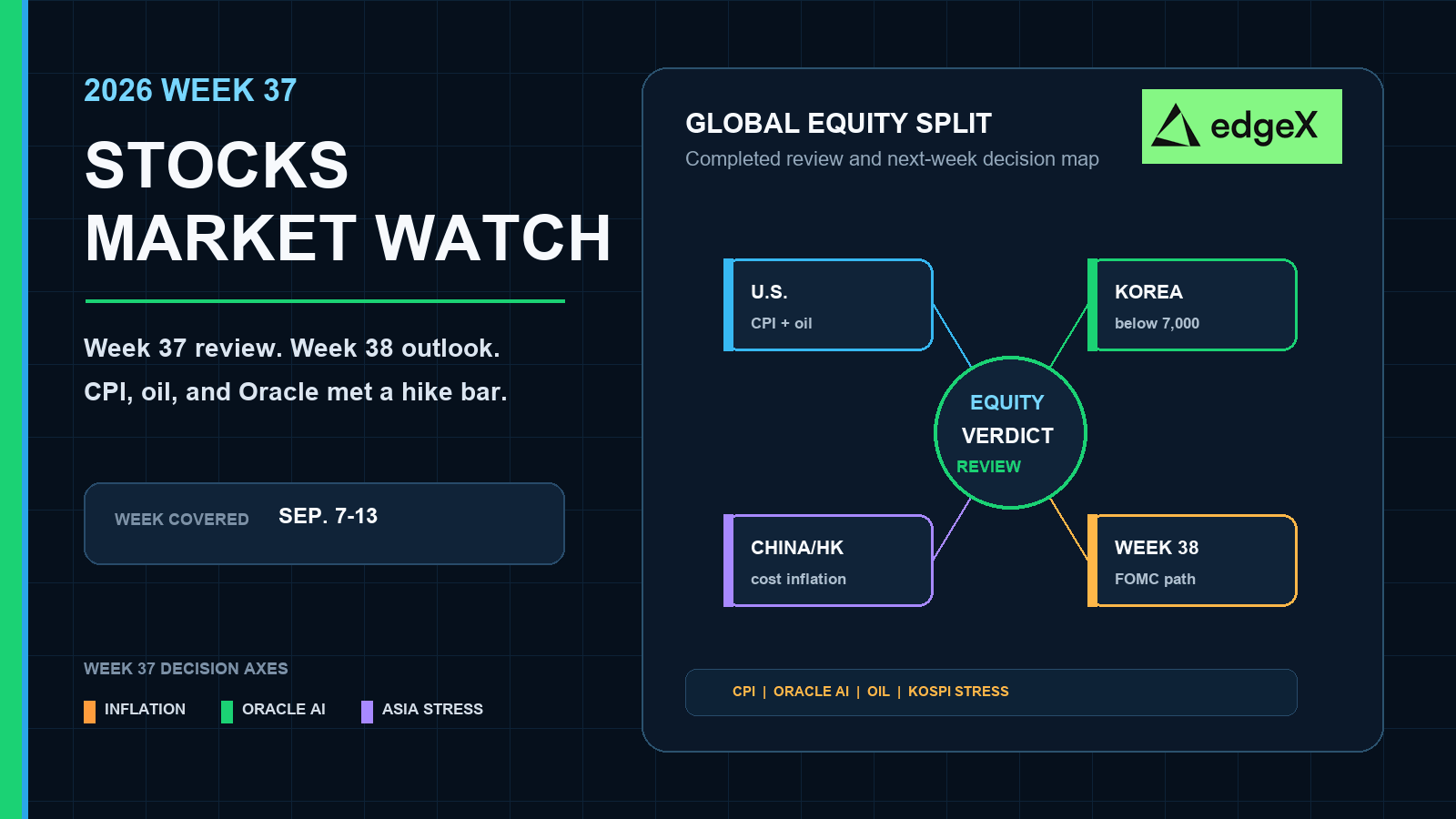
Week 37 confirmed that AI earnings strength can survive a hawkish inflation week without protecting index returns. Oracle’s triple-digit cloud-infrastructure growth reinforced the case for continued AI capital spending, while August U.S. PPI and CPI, an oil surge toward $100-plus crude, and equity-fund outflows raised the discount-rate constraint into the September FOMC. U.S. benchmarks finished lower for the holiday-shortened week even after Friday’s rebound. Korea’s KOSPI broke below 7,000 under oil and flow pressure. Hong Kong retreated from the prior week’s 25,651 close, and mainland equities still lacked a clearly verified demand-led weekly recovery after energy-driven Chinese inflation prints. Week 38 therefore starts with a policy decision, not an open AI rerating: the FOMC path, yields, and Asia stress relief will decide whether selective AI leaders can lift global breadth.
Week 37 Put Inflation, Oil, and AI Earnings on the Same Tape
Week 37 shifted attention to the interaction among inflation, oil, interest rates, and technology earnings. Investors weighed whether price pressures would ease enough to reduce the expected policy burden when the U.S. data arrived. They left with a firmer expected policy path, a still-powerful Oracle AI print, and unfinished global breadth as oil turned the inflation week into a multi-asset stress test.
U.S. equities spent most of the shortened week giving back ground as yields and crude rose, then recovered part of the damage on Friday when the Consumer Price Index matched the headline consensus and oil pulled back. Indexes still finished lower, leaving the September FOMC as the next hard gate. Asia did not get relief: Korea cracked a key level, and China/Hong Kong traded energy-led inflation without a completed demand repair.
U.S. indexes finished lower after a four-day slide and a Friday repair
Session coverage put Friday’s closes at 7,656 on the S&P 500 (+0.86%), 52,657 on the Dow (+0.98%), 26,333 on the Nasdaq (+0.96%), and 2,903 on the Russell 2000 (+0.45%). The same wrap reported the weekly scoreboard: S&P 500 −0.8%, Dow −1.6%, Nasdaq −0.7%. Seeking Alpha’s weekly note put the S&P close at 7,656.98, about 1.8% below the August 13 record high. Friday stopped a four-session losing streak without reversing oil, yield, and Fed-hike pressure.
Korea cracked 7,000 while Hong Kong and mainland China absorbed the global rate impulse
The KOSPI closed September 11 at 6,909.91, down 1.76% on the day and below 7,000 for the first time in months, according to Asia session coverage. Samsung Electronics fell 3.9% and SK Hynix 3.4% as oil, hotter U.S. inflation, and near-certain Fed-hike pricing hit energy importers and chip exporters together. Foreign flows and the won amplified the drawdown; AI-linked memory names did not immunize the benchmark.
Hong Kong finished the week lower. Trading Economics put the Hang Seng area near 24,806 on September 11, down 0.60% on the day and well below the Week 36 Friday close of 25,651. Session notes also had the Hang Seng about 0.66% lower on Friday while the Shanghai Composite fell about 1.20%, with onshore pressure harder than offshore. Mainland Chinese equities did not produce a clearly verified broad weekly advance alongside the inflation print. Energy-led CPI and PPI explained cost pressure better than household-demand healing.
Week 37 Global Equity Dashboard
| Market | Completed Week 37 evidence | What the result means |
|---|---|---|
| S&P 500 | −0.8% for the week; Friday close 7,656.98 after +0.86% rebound | AI support and Friday repair could not offset oil, PPI, and hike-odds pressure |
| Nasdaq Composite | −0.7% for the week; Friday +0.96% to 26,333 | Cloud/AI earnings credibility held; duration multiples still paid a higher rate cost |
| Dow Jones Industrial Average | −1.6% for the week; Friday +0.98% to 52,657 | Broader sector mix absorbed more of the oil and yield shock than pure AI beta |
| KOSPI | September 11 close 6,909.91, −1.76% on the day, below 7,000 | Oil, flows, and Fed-hike pricing outweighed the global AI demand handoff |
| Mainland China | Energy-led CPI 0.8% and PPI 3.8%; full-week index % not uniformly verified | Cost inflation arrived without a clean consumption-led equity confirmation |
| Hang Seng | September 11 area near 24,806 versus Week 36 close 25,651 | Offshore benchmark reversed the prior week’s repair under global yields and China stress |
Oracle Extended the AI Infrastructure Case Under a Higher Discount Rate
Oracle’s fiscal first-quarter release supplied the week’s clearest company-level AI checkpoint. Total revenue reached $19.35 billion, up 30% year over year. Cloud revenue rose 62% to $11.6 billion. Cloud infrastructure revenue jumped 121% to $7.4 billion. Adjusted EPS was $1.92, up 30% year over year. Remaining performance obligations climbed to $664 billion, up $209 billion from a year earlier, and the company booked more than $30 billion in new AI cloud contracts.
Shares jumped about 7% after hours, while free cash flow of −$5.4 billion and capital spending of about $28.5–$28.6 billion kept the funding debate alive. Oracle raised the full-year revenue floor to at least $90 billion and guided fiscal second-quarter revenue growth of 30% to 34%. The package reduced the chance of an immediate AI-capex air pocket without removing cash-burn or valuation risk, and without lifting the S&P 500 or KOSPI into a clean weekly gain.
Earnings certainty rose; index certainty did not
Oracle raised confidence that hyperscaler demand is still converting into cloud revenue and backlog. U.S. mega-cap suppliers could still argue for earnings duration, while Korean memory stayed exposed to flows, oil, and the won. Hong Kong technology remained sensitive to offshore liquidity, and mainland technology still needed local orders. Without broader breadth, Week 37 stayed strong on AI evidence and weak on global participation.
Inflation and Oil Repriced the Discount Rate
The August price sequence was the week’s decisive macro event for stocks. Producer prices rose 0.4% on the month and 5.4% over the year. Friday’s CPI printed +0.4% headline and +3.4% year over year, in line, while core rose 0.3% month over month to +2.4% year over year. The package was firm enough, alongside the oil spike, to push September hike odds toward about 90% and leave the 10-year near 4.975%.
Oil did as much work as the survey prints. WTI settled Friday at $100.05 and Brent at $104.61 after both benchmarks gained about 8% on the week. Middle East headlines kept a risk premium in crude even as Friday’s pullback helped equities repair. Growth stayed visible while the cost of capital rose. Michigan sentiment at 47.8 and one-year inflation expectations at 4.6% reinforced household caution without a pure recession tape.
Fund flows confirmed the risk reset
Lipper data cited in Friday’s wrap showed $32.27 billion of net equity-fund selling, the largest weekly disposal since mid-December 2025, including record large-cap outflows of $40.44 billion. An FOMC hike into elevated yields would therefore land on a market already de-risking, where AI single-stock strength can coexist with index-level distribution.
Asia Still Needed Demand Confirmation Beyond the AI Handoff
China’s midweek inflation package clarified cost pressure more than final demand. August CPI accelerated to 0.8% year over year from 0.5%, and PPI rose 3.8% from 3.5%, according to NBS-linked reports. Energy did much of the consumer-side work, while food stayed soft and factory-gate inflation reflected commodities more than household recovery. Equities could firm briefly without proving broader mainland earnings revisions.
That helps explain Hong Kong’s reversed repair and mainland fragility into Friday’s deeper onshore decline. Week 37 left Asia as an open confirmation issue into the FOMC week.
Korea’s break of 7,000 showed the oil-to-equity channel
Friday’s break through 7,000, led by Samsung and SK Hynix, left the KOSPI as the clearest regional stress marker. South Korea’s exposure to imported energy costs can transmit a Middle East supply premium into equity, currency, and foreign-flow volatility. Oracle and the broader AI infrastructure demand case support long-run memory earnings; they do not stabilize Korea when oil is up about 8% and U.S. hike odds are near 90%.
What Week 37 Changed for Global Stock Selection
AI earnings and inflation pulled equities in opposite directions. Oracle raised confidence in infrastructure demand; CPI, PPI, oil, and outflows raised the cost of capital. Regional selection remained a choice among U.S. earnings duration, Korean memory beta, mainland China demand transmission, and Hong Kong liquidity.
A healthy global advance would need U.S. gains beyond the largest AI names, Korean breadth after the 7,000 break, and Chinese consumption strength rather than only cost-push inflation. Week 37 did not meet that standard, leaving a constructive AI core and a harder policy bar into Week 38.
Week 38 Outlook: FOMC, Global Tightening, and Asia Stress Relief Must Broaden the Signal
Week 38 runs from September 14 through September 20. It tests whether Week 37’s inflation-and-oil shock hardens into a multi-week de-rating or stabilizes once the FOMC delivers, and whether Asia can reverse the KOSPI and Hang Seng drawdowns without another crude spike. The base case is selective volatility around a widely expected U.S. hike: AI remains supportive after Oracle, while elevated yields and energy risk keep valuation expansion narrow.
The U.S. calendar centers on the September 15–16 FOMC, then retail sales, industrial production, regional surveys, and claims. After a 0.8% weekly S&P decline and near-5% 10-year yields, even a priced hike can move equities through tone on inflation, oil, and further tightening. A calm delivery with contained real yields would stabilize quality growth and AI infrastructure. A hawkish surprise or another oil jump would keep leadership thin. Korea’s won, flows, and chip leadership test whether Oracle demand reaches memory without energy sabotage. China activity and Hong Kong liquidity will show whether the energy-led CPI and PPI readings prompt policy support and improved earnings expectations, or instead deepen margin pressure.
Treat the week as a sequence: FOMC sets the rate backdrop, BOE and BOJ decisions add confirmation, and Asia closes show whether Week 37 stress was a flush or deeper de-risking. The constructive case is a delivered hike, stable credit, softer oil, steadier Korean flows, and firmer Chinese demand. The downside is a hawkish package plus sticky crude, another KOSPI leg lower, and weak China demand. Confirmation needs better breadth, stable credit, a steadier won, Hang Seng repair, and gains beyond the largest technology weights.
U.S. policy tone will decide whether CPI becomes a lasting multiple problem
A widely expected hike is not automatically equity-negative if real yields stabilize and the Committee avoids an open-ended oil-chasing cycle. Labor and inflation strength need not force an immediate collapse in AI multiples after Oracle’s backlog print. A door left open to repeated hikes while crude stays near $100 a barrel would extend Week 37’s de-rating into rate-sensitive groups. One meeting will not erase the August CPI/PPI baseline; it will decide whether that baseline is already priced.
Korea needs flow repair and China needs demand transmission
Korean equities need cooler foreign selling and won pressure after the 7,000 break, plus memory and equipment breadth beyond the two largest chipmakers. Stable or lower oil would help directly. Mainland China and Hong Kong need activity and earnings evidence, not only energy-driven price indexes. Better consumption, investment, or exports would support onshore benchmarks and could stabilize the Hang Seng after the drop from 25,651 toward the 24,800 area.
Week 38 Decision Map
| Week 38 setup | U.S. stocks | South Korean stocks | Mainland China and Hong Kong |
|---|---|---|---|
| Delivered hike, stable yields, softer oil | AI and quality leaders stabilize; breadth can improve if credit holds | Chip and export names recover if won/flows stabilize after the 7,000 break | Lower global rate stress helps Hong Kong; mainland still needs demand proof |
| Hawkish FOMC tone and rising real yields | Earnings leaders outperform while long-duration and small-cap multiples compress | Memory may hold relative strength, but oil and outflows limit index repair | Hong Kong technology faces valuation pressure; onshore policy trades may diverge |
| Another oil spike with sticky inflation | Energy up, broad equities down; AI duration stays expensive to own | KOSPI remains one of the most exposed major benchmarks | Cost-push inflation without demand healing keeps China/HK fragile |
| Better Korean flows and firmer China demand | U.S. industrial and semiconductor suppliers gain confirmation | Leadership broadens beyond the two largest chipmakers | CSI 300 and Hang Seng receive stronger earnings and liquidity support |
The constructive Week 38 scenario needs a non-disorderly FOMC delivery, contained oil, broader Korean participation after the 7,000 break, and firmer Chinese demand. Failure would turn Week 37’s Oracle confirmation into a short-lived AI bounce under a higher policy bar. Closes, breadth, currencies, and yields will show whether the initial reaction held.
Trade Stocks Without the TradFi Gatekeeping
The stock market moves fast. Your trading infrastructure should too.
As RWA markets mature and stock-linked perpetual markets attract more attention, traders are examining alternatives to conventional brokerage access and custody models.
edgeX Exchange offers a decentralized perpetual-futures venue where eligible users can trade stock-linked markets while retaining control of their assets. The platform combines self-custody, an order-book trading experience, USDC settlement, and mobile access.
- Self-custody: users retain control of their private keys.
- Order-book execution: the platform is designed for high-speed trading and deep liquidity.
- No traditional brokerage onboarding: access does not depend on a conventional securities account.
- USDC settlement: positions use a familiar dollar-linked settlement asset.
- Mobile access: edgeX is available on iOS and Android.
Stock-linked perpetuals carry leverage, liquidity, smart-contract, oracle, and market risks and do not represent ownership of the underlying shares. Availability may vary by jurisdiction. Explore markets on edgeX.
Frequently Asked Questions
What defined the stock market in Week 37?
Oil, U.S. inflation, and Oracle’s AI cloud beat defined the week. Crude’s roughly 8% weekly gain and firm PPI/CPI prints raised September Fed-hike odds, while Oracle’s 121% cloud-infrastructure growth kept the AI earnings case alive. U.S. indexes finished lower for the holiday-shortened week, Korea broke below 7,000, and Hong Kong reversed the prior week’s repair.
How did U.S. stocks perform in Week 37?
The S&P 500 fell 0.8%, the Dow 1.6%, and the Nasdaq 0.7% for the week. Friday’s CPI rebound lifted the S&P 0.86% to 7,656.98 and snapped a four-day losing streak, but it did not erase the weekly decline ahead of the FOMC.
Why did the KOSPI break below 7,000 despite Oracle’s AI confirmation?
Oracle supported the long-run memory and cloud-infrastructure demand case, but Korea remained exposed to oil, foreign flows, and currency conditions. The KOSPI closed September 11 at 6,909.91, down 1.76% on the day, with Samsung and SK Hynix falling more than 3% in the session.
What happened in Chinese and Hong Kong equities?
China’s August CPI rose to 0.8% y/y and PPI to 3.8% y/y on energy and commodity pressure rather than a completed demand recovery. The Hang Seng area near 24,806 on September 11 stood well below the prior week’s 25,651 close, and Friday’s onshore decline was harder than Hong Kong’s.
What is the base case for stocks in Week 38?
The base case is selective volatility around a widely expected FOMC hike. AI earnings remain supportive after Oracle, but U.S. policy tone, oil, Korean flows, and Chinese demand must broaden the signal before a synchronized global rally becomes credible.
What would invalidate the constructive Week 38 outlook?
A hawkish FOMC surprise, another oil spike, weak semiconductor follow-through, continued Korean outflows after the 7,000 break, and disappointing Chinese activity would pressure long-duration shares and expose the unfinished global breadth problem left by Week 37.

