Dow Posts Third Straight Weekly Loss as 10-Year Treasury Yield Nears 5%
Key Takeaways
- •The Dow Jones Industrial Average fell 0.2% to 51,682.64, posting its third consecutive weekly loss and its weakest week since March, while the S&P 500 gained 0.2% and the Nasdaq rose around 0.4% on Friday.
- •The 10-year Treasury yield ended the week at 4.995%, just under the widely watched 5% threshold, and the 2-year yield closed at 4.741%, its highest level since July 2024.
- •The Federal Reserve raised its benchmark rate by 25 basis points on Wednesday, the central bank's first increase in three years, and CME FedWatch data showed a 47.1% probability of another quarter-point hike through December.
- •Oil prices retreated below $100 a barrel on Friday, though energy markets remain sensitive to disruptions linked to the war in Iran and shipping through the Strait of Hormuz.
- •Semiconductor shares recovered from earlier pressure that followed Anthropic and OpenAI's calls for a slower pace of AI development over safety concerns, with the PHLX Semiconductor Index finishing the week slightly higher.
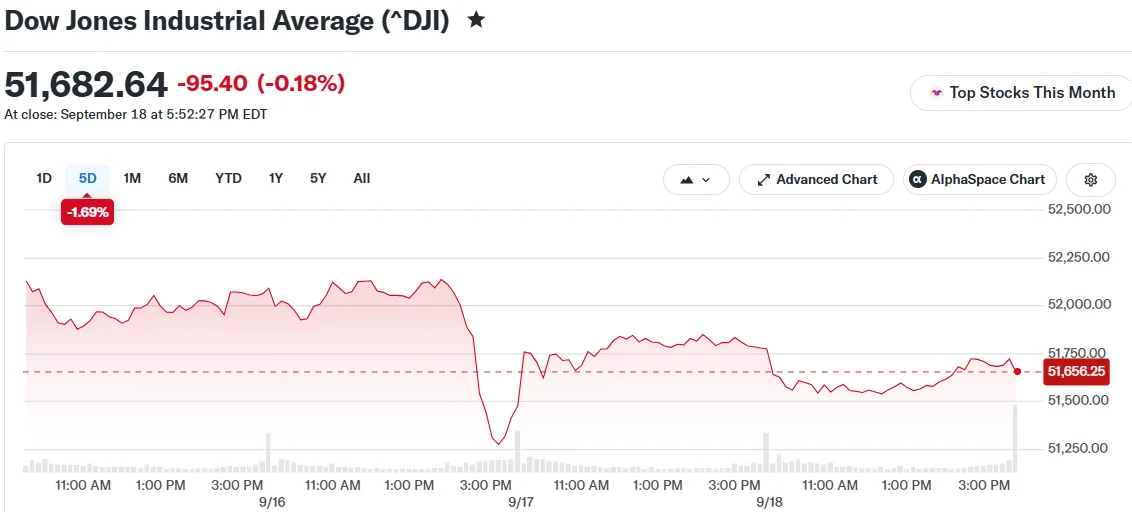
U.S. stocks ended Friday mixed as investors continued to assess higher interest rates, bond yields approaching 5% and the outlook for inflation.
The Dow Jones Industrial Average fell about 0.2% to 51,682.64, leaving the index lower for a third consecutive week. It was also the Dow's weakest week since March. The S&P 500 gained 0.2% to close at 7,650.50, but still finished the week slightly lower. The Nasdaq Composite rose around 0.4% and ended the week with a gain.
Treasury Yields Climb After First Fed Hike in Three Years
Bond yields remained one of the main pressures on stocks. The 10-year Treasury yield ended the week at 4.995%, putting it just below the 5% level, a widely watched threshold because the 10-year rate anchors mortgage pricing and long-term borrowing costs across the economy.
The 2-year Treasury yield closed at 4.741%, its highest 3 p.m. close since July 1, 2024, according to Dow Jones Market Data.
U.S. 2-Year Treasury Yield jumps to 4.76%, the highest level since July 2024 📈 📈 pic.twitter.com/YUHLoLwrkC
— Barchart (@Barchart) September 19, 2026
https://x.com/Barchart/status/2101218017723949393?ref_src=twsrc%5Etfw
The moves followed the Federal Reserve's decision on Wednesday to raise its benchmark interest rate by 25 basis points, the central bank's first rate increase in three years. The rate influences what consumers and businesses pay to borrow, from credit cards to corporate loans. Traders are now considering whether more increases could follow. CME FedWatch data showed a 47.1% probability of another quarter-point increase and a 42.4% probability of a total half-point of further hikes through December.
Investors remain focused on inflation after recent energy price increases added pressure to consumer and business costs. JPMorgan Chase CEO Jamie Dimon told Yahoo Finance this week that it was still unclear whether inflation had been brought under control.
Oil Retreats Below $100 as Tech and Chip Stocks Recover
Oil prices provided some relief on Friday by moving back below $100 a barrel after previously climbing above that level. Energy markets remain sensitive to disruptions linked to the war in Iran and shipping through the Strait of Hormuz, the key shipping lane between Iran and the Arabian Peninsula that carries a large share of the world's seaborne oil.
Technology stocks performed better than many other parts of the market. Semiconductor shares recovered from losses earlier in the week, and the PHLX Semiconductor Index finished the week slightly higher. Chip stocks had come under pressure after Anthropic and OpenAI called for a slower pace of AI development because of safety concerns.
Morgan Stanley Wealth Management portfolio manager Daniel Skelly said oil prices, high bond yields and the U.S. midterm elections could continue to affect near-term market volatility.
Wall Street will now focus on moves in Treasury yields, oil prices and expectations for the Federal Reserve's October meeting after the Dow recorded its third straight weekly decline.

