Stock Market Today: US Futures Rise as Trump-Xi Summit, Iran Tensions and Fed Policy Take Focus
Key Takeaways
- •U.S. stock futures pointed to a firmer Wall Street open Monday, with Nasdaq 100 futures up about 0.7%, S&P 500 futures gaining roughly 0.5%, and Dow futures rising around 0.4%.
- •President Donald Trump and Chinese President Xi Jinping are scheduled to meet in Washington on Thursday, with trade, tariffs, artificial intelligence, and critical minerals expected to dominate the agenda.
- •Treasury Secretary Scott Bessent met Chinese Vice Premier He Lifeng in New York ahead of the summit, discussing trade and a possible AI safety notification system between the two nations.
- •The Federal Reserve raised its benchmark rate by 25 basis points last week to a target range of 3.75% to 4.00%, its first increase since July 2023, leaving the 10-year Treasury yield trading near 5%.
- •Brent crude fell around 2% Monday despite Iran-backed Houthi missile and drone attacks claimed on Riyadh, as markets assessed reports of stronger Gulf oil flows and the possible restoration of Saudi supply infrastructure.
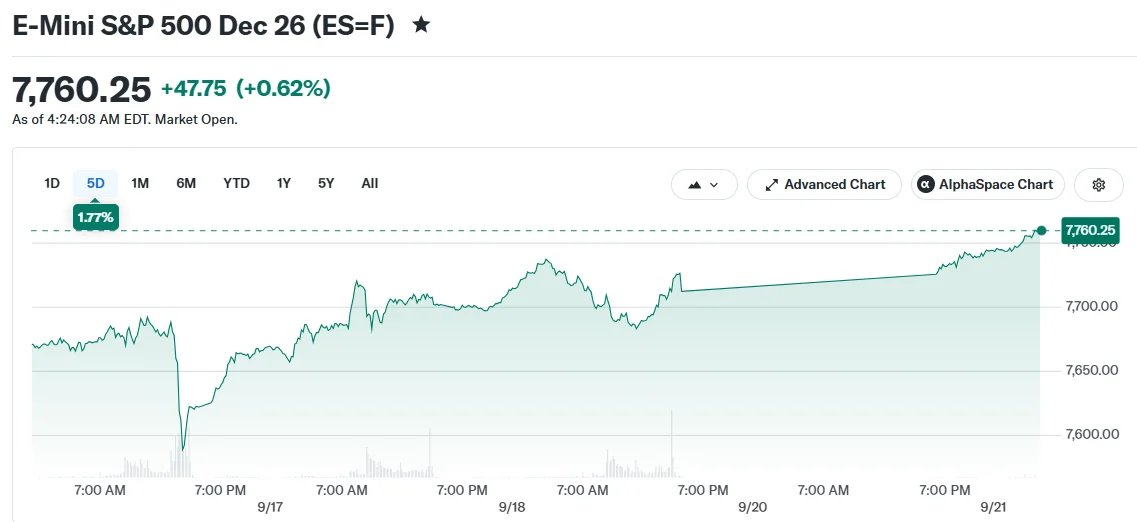
U.S. stock futures moved higher Monday as investors turned their attention to U.S.-China trade talks, renewed Middle East tensions and the outlook for interest rates at the start of a new trading week. S&P 500 futures gained about 0.5%, while Nasdaq 100 futures rose roughly 0.7% and Dow futures climbed around 0.4%, pointing to a firmer open on Wall Street. Futures provide an early read on sentiment before the cash market opens.
The advance followed a difficult stretch for the Dow Jones Industrial Average, which fell about 1.7% last week and recorded its third consecutive weekly decline. The S&P 500 slipped roughly 0.1% over the same period, while the Nasdaq Composite managed a gain of about 0.7%, keeping technology shares at the center of attention.
Trump-Xi Summit Moves Into Focus
Markets are closely watching Thursday's planned meeting between U.S. President Donald Trump and Chinese President Xi Jinping in Washington. China's Foreign Ministry confirmed that Xi will visit the United States from September 23 through September 25. The summit pairs the leaders of the world's two largest economies, and its agenda touches directly on the tariff and technology policies that shape global supply chains.
, tariffs, artificial intelligence, critical minerals and other economic issues are expected to feature in the discussions. Reuters reported that extending the current trade truce is likely to be one of the main topics on the agenda. Critical minerals such as rare earths are essential inputs for semiconductors, electric vehicles and defense applications, which has made their supply a recurring point of friction between Washington and Beijing.
The run-up to the summit was highlighted by Treasury Secretary Scott Bessent, who wrote on X on September 20:
"In New York City, Vice Premier He Lifeng and I are continuing our discussions on the U.S.-China economic and trade relationship ahead of @POTUS' historic summit with President Xi in Washington. These talks help lay the groundwork for President Trump to advance America's economic… pic.twitter.com/phmF11Aoxi"
— Treasury Secretary Scott Bessent (@SecScottBessent), September 20, 2026
Bessent met Chinese Vice Premier He Lifeng in New York ahead of the summit. The two officials discussed trade as well as a possible AI safety notification system between the United States and China — an indication of how artificial intelligence has moved to the core of the bilateral agenda alongside tariffs and minerals.
Asian markets also moved higher Monday. MSCI's Asia-Pacific index excluding Japan gained about 0.9%, with technology shares in South Korea and Taiwan helping to lead the advance. Both economies anchor the global semiconductor supply chain, which is why their equity moves are often read alongside U.S. tech shares.
Middle East Tensions Keep Oil in Focus
Investors are also monitoring the Middle East after Yemen's Iran-backed Houthis claimed missile and drone attacks on Riyadh over the weekend. Saudi Arabian and other Gulf markets declined Sunday following the attacks. The region concentrates a large share of the world's oil production and export capacity, which is why traders watch escalation risk there so closely.
Despite the heightened geopolitical tensions, oil prices moved lower Monday. Brent crude fell around 2%, extending recent declines as markets assessed reports of stronger oil flows from the Gulf and the possible restoration of Saudi supply infrastructure.
Lower oil prices provided some relief for equity markets, as energy costs have been contributing to inflation concerns. The Federal Reserve's policy outlook remains closely tied to inflation and the direction of oil prices.
Fed Policy and Treasury Yields Remain Key
The Federal Reserve raised its benchmark interest rate by 25 basis points last week, lifting the target range to 3.75% to 4.00%. It was the central bank's first rate increase since July 2023. Rate increases work through the economy by lifting borrowing costs for households and businesses.
Treasury yields remain elevated following the move. The 10-year Treasury yield has been trading close to 5%, while markets continue to price the possibility of further Fed tightening later this year. The 10-year underpins borrowing costs from mortgages to corporate loans, and elevated yields tend to weigh hardest on the valuations of growth companies whose earnings sit further in the future.
Technology shares have held up better than the broader market, with chip stocks recovering after weakness earlier last week. Monday's rise in futures continued that pattern, with Nasdaq futures outperforming Dow futures before the opening bell. Chipmakers sit at the intersection of the week's key themes, sensitive to both interest-rate expectations and the trade agenda being discussed in Washington.
Investors will now watch developments in the Middle East, comments from Federal Reserve officials and Thursday's Trump-Xi summit as markets begin the trading week.
Source: CoinCentral

