Stock Futures Gain Ground as Treasury Yields Retreat From Crisis-Era Peaks
Key Takeaways
- •Dow and S&P 500 futures advanced about 0.3% in early Friday trading, while Nasdaq 100 futures gained between 0.5% and 0.6%.
- •The 10-year Treasury yield climbed to its highest level since the 2008-2009 financial crisis on Thursday before beginning to retreat as Friday's session approached.
- •West Texas Intermediate crude fell to roughly $92 per barrel and Brent hovered near $98 after reports of ongoing US-Iran talks over Strait of Hormuz access, dragging down premarket shares of Chevron, Exxon Mobil, Devon Energy, and Occidental Petroleum.
- •Chinese President Xi Jinping's Washington visit, which included a state dinner, ended without new tariff arrangements or bilateral trade compacts, leaving the US-China commercial relationship at the status quo.
- •Questar Capital Partners' Richard Reyle suggested the Federal Reserve may implement additional interest rate increases before year-end, warning that further yield gains from current levels would be negative for stocks.
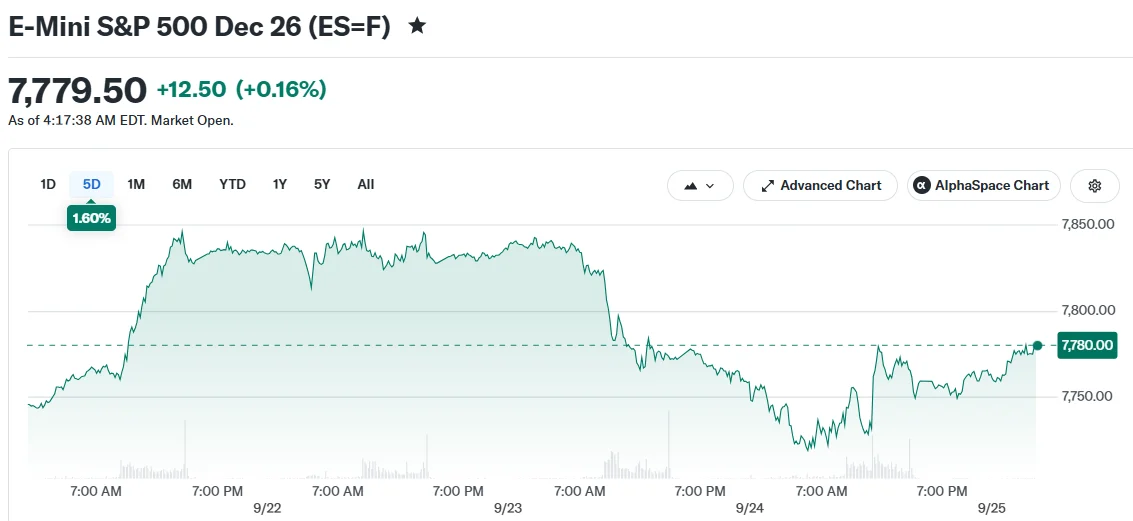
US stock futures posted gains on Friday morning as market participants assessed a combination of economic signals and international developments that have shaped bond markets and energy prices throughout the week. Dow Jones Industrial Average futures and S&P 500 futures each advanced approximately 0.3% in early trading, while futures tied to the Nasdaq 100 showed stronger momentum, gaining between 0.5% and 0.6%.
The positive tone followed a turbulent stretch for equities driven by volatility in fixed-income markets. During Thursday's session, the 10-year Treasury yield climbed to 5.16%, its highest level since the 2008-2009 financial crisis, before beginning to moderate. Crude oil prices also came under pressure, with West Texas Intermediate falling to approximately $92 per barrel, and Chinese President Xi Jinping concluded a Washington visit that produced no significant new trade agreements.
Treasury Yields Moderate After Reaching Multi-Year Peaks
As Friday's session approached, yields showed signs of stabilization. The benchmark 10-year Treasury note retreated to approximately 5.17%, registering a modest decline from Thursday's peak after a series of sharp increases.
The speed of the move drew pointed commentary from market observers. In a post on X, The Kobeissi Letter highlighted how rapidly borrowing costs had climbed:
“Unbelievable. 3 hours later and the 10Y Note Yield is now above 5.20% for the first time in 19 years. The 10Y Note Yield is now up +50 basis points in 30 days and +30 basis points in 2 days. Even more remarkable is that the average American has no idea this is happening. Yet.… pic.twitter.com/p5BOJfVIEy”
— The Kobeissi Letter (@KobeissiLetter) September 24, 2026 (post on X)
During an interview with Yahoo Finance, BlackRock's Rick Rieder characterized the bond market selloff as “not a crisis but an eye-opener.”
Richard Reyle, chief investment officer at Questar Capital Partners, suggested the fixed-income market is delivering an unambiguous message. In his interpretation, the Federal Reserve may implement additional interest rate increases before the end of the year.
“So far, stocks have been able to withstand the rising bond yields, but any further increase from current levels is a negative for stocks, plain and simple,” Reyle said.
Elevated yields increase financing costs for corporations and households alike. Over extended periods, this dynamic can exert downward pressure on equity valuations. Rising yields also lift the return available on government bonds, a lower-risk asset class that competes with equities for investor capital.
Crude Prices Slide on Diplomatic Developments in the Middle East
Oil prices experienced downward pressure on Friday. West Texas Intermediate crude retreated to the $92-per-barrel range, while Brent crude, the international pricing standard, hovered around $98 per barrel.
The decline followed a Reuters dispatch indicating that Washington and Tehran are engaged in ongoing discussions regarding access through the Strait of Horm, a strategic passage that handles a substantial portion of worldwide petroleum transport. The waterway links Persian Gulf producers to open-water shipping routes that serve major import markets in Asia and beyond. Market participants interpreted the diplomatic engagement as encouraging progress toward de-escalation in the region, and the softening in crude prices contributed to the moderation in Treasury yields as well.
Even with the recent retreat, gasoline prices across the United States held near $4.50 per gallon on average, a level that continues to strain consumer finances.
The slide in oil prices weighed on energy sector equities during premarket hours. Shares of Chevron, Exxon Mobil, Devon Energy, and Occidental Petroleum all registered losses before the opening bell.
The University of Michigan's consumer sentiment survey is scheduled for release on Friday. The data will provide insight into whether American inflation expectations are evolving, a measure the Federal Reserve weighs closely in its interest-rate decisions.
Chinese President Concludes Washington Diplomatic Mission
President Xi Jinping of China completed his Washington engagement on Friday. His schedule included an elaborate state dinner on Thursday evening, featuring a ceremonial red carpet reception and the participation of prominent American business leaders.
Notwithstanding the formal proceedings, the diplomatic visit yielded limited substantive policy achievements. Washington and Beijing essentially agreed to maintain the existing commercial relationship status quo through the coming months, and the discussions concluded without producing new tariff arrangements or bilateral trade compacts. The United States and China rank among each other's largest trading partners, a relationship with reach across global supply chains.
Attention will remain focused on Treasury yields and energy prices moving forward, as the two factors have emerged as the dominant influences on equity market volatility during the current week.
Source: Blockonomi

