Stock Market Today: Wall Street Futures Steady as Democrats Win House and Senate
Key Takeaways
- •Democrats won control of both the Senate and House in the 2026 midterm elections, with projections of 53 Senate seats and 220 House seats, establishing a divided government.
- •Advanced Micro Devices rose about 6% in premarket trading after a third-quarter earnings beat, while Nvidia and Micron Technology each dropped more than 1% as traders weighed ballot measures and newly elected officials who could restrict data center construction.
- •Brent crude fell 0.9% to near $103.40 a barrel and West Texas Intermediate slipped 0.7% to around $95.90, following a 7% drop on Monday, as President Trump linked Republican losses to high pump prices and the war with Iran.
- •Democrats are expected to increase scrutiny of the administration's Middle East policy and push measures to cool gasoline prices, with odds remaining high for a Federal Reserve interest rate hike in December.
- •Wednesday's economic calendar includes ISM and S&P business activity readings and ADP private payrolls data, alongside earnings from Arm Holdings, McDonald's, Qualcomm, Novo Nordisk, and Uber, ahead of Friday's October nonfarm payrolls report.
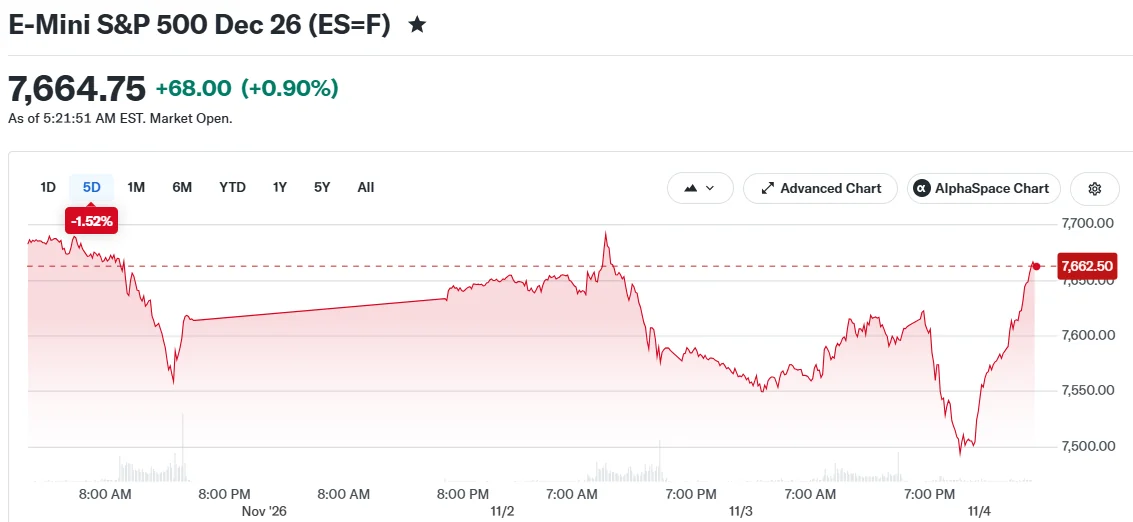
United States stock futures edged higher on Wednesday, November 4, after Democrats won control of both chambers of Congress in the 2026 midterm elections, a result that sets up a divided government in Washington.
Midterm elections fall midway through a president's term, with every House seat and roughly one-third of Senate seats on the ballot. Divided government — when the party holding the White House does not control Congress — generally requires bipartisan negotiation to pass major legislation and gives the opposition a larger role in congressional oversight.
Democrats secured majorities in the Senate and House of Representatives. A projection shared on X by commentator Mario Nawfal put the party at 53 Senate seats and 220 House seats, surpassing the respective majority thresholds in both chambers.
🇺🇸 Democrats have won control of BOTH chambers of the U.S. Congress in the 2026 midterm elections, securing majorities in the Senate and House of Representatives. The party is projected to have won 53 Senate seats and 220 House seats, surpassing the respective majority… pic.twitter.com/vnFGtfGyrN
— Mario Nawfal (@MarioNawfal) November 4, 2026
https://x.com/MarioNawfal/status/2117910976175726977?ref_src=twsrc%5Etfw
Futures tied to the Dow Jones Industrial Average rose 0.6%. Contracts on the S&P 500 climbed 0.2%, while Nasdaq-100 futures traded just above the flat line. Stock futures track the major indexes outside regular trading hours and are commonly used to gauge the tone of the coming session.
How Chip Stocks Reacted
Advanced Micro Devices rose about 6% in premarket trading after the chipmaker posted a third-quarter earnings beat.
Other chip names moved in the opposite direction. Nvidia and Micron Technology each fell more than 1% as markets quickly priced in the Democratic sweep. Traders pointed to ballot measures and newly elected officials who could restrict data center construction.
Data centers are the large facilities that house the computing power used for artificial intelligence. Any limits on new sites could affect demand for chips going forward, underscoring how closely semiconductor demand is now tied to data center construction.
Investors are also watching for potential action on housing and pharmaceuticals following the vote. Both areas featured in the political debate heading into the election.
Yahoo Finance's Jared Blikre noted on Tuesday that midterm elections have a history of shaping stock performance in the near term, though they do not move markets much over the long term.
Oil Slips as Trump Links Losses to Gas Prices
Crude oil prices turned lower on Wednesday morning. Brent crude, the international benchmark, dropped 0.9% to near $103.40 a barrel, and West Texas Intermediate, the U.S. benchmark, slipped 0.7% to around $95.90. Brent remains above $100 a barrel amid ongoing supply risks. The declines follow a sharp 7% drop on Monday.
Traders are weighing ongoing Middle East supply risks against expected political pressure on the White House to lower fuel costs.
President Donald Trump spoke early Wednesday about the election results, linking Republican losses to high pump prices and the war with Iran.
"People agree with what I'm doing on Iran, but they really probably weren't willing to do the short-term consequence of paying more for gasoline," Trump said. He called the price surge a "short-term problem for long-term gain."
Trump also described election night as an "evening that was not that pleasant" for his party.
Democrats are expected to increase scrutiny of the administration's Middle East policy, and incoming lawmakers are expected to push for measures to cool gasoline prices. Energy costs remain a steady part of consumer inflation, with fuel prices flowing directly into household expenses and keeping pressure on the Federal Reserve. Odds remain high for an interest rate hike in December, and Fed officials weigh hiring and inflation data when setting policy, keeping this week's labor reports in focus.
Economic Calendar in Focus
Wednesday's economic calendar includes S&P and ISM data on economic activity. The Institute for Supply Management releases closely watched readings on U.S. business activity, with both the ISM and S&P indexes measured against the 50 mark that separates expansion from contraction. ADP's private payrolls report, a monthly gauge of hiring at U.S. companies, will give a look at what has been called a "low hire, low fire" job market.
Several companies are scheduled to report earnings on Wednesday, including Arm Holdings, McDonald's, Qualcomm, Novo Nordisk, and Uber Technologies. Those reports are expected to offer more data on consumer health and demand for AI.
The October nonfarm payrolls report, the Labor Department's monthly snapshot of U.S. hiring, is due on Friday.

