Steve Hanke: Trump Has Mixed a 'Deadly Cocktail' for the Bond Market—and the Bond Vigilantes Have Crossed Bessent's 'Red Line'
Key Takeaways
- •Hanke said the recent Treasury selloff reflects a "deadly cocktail" of monetary and market forces, with money growth as the most important factor.
- •He said Divisia M4 is growing 6.7% year over year, above the roughly 6% pace he associates with the Federal Reserve's 2% inflation target.
- •He argued the bond market has already pushed yields beyond the informal level Treasury Secretary Scott Bessent has been trying to defend, especially on the 10-year note.
- •Hanke said he expects bond selling to continue and sees the 10-year Treasury yield rising by another 50 basis points.
- •He rejected the idea of a U.S. quiet default and said the dollar remains the leading international currency despite de-dollarization claims.
The bond market is the only major asset class currently pricing risk correctly, according to Johns Hopkins economist Steve Hanke—and what it is pricing in, he says, is ugly.
In an interview with Fortune, Hanke argued that President Trump has inadvertently mixed what he calls "a deadly cocktail" for Treasuries. The result is a bond selloff that has already pushed yields past the informal threshold Treasury Secretary Scott Bessent has been trying to defend.
"It's a deadly cocktail," Hanke said.
The vigilantes are back
The economist said "the bond vigilantes have come out of hibernation"—a reference to investors who have served as the scourge of administrations for decades, selling government debt en masse to punish what they see as reckless fiscal or monetary policy and ultimately driving yields higher until policymakers change course. The mechanics are straightforward: bond prices and yields move inversely, so heavy selling of Treasuries translates directly into higher yields.
Economist Ed Yardeni, now president of Yardeni Research, coined the term in a 1983 paper, writing that if fiscal and monetary authorities would not regulate the economy, "the bond investors will." A decade later, James Carville, Bill Clinton's chief political strategist, gave the idea its most famous endorsement, saying he wanted to be reincarnated as the bond market: "You can intimidate everybody." The quip captured an era in which bond-market pressure loomed over the Clinton White House's fiscal choices.
Hanke expects the selling to continue. He said the 10-year Treasury yield could climb another 50 basis points, and that he will remain "very bearish" on bonds "for quite some time."
Three ingredients in the cocktail
Hanke—a professor of applied economics at Johns Hopkins, a special counselor at the Center for Financial Stability, a Fortune senior contributing columnist, and a veteran of President Reagan's Council of Economic Advisers—laid out the selloff as the product of three distinct forces, ranked in order of importance.
The first and most important, he said, is monetary. "The first thing is always money."
Hanke pointed to Divisia M4, the broadest and, in his view, most reliable measure of the money supply. It is produced by the Center for Financial Stability and tracked by monetary economist William Barnett. Unlike simple-sum aggregates such as M2, which count every dollar equally, the Divisia indexes weight each component of money by the transaction services it actually provides. Divisia M4 is growing at 6.7% year over year—above Hanke's own "Golden Growth Rate" of roughly 6%, the pace he considers consistent with the Federal Reserve's 2% inflation target.
That acceleration follows what Hanke calls the "bathtub" dynamic, a framework he has explained in previous Fortune interviews likening the supply of money to water pouring into an already full bathtub. The massive pandemic-era liquidity bubble has largely drained out of the financial system, he said, and the tub is now refilling.
"It's going to be a long time until inflation is at 2%," he said, referring to the Federal Reserve's target rate of inflation. Hanke argued that inflation expectations—not just realized inflation—are what drive bond yields, and those expectations are being fed by faster money growth.
"The inflation genie's out of the bottle, and it's not going back in," he said.
Crossing Bessent's red line
Wall Street strategists say the breach is rattling the Treasury Secretary directly—and the most concrete evidence came on July 31, the same day the 30-year yield hit 5.27%. The United States joined Japan in a coordinated yen-buying operation, the first joint currency intervention between the two countries since 1998, when Washington and Tokyo last teamed up to support the yen during the Asian financial crisis. The explicit concern was that a falling yen would push Tokyo to sell a portion of its $1.114 trillion in U.S. Treasury holdings—the largest foreign stash of U.S. government debt—to defend its currency, a dump that would send yields even higher. Bessent's notepad from a Camp David cabinet meeting visibly listed "Buy Japanese Yen (JPY) $5–10 bil."
Bloomberg reporting from early August separately described Bessent sending signals that he was eager to keep bond yields from spiking higher, with his focus squarely on the 10-year because it underpins mortgage rates and other consumer borrowing costs. Reuters similarly frames the current yield curve moves as exposing "Trump's and Bessent's rate dilemma," noting the disconnect between where Bessent wants yields and where the market has pushed them.
Hanke argued that dynamic is now fully in play—and that it has already blown through the threshold Bessent has been informally defending. The Treasury Secretary has said he wants the 10-year yield to carry a "3 handle," meaning below 4%, and multiple reports describe a widely understood marker of around 4.5% on the 10-year and 5% on the 30-year as his effective red line.
Hanke called it a "red line" for the Treasury Secretary, adding that it is a consensus view. "It's reading the tea leaves," he said, calling it a "commonly understood red line, not unique to Hanke."
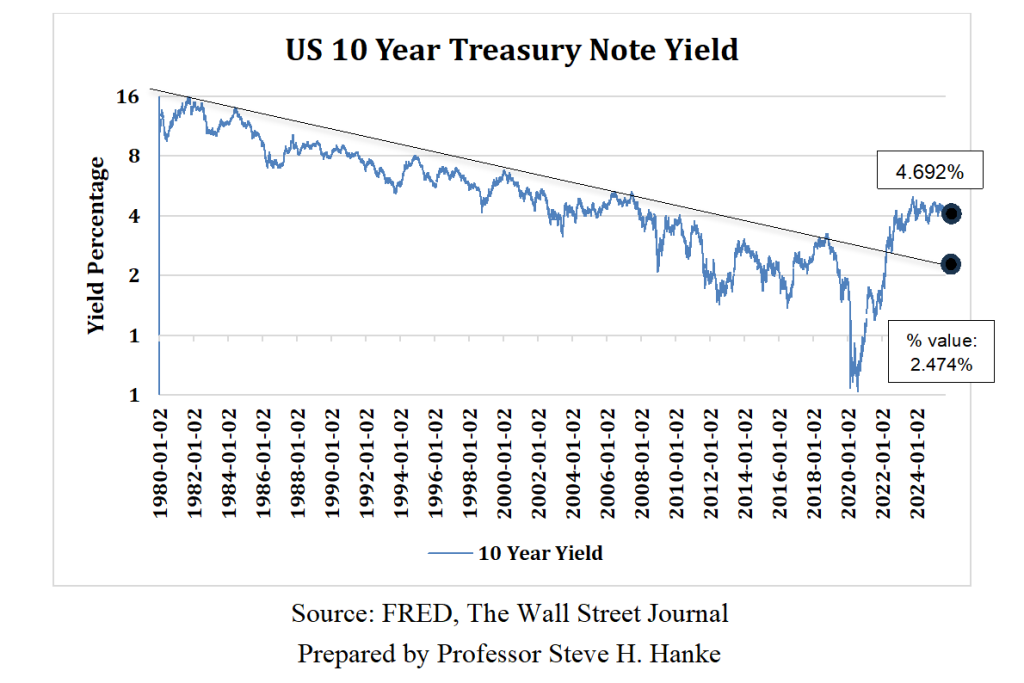
He pointed to a chart he prepared several days earlier on the 10-year yield, arguing that it tells the entire story of the end of the long bull market in bonds, showing that "even before you get to the new Trump administration, the market was under pressure." The sudden upswing in June 2021, he said, coincides with inflation peaking at 9.1% and the bond vigilantes coming out of their cave.
Stocks are 'sleepwalking,' oil is underpriced
Hanke's broader argument is that the bond market is the only part of the financial system currently pricing risk with any discipline.
"The equity market is sleepwalking along," he said, driven by a "stock market mania" fueled by "AI hype."
Commodity markets, in his view, are similarly mispricing risk. Crude oil inventories are running toward the bottom of the barrel, he said, setting up oil prices to "come roaring back" within the next month or two, even though refined products like gasoline and diesel are already reflecting tightness. He attributes shrinking refining capacity to Ukrainian strikes knocking Russian refineries offline and disruption to Middle Eastern refining capacity.
On whether the equity bubble will deflate, Hanke was careful to hedge: "It's virtually impossible" to predict when a bubble pops, he said, "with one exception"—if a central bank starts visibly tightening monetary policy and the money supply slows, the odds of a pop rise dramatically. Rising long-term rates, he argued, can function the same way, gradually "letting air out of the stock market" even without a formal Fed tightening cycle.
No 'quiet default'—and the dollar isn't going anywhere
Hanke pushed back hard on the idea of a "quiet default" by the United States, calling the framing absurd. The U.S. has never defaulted and, in his view, never will, "as long as we have the international currency"—a dynamic he says makes a Venezuela-, Argentina-, or African-sovereign-style default a non-starter.
He remains, in his words, "on the side of king dollar," arguing the currency isn't going anywhere anytime soon despite the reserve-currency erosion narrative gaining traction elsewhere.
Hanke acknowledged that tariff threats and sanctions policy are corrosive to the dollar's standing, but argued other forces are pushing the other way: dollar usage in global transactions has actually increased over the past three years. The euro has lost some ground over that period, he said, while the Chinese renminbi has gained share in percentage terms—but from such a small base that the gain is "almost a footnote." In his framing, the renminbi's gains are coming largely at the euro's expense, not the dollar's.
He dismissed "de-dollarization" as a durable trend, pointing out that over the past 120 years there have been only 14 dominant international currencies, and challenges to the reigning one are historically rare. The closest precedent in living memory, he said, is the pound sterling's loss of primacy to the dollar, tied to Britain's loss of its colonies. He allowed that pointing to that one episode risks recency bias, but maintained that the broader historical pattern still favors continuity over disruption.
The repricing will spread
Hanke's closing argument is that the repricing happening in bonds will eventually spread.
"When everybody else stops sleepwalking and starts pricing things in properly, there will be adjustments," he said—adjustments he expects to show up first in equities as the "stock market bubble" starts to deflate. Whether that ends in a sharp pop or a slower deflation, he said, is impossible to call with confidence.
But the signal he is watching most closely is simple: if the 30-year and other long rates keep climbing, that alone could do the work of letting air out of stocks, without the Fed lifting a finger. Both of the gauges Hanke leans on are public—the Center for Financial Stability posts its Divisia aggregates on a monthly cycle, and Treasury yields price continuously in the open market—making the levels he describes straightforward to track.
"The bond vigilantes are always kind of ahead of the curve," Hanke said, "and I think they are this time."
For this story, Fortune journalists used generative AI as a research tool. An editor verified the accuracy of the information before publishing.
This story was originally featured on Fortune.com.

