Analyst Celal Kucuker Predicts Stellar (XLM) Could Reach $2.50 on Long-Term Breakout
Key Takeaways
- •XLM has spent much of 2026 consolidating after an early-year high near $0.21, with trading largely confined to the $0.15 to $0.18 range.
- •Celal Kucuker projects that Stellar could rise to around $2.50 if it breaks out of a multi-year symmetrical triangle pattern.
- •Stellar’s real-world asset ecosystem has grown beyond $3 billion in tokenized assets despite weak price performance.
- •Weekly technical indicators are mixed, with most momentum readings still leaning slightly bearish and only Bull Bear Power showing a buy signal.
- •Analysts view a long-term rise to $10 as technically possible but highly unlikely without a fundamental change in the global financial system.
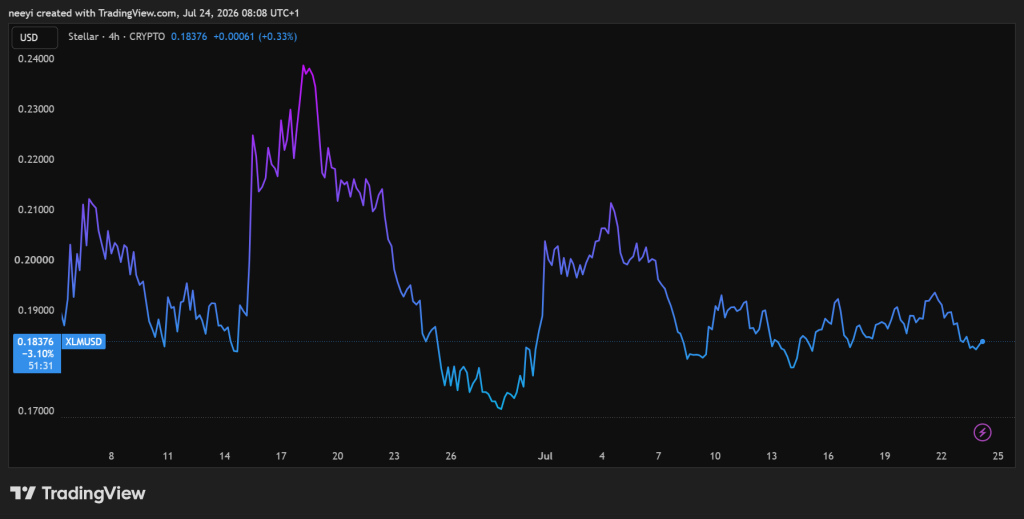
Stellar (XLM) has spent much of 2026 in a sideways pattern after retracing from its earlier rally, leaving investors to question whether the token has peaked for the current cycle or whether a significant move is still building. One analyst contends the answer may catch the market off guard.
Crypto analyst Celal Kucuker argues that Stellar possesses one of the strongest long-term chart structures among major cryptocurrencies. He projects that XLM could eventually climb to approximately $2.50 if its multi-year technical pattern breaks to the upside.
XLM reached an early 2026 high of around $0.21 before entering a prolonged consolidation phase. The token subsequently traded mostly between $0.15 and $0.18 as broader market conditions turned less favorable for altcoins.
Several factors contributed to the slowdown. Global macroeconomic uncertainty dampened demand for mid-cap cryptocurrencies. Elevated Bitcoin dominance directed capital toward Bitcoin rather than altcoins. Profit-taking also followed Stellar's strong rally earlier in the year. These dynamics repeatedly pushed the XLM price away from key resistance levels.
Despite the price stagnation, Stellar's fundamentals continued to strengthen throughout the period. The network expanded its real-world asset (RWA) ecosystem beyond $3 billion in tokenized assets. That figure places Stellar among the notable participants in a broader RWA tokenization trend that has drawn involvement from major financial institutions, including BlackRock and Franklin Templeton, which have launched tokenized treasury products across multiple blockchain networks. Institutional adoption remained one of the primary drivers of on-chain activity, even as XLM's market price failed to reflect that progress.
The divergence between network adoption and price performance is notable, as the two metrics frequently move at different paces. Strong fundamental growth can persist for months before prices begin to catch up.
On the technical chart, XLM spent much of its consolidation near the critical $0.18 support area. Higher trading volume would likely be required before buyers can mount a serious challenge to the next major resistance level.
Kucuker: Stellar Building Toward a Major Breakout
Kucuker contends that Stellar currently displays one of the cleanest long-term charts in the cryptocurrency market. His outlook is rooted in a large technical pattern that has been developing over several years.
The monthly chart shows XLM trading inside a massive symmetrical triangle. Every major rally since 2018 has stalled near the same descending resistance line. For context, XLM's all-time high of approximately $0.94 was recorded during the 2017–2018 crypto rally, meaning any move toward Kucuker's $2.50 target would represent uncharted territory well beyond the token's previous peak. Meanwhile, every major correction has produced a higher low than the previous one, forming a rising support trendline beneath the price.
These two converging trendlines have compressed the Stellar price into an increasingly narrow range. Such structures frequently draw the attention of technical analysts, as they reflect gradual market compression following extended consolidation. The longer the compression persists, the more closely traders monitor the eventual breakout direction.
Fibonacci extension levels on the chart provide estimated price targets in the event of a breakout above long-standing resistance. One of the most prominent Fibonacci targets appears near $2.56, closely aligning with Kucuker's projection of approximately $2.50.
XLM would first need to close above the upper resistance trendline that has rejected every major rally for years. A successful breakout could then open the path toward the next Fibonacci extension level, representing roughly a 15x increase from current prices.
Kucuker shared his analysis on X (Twitter): https://x.com/celalkucuker/status/2080291651801501911?s=46
The projection remains a technical scenario rather than a certainty. Stellar still needs to overcome one of its most formidable resistance barriers before any bullish outlook can materialize.
Weekly Technical Indicators Signal a Waiting Phase
Weekly indicators present a mixed picture for XLM. Most momentum indicators still lean slightly bearish, though one measure suggests buyers have begun defending important support levels.
- Relative Strength Index (RSI): 47.57 — indicating buyers and sellers remain relatively balanced, with momentum insufficient to confirm either a bullish or bearish trend.
- Stochastic Oscillator: 32.89 — producing a sell signal that suggests short-term buying pressure remains limited despite recent consolidation.
- MACD: −0.013 — continuing to generate a sell signal, indicating bearish momentum has not fully dissipated.
- Ultimate Oscillator: 39.55 — values below 50 generally signal that buying pressure remains weaker than selling pressure across multiple time frames.
- Bull Bear Power: 0.0066 — the only indicator currently producing a buy signal, with the positive reading suggesting buyers have started defending support levels during the broader consolidation.
Long-Term Outlook for Stellar
Regarding whether XLM could reach $10, analysts note that while such a level is technically possible over the long term, it is considered highly unlikely without a fundamental shift in the global financial system.
Stellar, launched in 2014 by Ripple co-founder Jed McCaleb, continues to serve as foundational infrastructure for cross-border payments, remittances, and real-world asset (RWA) tokenization, with adoption by major financial institutions. However, its long-term viability remains a subject of debate due to competition from other blockchain networks — most directly Ripple's XRP in cross-border payments and platforms such as Ethereum and Solana in broader decentralized finance applications — as well as evolving market trends.

