Startups Test Home-Based Mini Data Centers to Ease Pressure on the Power Grid
Key Takeaways
- •Span has deployed prototype cabinet-sized XFRA data center nodes in Northern California in partnership with Nvidia.
- •Span expects XFRA to generate about one to two megawatts of compute later this year and aims to scale to more than 1 gigawatt of annual capacity across the U.S. beginning next year.
- •Heata has installed servers in about 100 homes and says its system has saved about 1 gigawatt-hour of energy while generating 8 million liters of hot water.
- •Large data center expansion has raised concerns over power grid strain, electricity bills, water use and local environmental impacts.
- •Robert Davies estimates that only 30% to 40% of homes may be suitable for mini data centers or servers due to integration, internet and participation constraints.
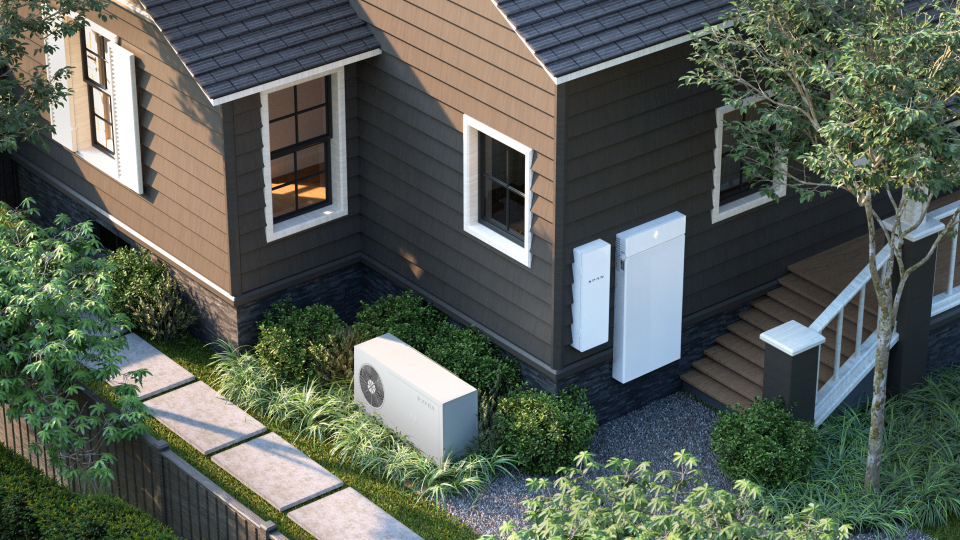
Startups are looking for opportunities in the backlash against rapid data center growth by developing mini data centers that can be installed at homes and small businesses. The companies say the systems may reduce the financial burden on residents and could have a lower ecological footprint than large warehouse-style data centers.
California-based Span, working in partnership with Nvidia, has deployed prototype data center “nodes” in Northern California. The cabinet-sized units, called XFRA, are mounted on the sides of homes and small businesses. Because the units require no fans, the technology is quiet, addressing one source of noise pollution that has prompted complaints from people living near large data center projects.
Ryan Harris, Span’s chief revenue officer, said the company estimates XFRA will be able to generate about one to two megawatts of compute later this year. Beginning next year, Span expects to scale across the U.S. to more than 1 gigawatt of annual capacity. PulteGroup, one of the largest homebuilders in the U.S., is testing the system. Nvidia will supply liquid-cooled RTX PRO 6000 Blackwell Server Edition GPUs for the platform.
“We do see a path to being able to contribute on an annual basis hundreds of megawatts, if not gigawatts, of scale compute capacity, while doing so in a deflationary-to-energy-price way,” Harris told Fortune.
The effort comes as tensions between hyperscalers and local residents have increased over the cost and environmental impact of artificial intelligence infrastructure. Data centers spanning areas comparable to dozens of football fields are being built across the country, and residents have protested new AI infrastructure projects. McKinsey projected in April 2025 that capital expenditures tied to such infrastructure could reach $7 trillion by 2030.
The large facilities built to store and process massive amounts of data have also added pressure to the already strained U.S. power grid. Goldman Sachs research said data center growth could potentially drive up electric bills by 6% over the next year. That grid pressure is central to the appeal of distributed systems: instead of concentrating new load at a single large campus that may require major utility upgrades, the startups are trying to spread smaller amounts of computing demand across existing buildings.
Water use has become another concern because many data centers rely on water for cooling. Two data center developments, one in Arizona and one in Georgia, took public water without authorization, and a recent study by the Houston Advanced Research Center projected that data centers could use as much as 399 billion gallons of water in Texas alone by 2030.
“We know what a big project this is, and what a nuisance it’s going to be, and what environmental impact it’s going to have on this area,” Kathryn Haushalter, a 42-year-old former U.S. Marine living in Saline Township, Mich., across from a future data center site, recently told Fortune. “I’m just so nervous for everybody else that doesn’t realize.”
How companies are putting data centers in homes
Span’s XFRA units are designed as part of a broader distributed AI infrastructure network. The system uses underused electrical capacity in homes to create something similar to a cloud of compute that can be supplied to service providers. Span says it can install the nodes at six times the speed of centralized 100-megawatt data centers and at about one-fifth of the construction cost.
The company charges a flat monthly fee of about $150. In return, it essentially pays a host’s electricity and internet bills. The compute produced by the nodes is distributed to customers such as hyperscalers and AI companies. According to Span, XFRA is not intended to replace commercial data centers, but to reduce strain on the grid. The model also puts practical questions usually handled inside dedicated facilities—such as equipment uptime, household integration, internet connectivity, and customer acceptance—closer to the homeowner.
Heata, a U.K.-based startup, also installs servers that function as a “virtual data center” by processing cloud computing workloads. Its model adds a heating component: thermal conductors move heat from computer processors into cylinders filled with water, supplying hot water for home heating needs.
Heata has installed units in about 100 homes and says it has saved about 1 gigawatt-hour of energy. The company says about 70% of the energy savings come from reduced need for domestic gas or electric heating systems, while the remaining 30% comes from reducing the need to cool data center processors.
A Heata spokesperson told Fortune the company has generated 8 million liters of hot water and saved households about $55,000 on energy bills.
Questions about the benefits of home data centers
Although these startups say their systems can save waste heat and money, Utah State University physics professor Robert Davies warned that efforts to modestly reduce the ecological harms of data center power use and grid strain could ultimately worsen the problem.
In a preliminary analysis, Davies calculated that only 30% to 40% of homes may be suitable for mini data centers or servers because of integration constraints, the need for stable internet service, and whether participants are willing to have the technology installed in their homes.
Separately, he estimated that only 2% to 3% of homes could realistically be heated through alternative energy-harnessing technologies because of limits on how much waste heat can be collected. In many geographies, heating demand is seasonal, meaning some heating energy could go unused.
Davies said the technologies are genuinely helpful and could still benefit millions of households. But he cautioned that presenting data center expansion as something that can be made more efficient may be risky when considering the broader environmental impact of AI infrastructure.
“These projects tend to be heavy on the benefit analysis and very light on the cost analysis,” Davies told Fortune. “And you don’t actually get a full sense of the cost until you do a whole systems analysis. These are multi-generational challenges, and are they solving problems that we really need solved?”
Davies said he worries that greater efficiency in repurposing data center waste could encourage even more data center expansion, placing additional pressure on the environment. He cited Jevons paradox, a 160-year-old theory holding that when a resource becomes more efficient to use, consumption of that resource may increase rather than decline. The theory is based on English economist William Stanley Jevons’ observation that more efficient steam engines made coal cheaper, which then increased total coal consumption.
“We now need about 45% less energy to do the same thing that we needed 35 years ago. So that seems awesome,” Davies said. “Are we using 45% less energy than we were 30 years ago? The answer is, no. Turns out, we’re using about 70% more energy.”
The Heata spokesperson said the company’s approach involves substitution, not only efficiency gains, because homes must be heated whether or not one of its servers is installed. According to the company, if demand for compute continues to rise, building an integrated energy system that helps meet heating demand becomes more important.
Davies, however, remains concerned that demand for compute could far exceed the ability to repurpose waste heat. He said that could lead to more data center construction, further burdening environmental capacity rather than extending it.
“The strategy that I see the sector applying here is seductive,” he said. “It seems useful, we want it to be useful. But in a whole systems analysis, it’s really not.”
A version of this story was published on Fortune.com on May 15, 2026. This story was originally featured on Fortune.com.

