Starlink Launches in Equatorial Guinea, Its 30th African Market
Key Takeaways
- •Starlink's launch in Equatorial Guinea marks its availability in 30 of Africa's 54 countries.
- •The service operates under provisional approval granted on 29 July 2026 by Vice President Teodoro Nguema Obiang Mangue, with final authorisation still pending.
- •GITGE, the state-owned digital infrastructure company, is responsible for assessing the regulatory conditions for Starlink's full integration.
- •Internet penetration in Equatorial Guinea stands at roughly 60% to 63% of the population, with around 885,000 active mobile connections.
- •The provisional-licence approach mirrors similar steps taken by regulators in Côte d'Ivoire and Guinea-Bissau before full Starlink approval.
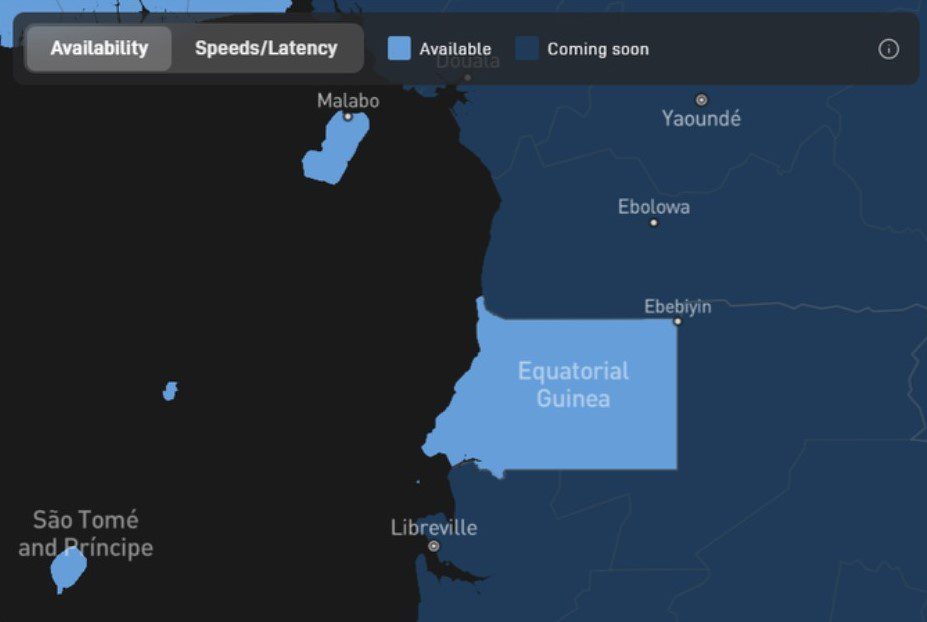
SpaceX’s satellite internet service, Starlink, has officially launched its low-Earth-orbit (LEO) high-speed offerings in Equatorial Guinea, marking its entry into 30 of Africa’s 54 countries. For a country of roughly 1.7 million people, much of it rural or insular, satellite coverage offers a way to extend connectivity without heavy investment in terrestrial towers.
In a post on X (formerly Twitter) on Saturday, the satellite internet operator announced its arrival in the Central African country, and its coverage and availability map now shows its presence there. “Starlink’s high-speed, low-latency internet is now available in Equatorial Guinea!” the X post reads.
The launch continues Starlink’s rapid expansion across Africa, where satellite internet has become a practical workaround in markets with limited fixed-line infrastructure. Following its recent entry into Côte d’Ivoire, the company has also gone live in the Central African Republic (CAR) and Senegal, and has secured regulatory approval to launch in Uganda after previous restrictions — all in 2026.
Provisional regulatory basis
The Equatorial Guinea launch follows provisional regulatory approval granted by the country’s Vice President, Teodoro Nguema Obiang Mangue, on 29 July 2026. Equatoguinean authorities noted that the approval is not final; it is intended to examine introducing Starlink into the country and review its benefits. Telecomunicaciones de Guinea Equatorial (GITGE), the state-owned company responsible for digital infrastructure, is in charge of assessing the regulatory conditions for Starlink’s integration.
Preliminary discussions with the company date back to 2025, including a provisional agreement that initially limited access to the oil sector. The pending final approval, and the terms GITGE sets for full integration, will shape how broadly the service can be offered and at what price.
A regional pattern of provisional licences
The approach mirrors what authorities in Côte d’Ivoire did with telecommunications regulator ARTCI, which granted a 12-month provisional licence last month. Testing satellite operators’ activities before full authorisation is becoming a common practice in the region: in Guinea-Bissau, the National Regulatory Authority for Information and Communication Technologies (ARN-TIC) first issued a provisional licence to Starlink at the end of 2024 before granting full approval.
Market context
According to DataReportal, internet penetration in Equatorial Guinea stands at roughly 60% to 63% of the population, with around 885,000 active cellular mobile connections.
Starlink will compete with state-owned telecom operators including GETESA (Guinea Ecuatorial de Telecomunicaciones Sociedad Anónima), Telgesa, and GITGE (Gestor de Infraestructuras de Telecomunicaciones de Guinea Equatorial).
Through its high-speed internet service, Starlink will seek to provide a 5G network, which is not yet available in the country. Its LEO services will also enable the operator to reach rural areas where terrestrial towers cannot.
Meanwhile, GETESA is partnering with Huawei on a network optimisation plan targeting 5G deployment, expanded fibre capacity, and mobile money platforms. The country connects internationally through submarine cable systems such as ACE and SAIL, while leveraging domestic terrestrial fibre networks.
Also read: Starlink closes in on Spectranet with 98,642 subscribers in Nigeria.
