Starknet Price Rallies 52% as Quantum Security Concerns Drive Demand
Key Takeaways
- •Starknet's STRK token rose 54.87% in 24 hours to around $0.109 by 06:00 UTC Sunday, while Bitcoin added just 0.25% and held near $83,000.
- •StarkWare CEO Eli Ben-Sasson said Starknet could target full quantum resistance by 2027, roughly two years ahead of Ethereum's roadmap goal of around the end of 2029.
- •StarkWare is actively considering converting Starknet from an Ethereum Layer 2 into an independent Layer 1, but the proposal has not been approved and no migration plan has been disclosed.
- •Ben-Sasson warned the quantum threat may be much closer than we think, arguing that advances in AI and mathematics could shorten the timeline for computers capable of breaking wallet signatures, though he did not claim such breaks are possible today.
- •Analyst Crypto Patel cited speculative upside targets of $0.22, $0.80 and $2.40 for STRK with a $0.063 to $0.045 buy-the-dip zone, levels he described as his own thesis rather than a StarkWare forecast.
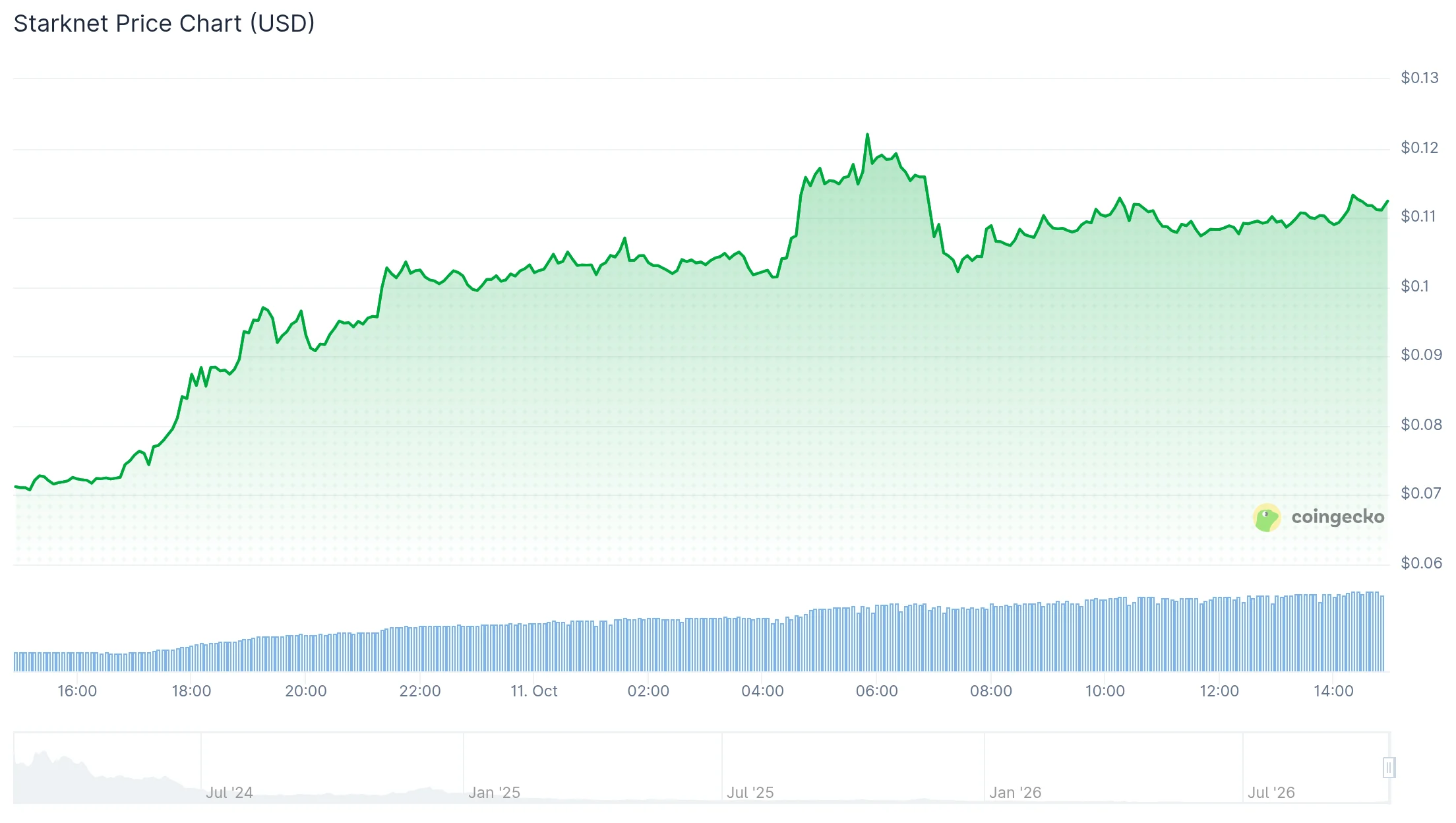
arknet’s STRK token rose more than 50% in 24 hours on Sunday, with CoinGecko data recording a 54.87% daily gain at 06:00 UTC. Bitcoin, by comparison, added 0.25% and remained nearly flat.
The move followed comments from StarkWare CEO Eli Ben-Sasson about accelerating defenses against quantum computing and advances in artificial intelligence. StarkWare is also considering whether Starknet, currently an Ethereum Layer 2, should become an independent Layer 1. Such a shift would be structurally significant because Layer 2s generally inherit Ethereum’s security rather than run their own consensus, and no transition has been approved — the proposal remains a target under consideration rather than a completed upgrade.
Ben-Sasson said Starknet could target full quantum resistance by 2027. Ethereum’s published roadmap places its goal for full Layer 1 quantum resistance around the end of 2029. Both dates are targets, and the 2027 objective does not mean that every component of Starknet is already protected. If both timelines held, Starknet would aim to reach the milestone roughly two years ahead of the base layer whose security it currently relies on.
Starknet Rally Follows Quantum Security Warning
Ben-Sasson said the quantum threat “may be much closer than we think.” He argued that advances in AI and mathematics could shorten the timeline for developing quantum computers capable of breaking wallet signatures. He did not say quantum computers can break those signatures today, and researchers continue to differ over when that capability could arrive. The debate matters beyond Starknet because wallet signatures secure user funds across the crypto industry, which is why quantum-resistance timelines have become a point of comparison between networks.
Ben-Sasson’s proposed “bunker mode” calls for suitable cryptography, frictionless upgrades and potentially an independent Layer 1. Starknet’s STARK proofs rely on hash functions considered resistant to quantum attacks, although some elliptic-curve components remain on the roadmap. As an Ethereum Layer 2, Starknet also depends on Ethereum’s security and upgrade timetable.
StarkWare has said it is actively considering an L1 transition, with 2027 as its target for becoming the first quantum-resistant network. An independent L1 could give Starknet greater control over security changes instead of requiring it to follow Ethereum’s migration schedule. It would also make Starknet responsible for securing its own transactions.
We are actively considering becoming an L1. This would enable Starknet to become the first fully quantum-resistant network, with 2027 as our target. — Starknet (@Starknet) October 8, 2026
A transition would raise questions about how applications, users, bridges and liquidity would move. StarkWare has not disclosed a complete migration plan, and Starknet has not formally adopted the change. The proposal would have to advance through Starknet governance before becoming an implementation decision. Those two steps — a formal governance decision and a published migration plan — are the clearest signals to watch as the 2027 target moves from consideration toward execution.
The security discussion has nevertheless become a catalyst for short-term trading in STRK. Starknet outpaced a mostly quiet broader market on Sunday. Bitcoin held near $83,000, with bearish sentiment and low levels of discussion. Ethereum was nearly flat, while sentiment toward ETH reportedly became extremely bearish. STRK attracted more attention: retail sentiment shifted from bullish to extremely bullish, and message activity remained extremely high, according to the platform’s indicators.
STRK Volatility Follows Rapid Price Increase
The STRK reaction combines security concerns with speculative momentum, and those factors could weaken independently as traders reassess the proposal and its execution timeline. Crypto Patel offered a separate technical analysis of Starknet’s price on X.
The commentator claimed that STRK had gained 437% from its cycle bottom and 215% from a retest of a breakout zone. Crypto Patel cited upside targets of $0.22, $0.80 and $2.40, identified $0.063 to $0.045 as a potential buy-the-dip area, and advised holders to consider taking partial profits as a risk-management measure. Those levels represent one trader’s thesis and are not a StarkWare forecast.
Crypto Patel also cited a descending-channel breakout, a retest and a change of character, or CHoCH, as signals being monitored for a possible further entry. Chart patterns do not establish whether buying will continue. A move substantially above a breakout zone can leave late buyers exposed if momentum fades or traders sell into strength.
Technical analysis placed STRK near $0.109 at 06:00 UTC. The proposed dip zone was therefore materially below the Sunday reference price, while the first upside target of $0.22 was approximately 102% above that reference level. The gap illustrates the difference between the token’s rapid market move and the speculative targets cited by the analyst.
The roadmap remains under development, and the proposed Layer 1 transition has not been approved. Trading activity is continuing to reflect both the quantum-security debate and the volatility surrounding STRK’s rapid advance.

