Starknet Price Jumps 19% While Bitcoin Dips Under $82,000
Key Takeaways
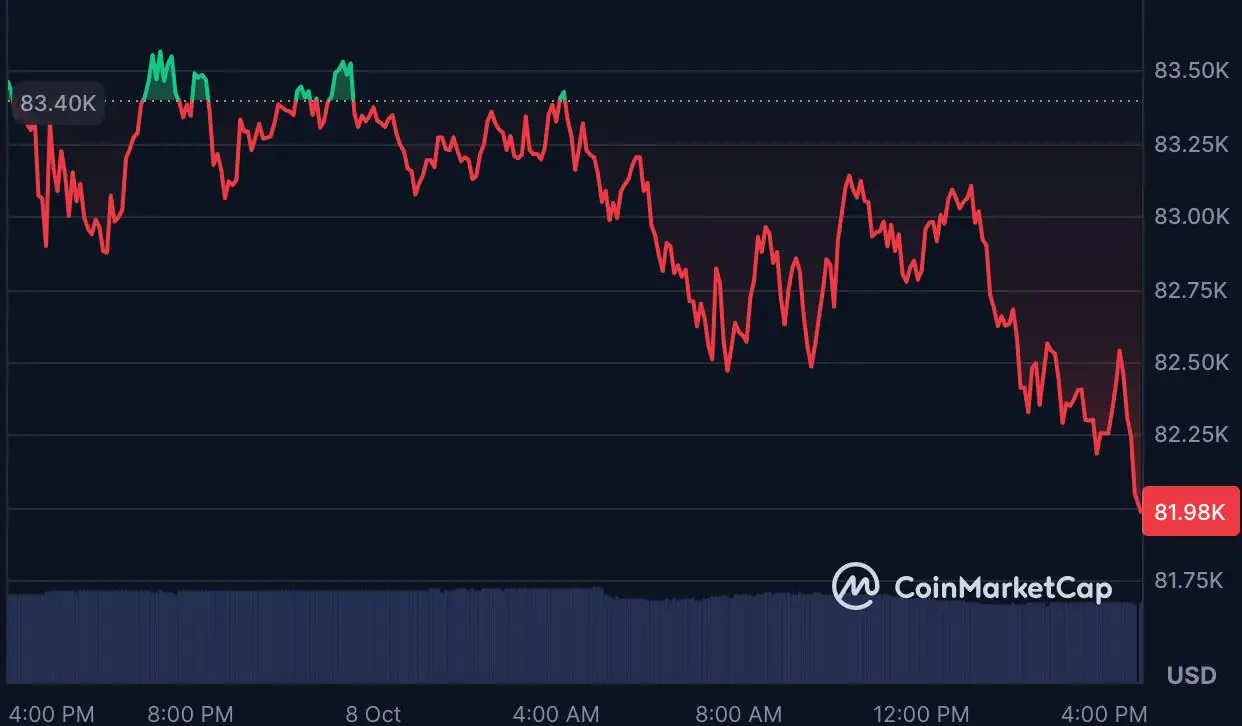
- •STRK gained 19% in 24 hours while Bitcoin traded below $82,000, making it an outlier during a broader crypto market decline.
- •Starknet completed its v0.14.4 mainnet upgrade on October 6, allowing developers to generate proofs for more complex application work within a single transaction flow.
- •Renewed warnings from Ethereum researchers have intensified the quantum-readiness discussion around STARK-based infrastructure, though no practical attack on Bitcoin or Ethereum wallet keys has been demonstrated.
- •The token has formed higher lows since mid-September and remains inside a rising channel, with its main support band at $0.046–$0.049.
- •Clearing the $0.060–$0.062 resistance range, which stopped the September advance, would require several daily closes above it to confirm a breakout.
Key Takeaways
- STRK gained 19% in 24 hours while Bitcoin traded below $82,000.
- The token remains inside a rising channel formed in September.
- The $0.046–$0.049 band is the stronger support beneath the advance.
- The $0.060–$0.062 range remains the ceiling that must be cleared to confirm a breakout.
STRK Rallied While the Broader Market Weakened
Starknet's STRK token jumped 19% in 24 hours while Bitcoin traded below $82,000, an outlier performance during a session in which most of the wider crypto market weakened.
Bitcoin's slide extended the selling pressure that began a day earlier. Oil-price concerns and geopolitical risk have unsettled the wider crypto market, leaving many traders less willing to exposure to riskier assets.
STRK nevertheless found buyers. Moves against a falling market tend to draw attention because they are often read as token-specific strength rather than a broad-market tailwind. The move does not make Starknet immune to broader market pressure, but it does make the project's recent developments and its technical structure more relevant than they would be during an ordinary market-wide advance.
Two Developments Put Starknet Back in Focus
No single announcement can explain STRK's 24-hour gain. Still, Starknet has had two timely developments this week that may have brought the project back into traders' view. Starknet is an Ethereum Layer 2 network that uses StarkWare's STARK proofs to verify computation off the base chain, an architecture that sits at the center of both developments.
Starknet completed its v0.14.4 mainnet upgrade on October 6. The update allows developers to generate a proof for more complex application work within a single transaction flow. The project's technical notes describe the release as small and largely transparent, so the upgrade alone offers no evidence of an immediate increase in users, revenue or token demand.
Security has also returned to the Starknet conversation. Its proof system relies on hash functions, while the network's account design can support different signature methods without forcing every user to migrate at once. Starknet's quantum-resistance roadmap explains how the team sees that flexibility working over time. Hash-based constructions carry a different risk profile from the elliptic-curve signatures that protect most crypto wallets, which is why STARK-based networks feature prominently in the quantum-readiness discussion.
Fresh warnings from Ethereum researchers have made quantum readiness a more immediate industry subject, although no practical AI attack on Bitcoin or Ethereum wallet keys has been demonstrated. CoinDesk reported on that debate on October 8. The timing gives traders a narrative around STARK-based infrastructure, but it cannot identify what caused STRK's move on its own.
StarkWare has already explored the issue beyond its own network. Its work on a quantum-safe Bitcoin backup transaction showed how AI-assisted coding lowered the estimated cost of preparing a potential protection route. That research has helped turn a distant security concern into a practical engineering discussion.
The Advance Still Has Support Beneath It
STRK has formed higher lows since mid-September and remains inside a rising channel. Each pullback has stopped above the previous one, while the channel's lower boundary has continued to rise beneath price.
The first area below the latest move sits around $0.052–$0.053, where the 0.236 Fibonacci retracement overlaps a level recovered during the advance. A pullback that holds there would leave the channel intact.
The key levels shaping the next move:
- $0.060–$0.062: Resistance marked by the September peak and the latest advance.
- $0.052–$0.053: First support below the recent move.
- $0.046–$0.049: Main support band.
- $0.041–$0.042: Next lower reference if the support band fails.
The more important support sits between $0.046 and $0.049. The channel floor runs through the upper part of that range, a horizontal level from recent trading sits nearby, and the 0.382 Fibonacci retracement strengthens its lower edge. A sustained break beneath the range would damage the sequence of higher lows and leave the channel without its nearest support.
The next lower reference sits near $0.041–$0.042, around the .5 Fibonacci retracement. The 50-, 100- and 200-day moving averages remain much lower, making them less useful for judging the next immediate move.
STRK Still Needs to Clear $0.060–$0.062
STRK has returned to the $0.060–$0.062 range that stopped the September advance. A brief move through that area would be less persuasive than several daily closes above it, followed by a pullback that holds the range as support.
Momentum has strengthened alongside price. The daily RSI is near 68 and remains above its smoothing line near 64. The indicator is also approaching the conventional overbought threshold of 70, meaning a pause would not automatically undo the broader recovery. Volume has increased during the advance, although the current daily bar remains incomplete, so volume confirmation will only be verifiable once the session closes.
STRK's gain has made it a notable exception during a weaker market session. The chart now presents a clear order of levels: $0.052–$0.053 is the first to defend, $0.046–$0.049 protects the wider channel, and $0.060–$0.062 remains the ceiling whose clearance would turn the recent advance into a more established breakout.
This article is for informational purposes only and does not constitute investment or trading advice. Technical levels are approximate and do not guarantee future price movements.

