Why Standard Chartered Sees Fivefold Upside for SKY
Key Takeaways
- •Standard Chartered has set a $0.325 price target for SKY by the end of 2028, implying an approximately fivefold increase from its $0.065 reference price and a valuation near $7.6 billion.
- •Geoff Kendrick describes Sky as a 'federal bank' because it issues stablecoins and charges borrowers wholesale rates, but the label refers only to its economic model and not to regulated deposit-taking status.
- •The Sky Frontier Foundation reported $107.35 million in gross protocol revenue and $33.29 million in net surplus for the second quarter, funds that must first cover savings-rate payments, reserves, security, and operations before reaching SKY holders.
- •SKY functions as a governance token without a predetermined dividend policy, so its value depends on whether governance continues allocating surplus to buybacks and staking rewards after other funding requirements are met.
- •The target assumes Sky captures part of the expected growth in stablecoin and onchain-credit activity, building on a base of $9.79 billion in combined USDS and DAI supply and $12.32 billion in protocol collateral at the end of the second quarter.
Standard Chartered has set a $0.325 target for Sky’s governance token, SKY, by the end of 2028, according to The Block. Based on the bank’s reference price of about $0.065, the target implies a fivefold increase and a valuation of approximately $7.6 billion.
Geoff Kendrick, Standard Chartered’s global head of digital-assets research, described Sky as a “federal bank” because the protocol issues stablecoins, operates through a governance framework and charges borrowers wholesale rates. The comparison refers to Sky’s economic model and does not mean that it is a regulated deposit-taking institution.
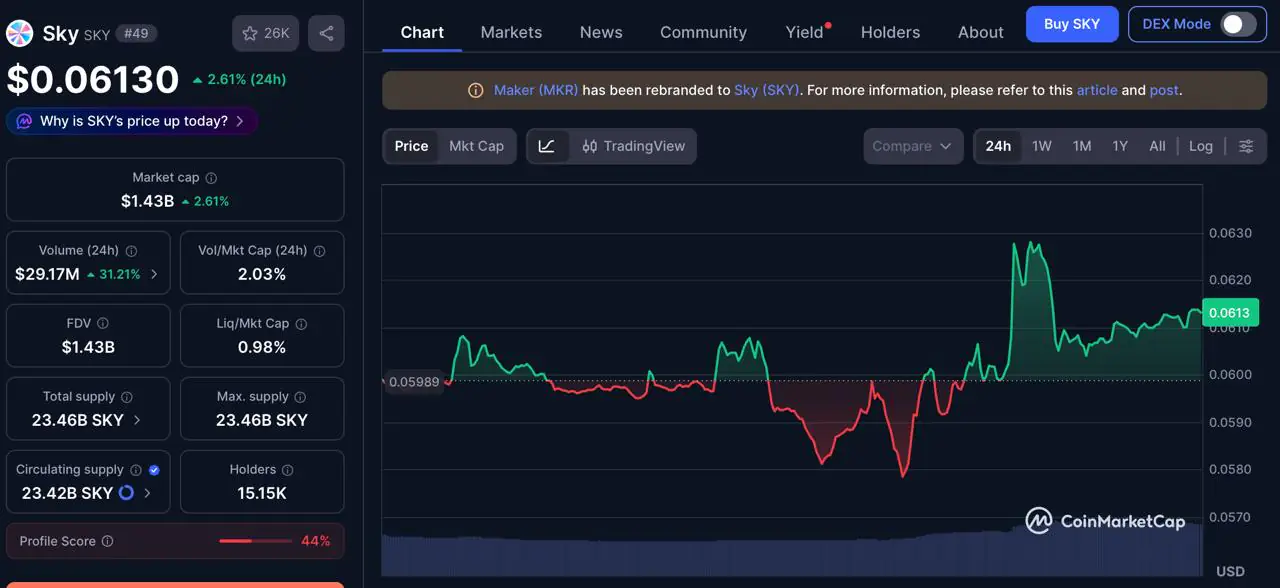
At the time of writing, Sky’s live interface showed SKY trading near $0.061, with a market capitalization of about $1.43 billion. Assuming its circulating supply remains unchanged, a price of $0.325 would produce a market capitalization close to $7.6 billion. Based on the live price reported by CoinMarketCap, the increase would be roughly 5.3 times because SKY was trading slightly below Standard Chartered’s $0.065 reference price.
The target depends on several operating assumptions: continued USDS adoption, sustainable protocol surplus and the proportion of that surplus ultimately directed toward SKY holders.
Sky’s Income Has Competing Claims
Sky, formerly known as MakerDAO, issues USDS against protocol collateral and generates income through borrowing, lending and capital-allocation activities. Users can deposit USDS into the protocol’s savings module and receive sUSDS, which accrues a governance-set savings rate funded from aggregate protocol surplus.
The Sky Frontier Foundation, an independent ecosystem foundation, reported $107.35 million in gross protocol revenue and $33.29 million in net protocol surplus for the second quarter. That surplus does not automatically go to SKY holders. It must also fund savings-rate payments, reserves, security, operations and any rewards for holders approved by governance.
As a result, the $0.325 forecast is not simply a projection based on USDS supply. It assumes Sky can expand its income base without allowing the cost of savings payments, reserves and risk management to absorb the value that could otherwise support SKY.
Governance Controls SKY’s Exposure to Surplus
Sky’s official documentation states that aggregate protocol surplus can fund open-market SKY purchases and staking rewards. However, token-holder governance determines the rates, reserve targets and other key parameters, all of which can change.
SKY is therefore a governance token rather than a share with a predetermined dividend policy. Its value depends partly on whether governance continues to allocate a meaningful portion of protocol surplus to buybacks and staking rewards after the broader system’s funding requirements have been met. Sky’s staking interface reflects the protocol’s mechanism for connecting governance participation and rewards.
The Forecast Relies on Greater Onchain-Credit Activity
Standard Chartered’s target assumes that Sky captures part of the stablecoin and onchain-credit growth the bank expects across decentralized finance. Standard Chartered has previously issued substantially larger forecasts for tokenized assets. However, as Coindoo noted in its comparison of tokenization estimates, institutional projections can differ sharply because they use different assumptions about adoption, regulation and liquidity.
Sky already has a material base. Its interface listed $9.79 billion in combined USDS and DAI supply, while the Sky Frontier Foundation reported $12.32 billion in protocol collateral at the end of the second quarter, according to its Q2 2026 report.
A key question is whether USDS becomes more widely used for lending, trading and settlement, rather than being held primarily to obtain subsidized yield. That distinction will determine whether Sky develops a larger and more durable income base or instead has to pay more to attract deposits.
Limits of the “Federal Bank” Comparison
Sky performs some bank-like economic functions, but its risk structure is different. The protocol’s risk documentation warns of smart-contract vulnerabilities, collateral losses, liquidity constraints, governance changes and the possibility that USDS could lose its dollar peg.
Its yield model also differs from that of reserve-backed stablecoin issuers. In Coindoo’s comparison of major stablecoins, sUSDS is described as earning a governance-set rate from Sky’s aggregate surplus, while reserve-backed issuers commonly retain income generated by their reserves. This structure may make sUSDS more attractive to users seeking yield, but it also leaves Sky more dependent on sustainable protocol income and prudent risk settings.
Metrics That Could Test the Target
Sky’s revenue and stablecoin scale provide the operating base behind Standard Chartered’s target. The relevant evidence will be whether governance continues converting future surplus into buybacks and staking rewards after funding savers, reserves and risk controls. The target therefore depends not only on USDS growth, but also on the durability of protocol income and the decisions made through Sky’s governance system.
This article is for informational purposes only and does not constitute investment, financial or trading advice. Cryptocurrency and decentralized-finance products carry substantial risk, including the potential loss of capital.

