Standard Chartered Launches RLUSD Custody on the XRP Ledger
Key Takeaways
- •Standard Chartered has launched a custody service that safeguards RLUSD holdings for institutional clients using the XRP Ledger as the underlying blockchain infrastructure.
- •RLUSD is a US dollar-pegged stablecoin issued by Ripple that debuted in December 2024 following approval from the New York State Department of Financial Services.
- •Ripple states that RLUSD is fully backed by cash, cash equivalents, and US government Treasuries.
- •Regulated custody is often a prerequisite for institutions to hold digital assets, and bank-backed custody can lower friction by providing a familiar counterparty and compatibility with existing settlement and reporting frameworks.
- •Standard Chartered's launch joins a broader industry trend among banks such as BNY, HSBC, and Northern Trust, though its practical impact depends on institutional demand and does not directly change RLUSD's peg mechanics or XRP's market position.
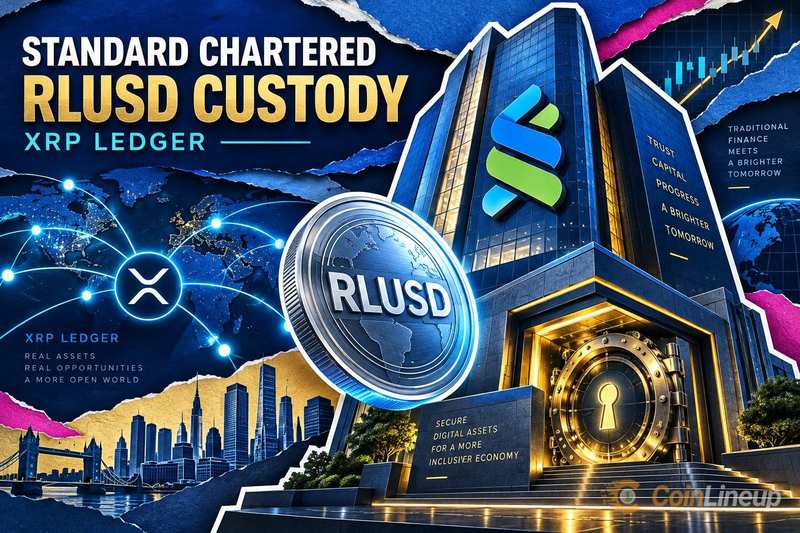
Standard Chartered, one of the world's largest international banks, has launched a custody service for RLUSD on the XRP Ledger. Under the new offering, the bank will safeguard RLUSD holdings on behalf of institutional clients, using the XRP Ledger as the underlying blockchain infrastructure.
RLUSD is a stablecoin, a type of digital asset designed to hold a fixed value pegged to the US dollar. It was issued by Ripple, the company behind the XRP Ledger, a public blockchain built for fast and low-cost payments that has been operating since 2012. RLUSD itself debuted in December 2024 after receiving approval from the New York State Department of Financial Services, and Ripple states that it is fully backed by cash, cash equivalents and US government Treasuries.
In this context, custody refers to the professional safekeeping of digital assets, similar to how a bank holds securities on behalf of investment clients. When a bank offers custody for a digital asset, it assumes responsibility for securing the private keys that control access to those funds.
Why Institutional Custody Matters for RLUSD
For large financial institutions, regulated custody is often a prerequisite before they can hold or work with a digital asset at all. Internal rules, compliance requirements, and risk policies typically require that assets sit with an approved custodian rather than in self-managed wallets.
Standard Chartered's entry into RLUSD custody signals that a regulated global bank considers the stablecoin and the XRP Ledger infrastructure mature enough for institutional-grade services. This is a different signal than retail adoption; it speaks to whether RLUSD can operate within traditional finance workflows. The London-headquartered bank, whose operations are concentrated across Asia, Africa and the Middle East, is also part of a broader industry pattern: global banks such as BNY, HSBC and Northern Trust have built digital asset custody capabilities in recent years, making custody one of the more established institutional crypto services. The broader institutional crypto space has also seen growing scrutiny, as regulators continue to examine how major crypto firms meet their compliance obligations.
For a stablecoin, bank-backed custody can reduce friction in two concrete ways. First, it gives risk-averse institutions a familiar counterparty they already have relationships with. Second, it allows RLUSD to fit inside existing settlement and reporting frameworks without requiring bespoke infrastructure.
What This Could Mean for the XRP Ledger Ecosystem
The XRP Ledger has long positioned itself as infrastructure for cross-border payments and tokenized assets. Standard Chartered's custody launch adds a named institutional participant to that ecosystem, which could make the network more visible to other banks and asset managers evaluating blockchain infrastructure.
That said, the practical impact depends on how much demand exists for RLUSD custody among institutional clients and whether other banks follow with similar offerings. A custody launch is an enabling step, not a guarantee of adoption. Institutional appetite for digital assets has been uneven; Bitcoin and Ethereum ETFs have previously recorded significant outflows over a single week, a reminder that institutional interest does not always translate into sustained inflows.
For anyone holding XRP or watching the XRP Ledger ecosystem, this development is a sign that established banks are building operational infrastructure around Ripple's stablecoin. It does not change RLUSD's peg mechanics or XRP's own market position directly, but it does expand the institutional rails that RLUSD can travel on. From here, the concrete signals to follow are RLUSD's on-ledger activity, whether additional custodians extend support, and whether similar bank services reach other tokenized assets on the ledger.
Disclaimer: This article is for informational purposes only and does not constitute financial or investment advice. Cryptocurrency and digital asset markets carry significant risk. Always do your own research before making decisions.

