Standard Chartered's Reported $2 Target for ENA: What Has to Go Right?
Key Takeaways
- •Standard Chartered has reportedly begun publishing research on Ethena for the first time, assigning ENA a $2 price target with a horizon extending to the end of 2028.
- •Ethena's USDe is a synthetic dollar backed by crypto assets paired with short futures positions, a hedge that reduces directional risk while leaving funding-rate, liquidity, execution, custody and counterparty risks in place.
- •Ethena's fee-switch proposal would allocate a portion of net protocol revenue to ENA buybacks only after defined USDe supply milestones are reached and the governance process approves the framework.
- •The onchain-dollar market is expanding, with adjusted stablecoin volume rising 58% and adjusted transaction count up 35% in the 12 months through August 31, according to Visa Onchain Analytics data cited in the article.
- •ENA is holding its first daily-chart support zone near $0.244-$0.246, while Standard Chartered's prior Chainlink forecast triggered no price move on release day, underscoring that bank targets alone do not drive short-term token prices.
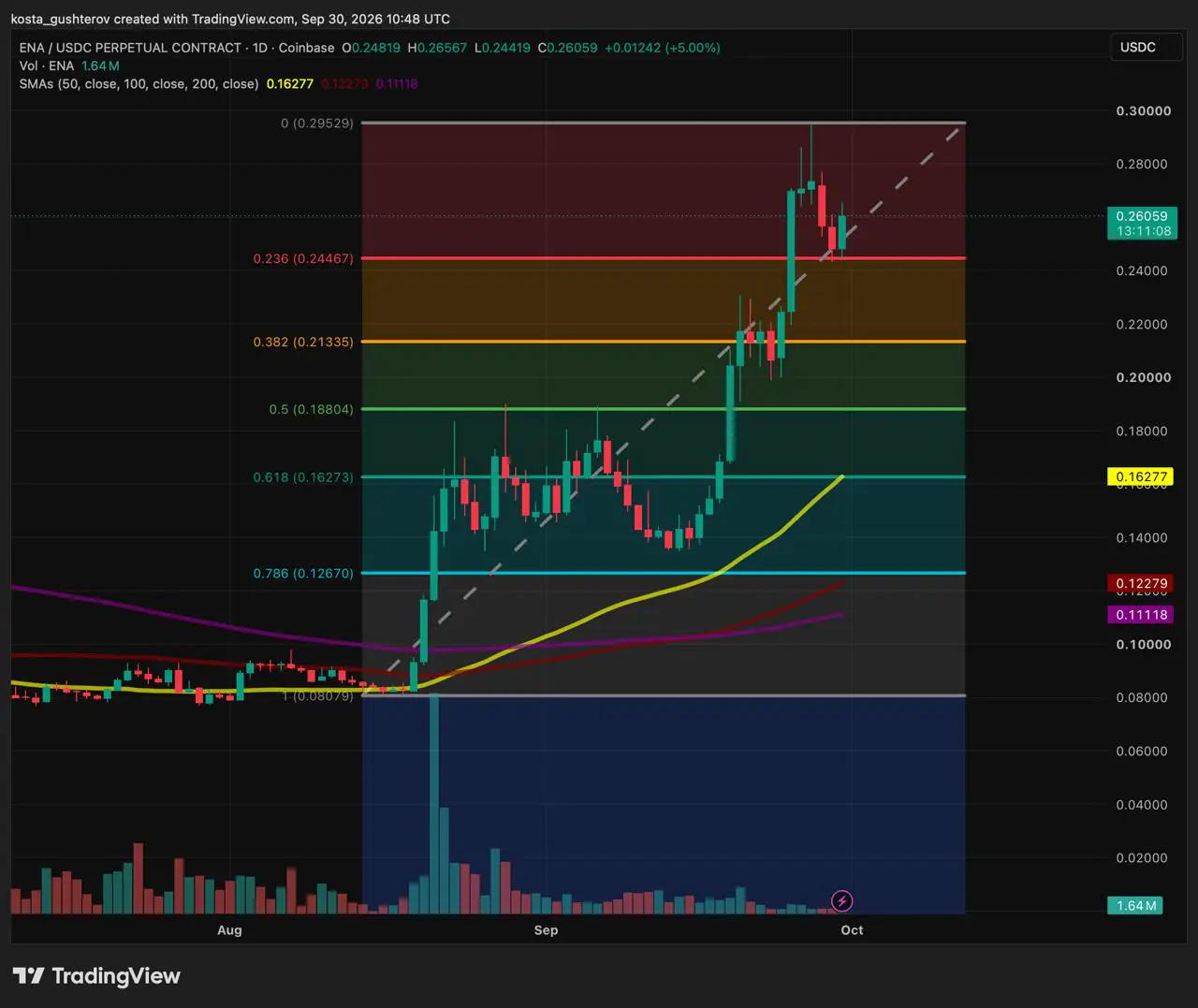
Standard Chartered, the London-headquartered global bank, has reportedly initiated coverage of Ethena (ENA) with a $2 price target extending through the end of 2028, according to The Defiant. Initiating coverage marks the point at which a research team begins publishing a rating and target on an asset, and because the bank's note has not been made public, the case must be assessed through Ethena's business model and the conditions attached to it. Five points frame the discussion: the target horizon runs to the close of 2028; USDe relies on crypto collateral paired with short futures hedges; protocol growth requires a route into ENA value; buyback mechanics remain conditional on governance and milestones; and ENA is holding near $0.245 on the daily chart.
How Ethena's dollar model works
Ethena is a synthetic-dollar protocol built on crypto rails, a different structure from stablecoins that hold cash and cash-equivalent reserves. Its flagship product, USDe, is a dollar-denominated digital asset backed by crypto assets and corresponding short futures positions, according to Ethena's documentation. The design is intended to reduce the impact of directional moves in the collateral: if the crypto assets backing USDe rise or fall, the short derivative positions are meant to move in the opposite direction.
Staking rewards from the collateral and funding payments in perpetual-futures markets — periodic payments between long and short traders that help keep contract prices aligned with spot — can contribute to the returns generated through Ethena's savings product, sUSDe. The hedge, however, is designed only to reduce directional risk. It does not remove funding-rate, liquidity, execution, custody or counterparty risk. For that reason, USDe should be assessed through the resilience of its full operating model rather than its dollar peg alone.
Why the wider onchain-dollar market matters
Digital dollars are increasingly used for settlement, collateral, savings products and tokenized investments, giving protocols such as Ethena a potential role beyond serving traders who need a stable balance between crypto positions. Coindoo recently examined why crypto's next growth phase may be built on dollars rather than Bitcoin. Citing Visa Onchain Analytics, that analysis found adjusted stablecoin volume rose 58% and adjusted transaction count increased 35% in the 12 months through August 31.
Those figures indicate that onchain-dollar rails are expanding. They do not show which protocol will retain the activity, how much of it is economically valuable, or whether a larger stablecoin market will create demand for ENA. Ethena still has to compete for distribution, liquidity and user trust.
Where ENA fits into Ethena's growth
A larger USDe supply could support higher protocol activity and revenue. The benefit to ENA depends on how that revenue is allocated among reserves, operating costs, user rewards, token emissions and tokenholder mechanisms.
The Defiant cited Ethena's buyback programme as part of Standard Chartered's reported investment case. The public fee-switch proposal provides the necessary detail: it would direct part of net protocol revenue to ENA buybacks — repurchases of the token from the market — after specified USDe supply milestones are reached, subject to the governance process and the framework's conditions. That is a possible value-accrual route, not a fixed source of demand. The scale of any buybacks would depend on revenue, the milestones reached and eventual implementation, so a strong USDe growth figure alone tells only part of the story.
Four checks underpin the long-term ENA case:
- USDe supply: Is Ethena attracting and retaining dollar balances?
- Revenue quality: Are funding, staking and other income sources holding up?
- Fee-switch status: Have the required milestones and governance steps been met?
- Token economics: Are buybacks material beside ENA emissions and wider market supply?
A previous Standard Chartered call offers a useful caution
Standard Chartered's earlier Chainlink forecast shows why a bank target should not be treated as a simple explanation for a token's next daily move. Coindoo's team recorded that LINK was largely unchanged on the day the bank released its August forecast, then gained about 6% the following day before extending its recovery in later sessions.
The timing made the forecast part of the market narrative, yet it did not establish that the call caused buying. The current ENA move arrives while altcoins are recovering more broadly, making it even harder to separate interest in one reported target from the wider market backdrop. Past market reactions do not guarantee future results. The Chainlink episode serves mainly as a reminder that analyst coverage can draw attention while price still depends on liquidity, positioning, risk appetite and the token's own technical structure.
ENA is holding its first support area
On the daily ENA/USDC chart, the first support range sits near $0.244-$0.246. The 23.6% Fibonacci retracement lies around $0.2447, and a rising diagonal trendline approaches the same area. Daily closes that keep ENA above this range could indicate that buyers are still defending the latest advance, while a sustained move below it could bring the next, wider support zone into view.
ENA repeatedly stalled, pulled back and recovered around the $0.21-$0.22 area during September's advance. That history gives the 38.2% retracement near $0.213 more context than a Fibonacci line on its own. If the first support weakens, that is the next range where the market could reveal whether buyers remain active.
The reported target creates a framework to test
The $2 call — a level roughly eight times ENA's quoted price near $0.245 — gives ENA a long-term narrative, but the useful evidence will arrive in smaller steps. Readers can watch whether USDe grows outside favourable funding conditions, whether Ethena adds new uses without weakening its risk controls, and whether the fee-switch framework delivers a visible benefit to ENA holders.
For now, the daily chart offers the nearer test around $0.245. The longer-term case rests on Ethena's ability to turn a growing digital-dollar business into durable, measurable value for its token.
This article discusses a Standard Chartered price target reported by The Defiant and is provided for informational purposes only. It does not constitute financial or investment advice.

