At HSC Conference in Ho Chi Minh City, OrbitX's Harsha MV Lays Out the Recipe for a Borderless Stablecoin Neobank
Key Takeaways
- •Harsha MV, Global Head of Marketing and Growth at OrbitX, told the HSC Conference in Ho Chi Minh City that billions of people hold stablecoins, yet only a small fraction of that value circulates through real-world payment rails.
- •The World Bank estimates that sending a $200 remittance still costs more than six percent on average, double the UN's three percent target, while stablecoins like USDT and USDC are widely used as stores of value where local currencies are volatile.
- •The proposed neobank framework pairs custody infrastructure with four "plugs"—payouts, pay-ins, cards, and QR payments—and warns that market entry hinges on rails, compliance, and licensing rather than software, with misconceptions costing teams four to six months per market.
- •Regional payment habits diverge sharply: Vietnam is a QR-first economy where a card product would likely fail, whereas consumers in the UAE and much of Europe rely on contactless payments that make QR solutions largely irrelevant.
- •Obopay, after twenty-four months of development, offers a single API activating market-specific plugs such as virtual IBANs, white-labeled cards, QR payments, and multi-chain support across more than eighty countries, and demonstrated live QR payments for attendees in Vietnam.
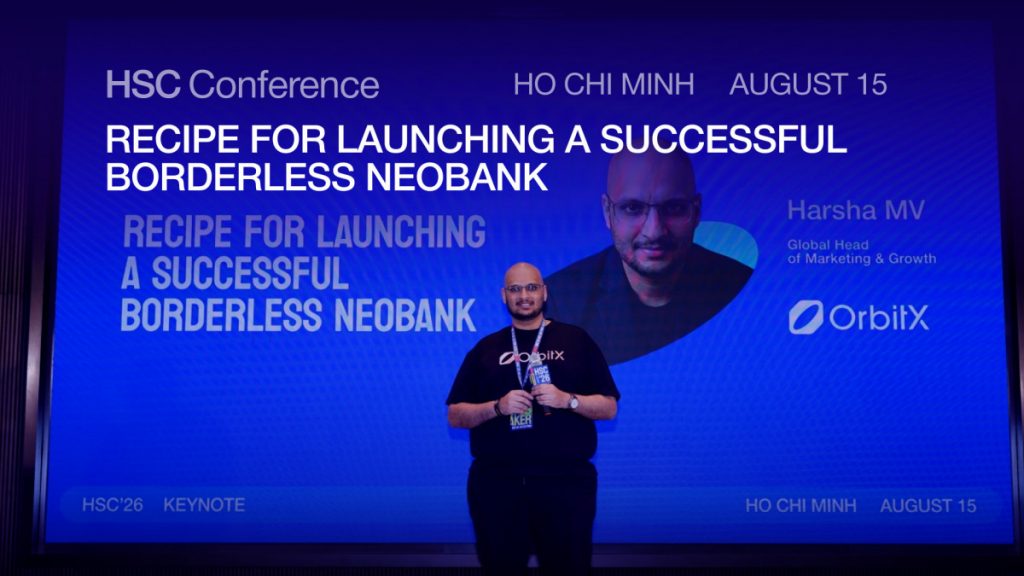
On August 15, HSC Conference convened its latest edition in Ho Chi Minh City, gathering senior figures from financial institutions, technology companies, and the venture capital world to debate blockchain infrastructure, digital assets, and the future of on-chain financial markets.
Among the standout sessions was "Recipe for Launching a Successful Borderless Neobank," delivered by Harsha MV, Global Head of Marketing and Growth at OrbitX. Drawing on extensive fieldwork with the builders of exchanges, wallets, and neo-banks across Latin America, Southeast Asia, and Africa, Harsha challenged the assumption that stablecoin adoption is primarily a software problem. He instead identified what he called the central paradox of digital finance today: billions of people hold stablecoins, yet only a narrow sliver of that value actually circulates through real-world payment rails.
That paradox carries real economic weight. The World Bank estimates that sending a $200 remittance still costs more than six percent on average—double the UN's three percent target—and dollar-pegged stablecoins such as USDT and USDC have become widely used as a store of value and transfer tool in economies where local currencies are volatile. The gap Harsha described sits precisely between holding that value and being able to spend it.
The keynote mapped the strategic, regulatory, and technical ingredients required to close that gap. It introduced a framework built on custody infrastructure and geography-specific "plugs"—from Vietnam's QR-first economy to Europe's contactless card networks—designed to turn static digital balances into functional, borderless money.
Ownership without utility
Harsha described a recurring frustration among entrepreneurs building exchanges, wallets, and neo-banks. "They have users, they have wallets, they have stable coins, but they don't know how to make it useful," he explained.
For millions of holders, the fundamental questions remain unanswered: How can people receive salaries? How can migrant workers remit money home? How does one buy lunch? Addressing these practical gaps, he proposed, is the essential first step toward constructing a viable neo-bank.
The architecture of a neo-bank: custody and plugs
The speaker outlined a two-part framework for building such institutions. The first component is custody: the infrastructure for receiving, holding, and transferring stablecoins across various blockchains. The second, more complex element consists of what he termed "plugs"—the connective tissue that converts digital balances into spendable value.
He identified four standard plugs essential to any functional ecosystem:
- Payouts enable users to transfer stablecoin balances into third-party bank accounts.
- Pay-ins allow funds to flow back into wallets via crypto, fiat, or QR codes.
- Cards leverage existing global card networks to bridge digital assets with merchant infrastructure.
- QR payments facilitate instant settlement, an increasingly critical capability for merchants unwilling to wait days for traditional card clearing.
Geography as strategy: why one size fits none
Perhaps the most critical insight of the session was its emphasis on geographic specificity. Harsha warned that building plugs is frequently misunderstood as a software problem when, in reality, it is a question of rails, compliance, and licensing—a misconception that can cost teams four to six months in every new market. That licensing burden is becoming more concrete rather than less, as major markets from the European Union, whose MiCA regime now regulates stablecoin issuers, to the United States formalize their own stablecoin rules.
He illustrated the point with vivid regional contrasts. Vietnam, he noted, is a "QR-first" economy where even street vendors prefer instant QR transactions; launching a card product there would likely fail. The venue itself underscored the point: Vietnam has repeatedly ranked at or near the top of Chainalysis' Global Crypto Adoption Index, and QR payments became ubiquitous after the domestic VietQR standard was introduced by the National Payment Corporation of Vietnam in 2021. Conversely, in the UAE and much of Europe, consumers are deeply accustomed to contactless payments, making QR solutions largely irrelevant.
He further highlighted vertical opportunities. In Nigeria, a stablecoin neo-bank serving importers could eliminate the seven to twelve percent premium they currently pay to access dollars. In Brazil, a targeted service allowing parents to fund local BRL accounts for children studying abroad could dramatically simplify cross-border education payments.
A vertical recipe for market entry
Against the temptation to build universal platforms, Harsha offered a disciplined recipe: select a market, identify a specific audience within it, determine one or two inward and outward plugs that match local behavior, and launch narrowly.
"If you don't go vertical, if you don't try to dominate one particular category in one market, one use case, you will literally fail at the end of it," he cautioned, stressing that stablecoin-based neo-banks cannot afford to be everything to everyone.
The infrastructure layer
Concluding the session, Harsha positioned Obopay—a payments firm with roots in early mobile-money deployments across emerging markets—as the infrastructural response to these challenges. After twenty-four months of development, the firm offers a single API designed to activate market-specific plugs—ranging from named virtual IBANs and white-labeled credit cards to QR payments and multi-chain support—across more than eighty countries.
To demonstrate the technology's maturity, his team launched a live application featuring QR payments for attendees in Vietnam, inviting the audience to experience firsthand the speed of stablecoin-powered transactions.
By the session's own logic, the yardstick for this corner of the industry will be measured less in wallet counts and more in how much stablecoin value actually moves through local payment rails—the very gap the keynote set out to close. For builders seeking to transform digital assets into functional financial tools, the session offered both a strategic roadmap and a ready infrastructure partner.
Originally published by Metaverse Post.

