Stablecoin Supply Contracts by Over $20 Billion in 2026, Set for First Annual Drop Since 2023
Key Takeaways
- •Stablecoin supply has fallen by $20.7 billion in 2026, setting the sector on course for its first yearly contraction since 2023, when supply dropped by $7 billion.
- •November's $14.8 billion reduction was the largest monthly decline since the collapse of Terra UST in May 2022.
- •Tether's USDT supply shrank by $8.1 billion over 60 days to $173.7 billion, its largest such contraction since August 2022, while Circle's USDC fell to $69.3 billion from above $79 billion in March.
- •Declines varied across issuers, with Sky Dollar down 53% over 30 days and PayPal USD down 19%, while Ethena's USDe and Ripple's RLUSD were the only top-ten stablecoins to grow supply.
- •Bitcoin and Tether network address activity has risen despite falling supply, which Santiment analysts view as potentially strengthening the case for a more sustainable market recovery heading into 2027.
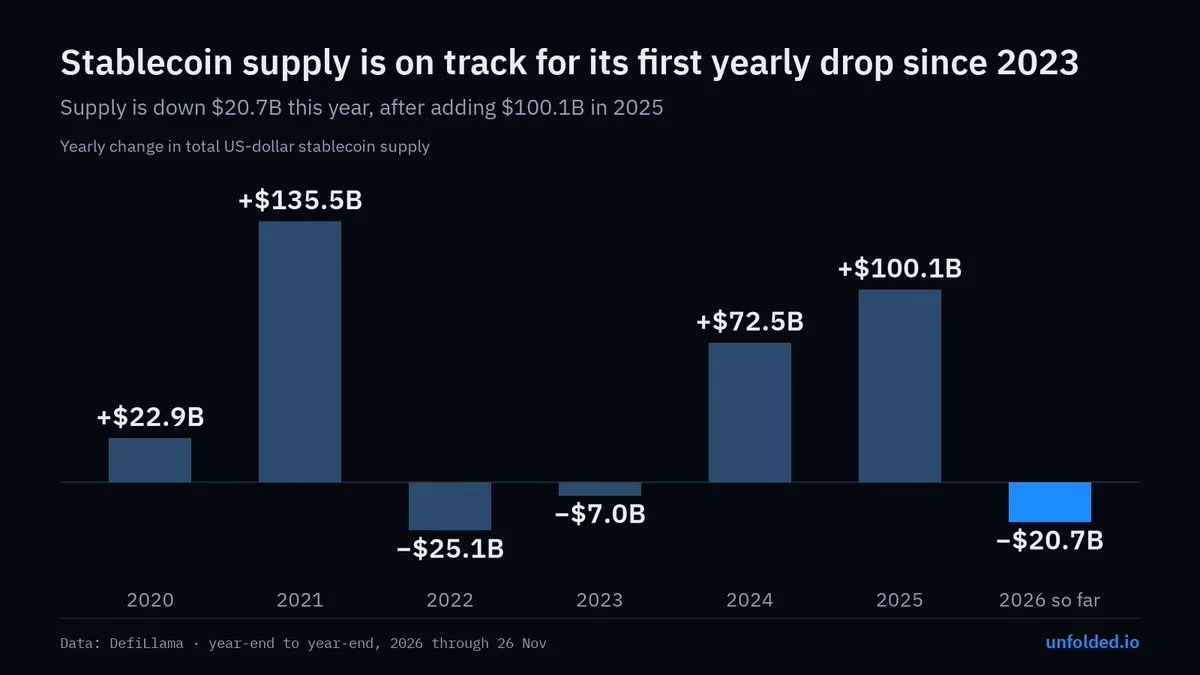
The stablecoin market has contracted by more than $20 billion in 2026, putting the sector on track for its first annual decline since 2023 and adding to evidence of a broad contraction across the cryptocurrency market. Stablecoins — blockchain tokens pegged to the US dollar — underpin much of the trading and settlement activity across crypto markets, which is why their aggregate supply is widely tracked as a gauge of how much capital sits inside the crypto economy.
According to the crypto insights account Crypto Unfolded, the total supply of US dollar-denominated stablecoins has fallen by $20.7 billion so far this year. The drop has been particularly evident in November, with $14.8 billion wiped from the stablecoin market cap — the largest monthly decline since the collapse of Terra UST in May 2022.
The contraction has not been uniform through the year. The stablecoin market cap opened 2026 at $300 billion and rose to $310 billion by May before entering a sustained decline. It briefly crossed back above $300 billion in late August as the crypto market recovered, but has since retreated alongside falling prices. Over the past 30 days, the total market cap has dropped 5% to $280 billion, according to DeFiLlama data.
On Track for First Yearly Drop Since 2023
The current decline would mark the sector's first annual contraction since 2023, when stablecoin supply fell by $7 billion. It is a sharp reversal from last year, when supply grew by more than $100 billion.
The drop is spread across all USD-pegged stablecoins. Tether (USDT), which at its peak had around $190 billion in total supply, is now down to $173.7 billion. USDT supply has fallen by $8.1 billion over the past 60 days, according to CryptoQuant — its largest contraction over that period since August 2022.
Circle's USDC has declined in parallel, hitting $69.3 billion after climbing above $79 billion in March 2026. The divergence has helped lift USDT dominance to 62%.
Performance has varied across the sector. Sky Dollar (USDS) has seen its supply crash by 53% over the past 30 days, driven by a $2 billion outflow and liquidity issues. World Liberty Financial's USD1 is down 27% in the same period, while PayPal USD has lost 19% of its market cap.
Gainers are scarce: Ethena's USDe and Ripple's RLUSD are the only top-ten stablecoins to have increased supply over the last 30 days. Elsewhere, Open USD (OUSD) gained 20% to cross the $1 billion mark, while SoFiUSD rose 9.55%.
Stablecoin Squeeze Weighs on Bitcoin Recovery
The mechanics behind these moves are straightforward: stablecoin supply expands when issuers mint new tokens against incoming dollars and shrinks when holders redeem, making it a running measure of dollar flows through crypto markets. The contraction in stablecoins could signal further trouble for the broader crypto market. A shrinking stablecoin supply indicates investors are moving cash out, meaning liquidity across crypto markets is drying up. That could cement the contraction in demand of the current cycle, with no dry powder waiting on the sidelines to buy dips and support prices.
Some analysts, however, view the contraction as a possible signal that the Bitcoin bear market is nearing its bottom. That was the outcome the last time USDT recorded its largest 60-day supply contraction.
Notably, activity on the Bitcoin and Tether networks has been increasing even as prices and supply decline. Bitcoin is logging more than 50,000 addresses daily, while USDT has recorded over 25,000 addresses daily on Ethereum — the same network where most of its supply decline has taken place.
Analysts at Santiment consider this a positive development that could "strengthen the case for a more sustainable market recovery heading into 2027."
With 2026 drawing to a close, the data points worth watching include whether the pace of monthly declines eases from November's $14.8 billion drop, whether USDT and USDC issuance stabilizes near current levels, and whether the elevated address activity on Bitcoin and Ethereum persists into year-end.
This article provides market information and does not constitute financial or investment advice.
Source: The Market Periodical

