Whales Lead as $30B in Stablecoin Liquidity Returns to Crypto Markets in September
Key Takeaways
- •Whale-led stablecoin inflows added roughly $30 billion in liquidity to crypto markets over the past 30 days, reversing the outflows recorded in early August.
- •Deposits above $1 million sent to Binance rose 40% over the past 30 days, and the exchange's stablecoin reserves stood around $42 billion as of October 2 after peaking at $43.8 billion on September 8.
- •Retail stablecoin participation weakened even as whale inflows grew, with daily active addresses falling 8.1% to about 5.1 million and daily turnover declining 32% to roughly $244 billion.
- •Total stablecoin supply reached $300.9 billion on October 1 across 195 assets, 152 issuers and 47 chains, and stablecoin issuers collectively hold over $200 billion in US Treasuries.
- •Over the third quarter, Ethereum lost $4.9 billion in stablecoin supply while TRON gained $5 billion, and HyperEVM added $1.5 billion in stablecoin liquidity.
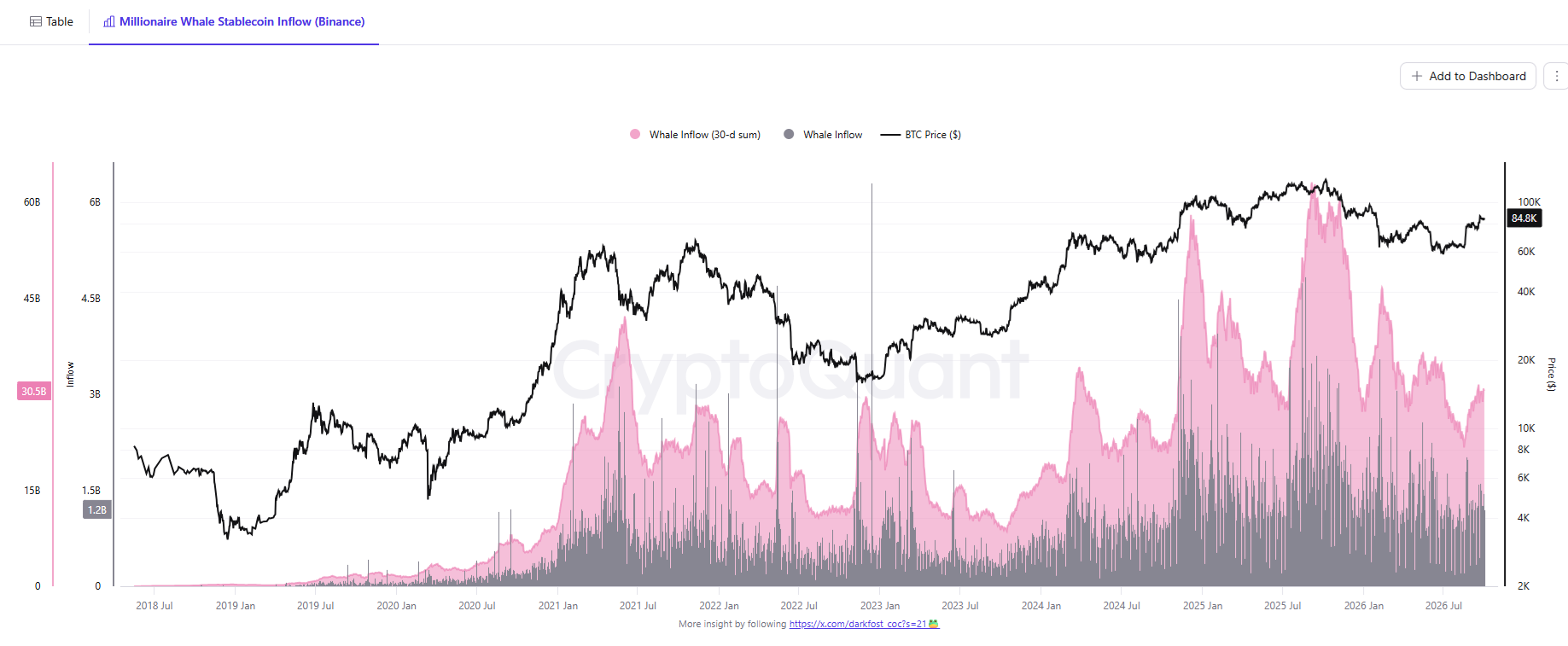
Roughly $30 billion in stablecoin liquidity flowed back into crypto markets over the past 30 days, led by whale deposits, reversing the outflows recorded in early August.
Stablecoins were a major source of market liquidity in September. As dollar-pegged tokens that serve as the market's on-chain cash, their movement onto exchanges is widely read as a gauge of trading-ready capital. Whale deposits added $30B in total liquidity, and the latest recovery of BTC above $85,000 coincided with another wave of stablecoin inflows.
September also broke the trend of subdued stablecoin activity. On-chain data showed a 40% increase in deposits above $1M sent to Binance over the past 30 days. During slower market periods, stablecoins often wait on the sidelines or are deployed into DeFi yield strategies where the risk is justified.
Inflows to Binance expanded from around $26B to over $30B in September, extending a trend that began around August 14. As Cryptopolitan reported, stablecoins have remained in demand recently and continue to be a major factor in crypto sentiment.
The new liquidity deployment indicated that whales sought to make use of the trend shift and position themselves for an October rally. Allocation remains cautious, however, as BTC is still shaky in the face of global uncertainty and growing bond yields.
Stablecoin inflows to Binance signal early market recovery
Stablecoin inflows to Binance remain weaker compared with previous market peaks. In the short term, however, the stablecoins are seen as a bullish signal, preparing for more asset exposure.
The inflows may also go toward derivatives trading, leading to expanded open interest, which is not necessarily immediately bullish. Some whales may attempt to short crypto assets from what they consider a temporary peak.
At the same time, the inflows coincided with a period of renewed large whale orders on Binance, signaling that some of the liquidity translated into direct spot demand.
The market recovery is still tentative, as Binance stablecoin reserves fluctuated over the past month. As of October 2, the exchange carried around $42B in stablecoin reserves, after peaking at $43.8B on September 8. All other exchanges combined hold around $58B in stablecoins. Liquidity is also shifting between markets, with some outflows from spot markets and into derivatives. Whether deposits above $1M keep expanding and reserves hold near their recent peak offers a running measure of how much of this whale-led liquidity stays in place.
Stablecoins became a leading narrative in September
Stablecoins saw rising social media volume, becoming one of the narratives in focus according to Santiment. Mentions also increased around discussion of the US Clarity Act. Stablecoins are more closely watched as issuers now hold over $200B in US Treasuries, turning them into some of the biggest debt holders and even offsetting debt shedding by China. Because the tokens are backed by reserve portfolios that include government debt, stablecoin growth now translates directly into demand for US Treasuries.
Despite the overall focus on stablecoins, retail behavior shows slower usage. Over the past 30 days, active addresses are down 8.1% to around 5.1M daily. According to Artemis, daily turnover is around $244B, down 32% in the past 30 days. Whale activity may have more impact on prices, but retail shows overall crypto sentiment and readiness to use stablecoins. The divergence indicates that September's liquidity build-up was concentrated among large holders rather than broad retail participation.
Q3 also brought shifts in stablecoin usage, according to a recent report by the RWA Foundation. Total stablecoin supply stood at $300.9B on October 1, with 195 assets, 152 issuers and 47 chains. A total of 308.4M addresses held stablecoins.
Over the past three months, Ethereum lost $4.9B in stablecoins, while supply on TRON increased by $5B. Tether's USDT supply contracted by $207.7M, while stablecoins by Circle and Ripple posted more active growth.
For retail and native traders, stablecoin growth on HyperEVM showed renewed activity, adding $1.5B in liquidity for Q3. Robinhood Chain added $649.2M in stablecoins over the same period, driving its own brand of trading and meme launchpads.

