Stablecoins Are Quietly Becoming Business Infrastructure, NOWPayments Data Shows
Key Takeaways
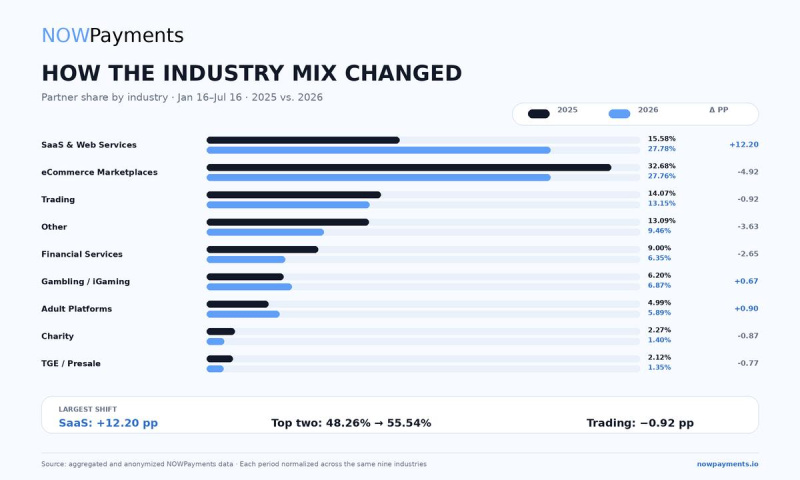
- •SaaS and eCommerce increased their combined share of NOWPayments' classified partner base from 48.26% to 55.54% year over year, a rise of 7.28 percentage points.
- •SaaS and web services grew from 15.58% to 27.78% of the partner sample, narrowing the gap with eCommerce Marketplaces, which stood at 27.76%, to just 0.02 percentage points.
- •Trading's share declined from 14.07% to 13.15%, leaving it third behind SaaS and eCommerce in the 2026 dataset.
- •USDT on TRON (TRC20) accounted for 54.58% of measured successful payments in eCommerce marketplaces, compared with 12.04% in trading and 9.60% in SaaS and web services.
- •NOWPayments recommends that businesses define their billing, checkout, settlement, payout, and reconciliation workflows before choosing stablecoin assets and networks.
Tallinn, Estonia, October 8, 2026 — Chainwire
SaaS and eCommerce increased their combined share of the classified partner base at NOWPayments from 48.26% to 55.54% year over year, while Trading slipped from 14.07% to 13.15%, newly aggregated data from the crypto payments platform shows.
Businesses can build stablecoin infrastructure around the wrong problem. The common mistake treating stablecoins — tokens designed to hold a steady value against a reference asset such as the US dollar — primarily as a coin-and-network decision. For a digital business, stablecoins may need to support a much broader set of operating workflows, including billing, checkout, settlement, payouts, and reconciliation — and which of those workflows matters most depends on the business model.
The new figures show the industry mix shifting toward companies that use payments as part of their day-to-day operations. Between January 16 and July 16, 2026, SaaS and web services accounted for 27.78% of classified partners, while eCommerce Marketplaces followed at 27.76%. Together, the two sectors represented 55.54% of the sample. During the same period in 2025, their combined share stood at 48.26%. The increase of 7.28 percentage points represents a 15.08% year-over-year rise in their combined share.
Trading remained an important part of the sample, but its share moved in the opposite direction, declining from 14.07% in 2025 to 13.15% in 2026 and leaving trading in third place behind SaaS and eCommerce.
The clearest upward shift came from SaaS, whose share from 15.58% to 27.78% in a single year, closing a 17.10 percentage point gap with eCommerce. The emerging picture is not one of stablecoins replacing trading. It is stablecoin adoption expanding into the operating infrastructure of digital businesses.
Unless otherwise stated, industry-distribution figures compare January 16 to July 16, 2025, with January 16 to July 16, 2026.
Partner Mix Shifting Toward Operational Use Cases
In 2025, eCommerce marketplaces led the dataset at 32.68%, with SaaS and Web Services following at 15.58% and Trading close behind at 14.07%. One year later, SaaS had raised its share by 12.20 percentage points to 27.78%, while eCommerce stood at 27.76% — leaving only 0.02 percentage points between the two sectors. Their combined share rose from 48.26% to 55.54%.
More than half of the classified partners in the 2026 sample therefore came from two sectors built around digital transactions, recurring services, and online customer relationships. For companies still weighing whether stablecoins belong in their operations, that composition is the detail worth noting: the fastest-growing segments are businesses that treat payments as part of daily workflows — billing, settlement, payouts — rather than around trading.
The rest of the partner mix changed more gradually. Financial Services moved from 9.00% to 6.35%. Gambling and iGaming increased from 6.20% to 6.87%, and adult platforms rose from 4.99% to 5.89%. Charity declined from 2.27% to 1.40%, while TGE/Presale — token generation events and presales — moved from 2.12% to 1.35%.
These figures measure changes in each industry's share of the sample rather than absolute partner growth. A category may lose share simply because another category expanded faster.
Methodology: Each percentage represents an industry's share of the full aggregated partner sample classified across the same nine categories. The comparison covers January 16 to July 16 in both 2025 and 2026, and each period was normalized independently. Absolute partner counts are not disclosed, and percentages are rounded to two decimal places. The findings describe partner distribution within the NOWPayments dataset, not payment volume, transaction value, or market-wide industry share.
Different Business Models Need Different Stablecoin Workflows
The industry data becomes useful when translated into the operating questions each business model may need to solve.
For a SaaS company, stablecoin payments may need to connect with recurring billing, invoice matching, account activation, renewals, settlement, and financial reconciliation.
A marketplace may need stablecoins to work across a longer flow — the payment can begin at checkout and continue through refunds, seller settlement, affiliate commissions, and other payouts.
Trading platforms face a different set of requirements, where priorities may include asset and network coverage, confirmation policies, liquidity, and treasury controls.
These are potential workflow drivers, not a universal description of every company in each category. The same stablecoin can serve all three sectors while performing a different operational job in each one. This is why a business should define the workflow before choosing the asset and network.
Network Mix Also Changes by Industry
Successful-payment data shows that industry differences extend to network usage.
USDT on TRON — Tether's dollar-pegged token issued on the TRON network under the TRC20 standard — accounted for 54.58% of the measured successful-payment sample within eCommerce marketplaces. Its share was 12.04% in trading and 9.60% in SaaS and web services. Within this dataset, USDT TRC20 was about 4.5 times as prominent in eCommerce as in Trading, and 5.7 times as prominent as in SaaS.
The corresponding shares were 4.76% in Gambling and iGaming, 1.85% in Financial Services, 1.49% in Other, and 0.60% in Charity. Adult Platforms and TGE/Presale each recorded a 0% share in the analyzed sample.
The difference supports the same conclusion as the industry data: a stablecoin setup that fits one business model may not fit another. For an eCommerce business, USDT on TRON may play a visible role in checkout activity. A SaaS company may see a different asset and network mix, while trading platforms may need broader coverage across both. Businesses should validate these decisions against their own successful-payment data instead of importing the preferences of another industry.
Methodology: Each percentage represents USDT TRC20's share of the aggregated successful-payment sample within the corresponding industry. Absolute transaction counts are not disclosed, and failed, expired, refunded, and test transactions are excluded. The figures describe activity within the NOWPayments ecosystem and should not be interpreted as market-wide currency shares. A 0% result means that no successful USDT TRC20 payments were recorded in the analyzed sample for that category.
Build the Workflow Before Choosing the Rails
Five operating areas provide a practical framework for evaluating stablecoin infrastructure:
- Billing: Does the payment need to connect with invoices, subscriptions, renewals, or account access?
- Checkout: Which assets and networks produce completed payments for the company's actual customers?
- Settlement: Which asset should the business receive, and when should funds become available?
- Payouts: Will funds need to move to sellers, affiliates, contractors, or customers?
- Reconciliation: How will the finance team match transactions with invoices, orders, and internal reporting?
Not every business needs all five. A SaaS platform may focus on billing and reconciliation; a marketplace may need checkout, settlement, and payouts; a trading platform may prioritize network coverage, liquidity, and treasury controls. A company should first identify which workflows apply, and asset and network selection comes after that.
The mistake is asking which stablecoin best. The better question is: best for what? Businesses should define the billing, checkout, settlement, payout, and reconciliation flow first. The coin and network should serve that workflow — not the other way around.
Lifshits explores the commercial side of crypto payments in her Cryptopolitan series, Crypto That Works for Business. The first column, The 22% Sales Boost Hiding in Your Crypto Checkout, examined how payment infrastructure can affect checkout performance. Future installments will continue looking at where crypto payments can increase revenue, lower costs, and remove operational friction.
If future rounds of this aggregation extend the comparison, three markers already stand out from the data: the SaaS–eCommerce gap, now just 0.02 percentage points; the trajectory of Trading's 13.15% share; and whether USDT TRC20's uneven spread across industries persists.
Stablecoin strategy starts with the job the money needs to do. The coin and network come next.
About NOWPayments
NOWPayments is a crypto business ecosystem designed to help companies accept payments, automate mass payouts, manage stablecoin treasury, and scale global digital asset operations through a single infrastructure. The platform supports more than 350 cryptocurrencies, over 30 stablecoins, flexible settlement options, and enterprise-grade APIs.
Media contacts: Angelina T, PR Manager, NOWPayments — angelina.tmk@nowpayments.io; Kate L, Commercial Director, NOWPayments — kate.l@nowpayments.io

