Spot Bitcoin ETFs Post Seven-Day Inflow Streak Amid Persistent Bear Market Concerns
Key Takeaways
- •US spot Bitcoin ETFs attracted $981 million in net inflows over seven consecutive days starting July 14, marking the longest such streak in nine months.
- •BlackRock's iShares Bitcoin Trust led ETF flows on July 22 with $38.78 million in net inflows out of a total $69 million across all spot Bitcoin ETFs that session.
- •Grayscale cautioned that Bitcoin's current bear market could extend through September or October, citing the four-year crypto cycle framework tied to halving events.
- •Crypto analyst Justin Bennett reported that BTC whales have reduced their long exposure relative to retail traders, potentially indicating distribution rather than accumulation.
- •Santiment warned that an unusually large single-day ETF inflow could signal excessive investor FOMO and potentially mark the formation of a local market top.
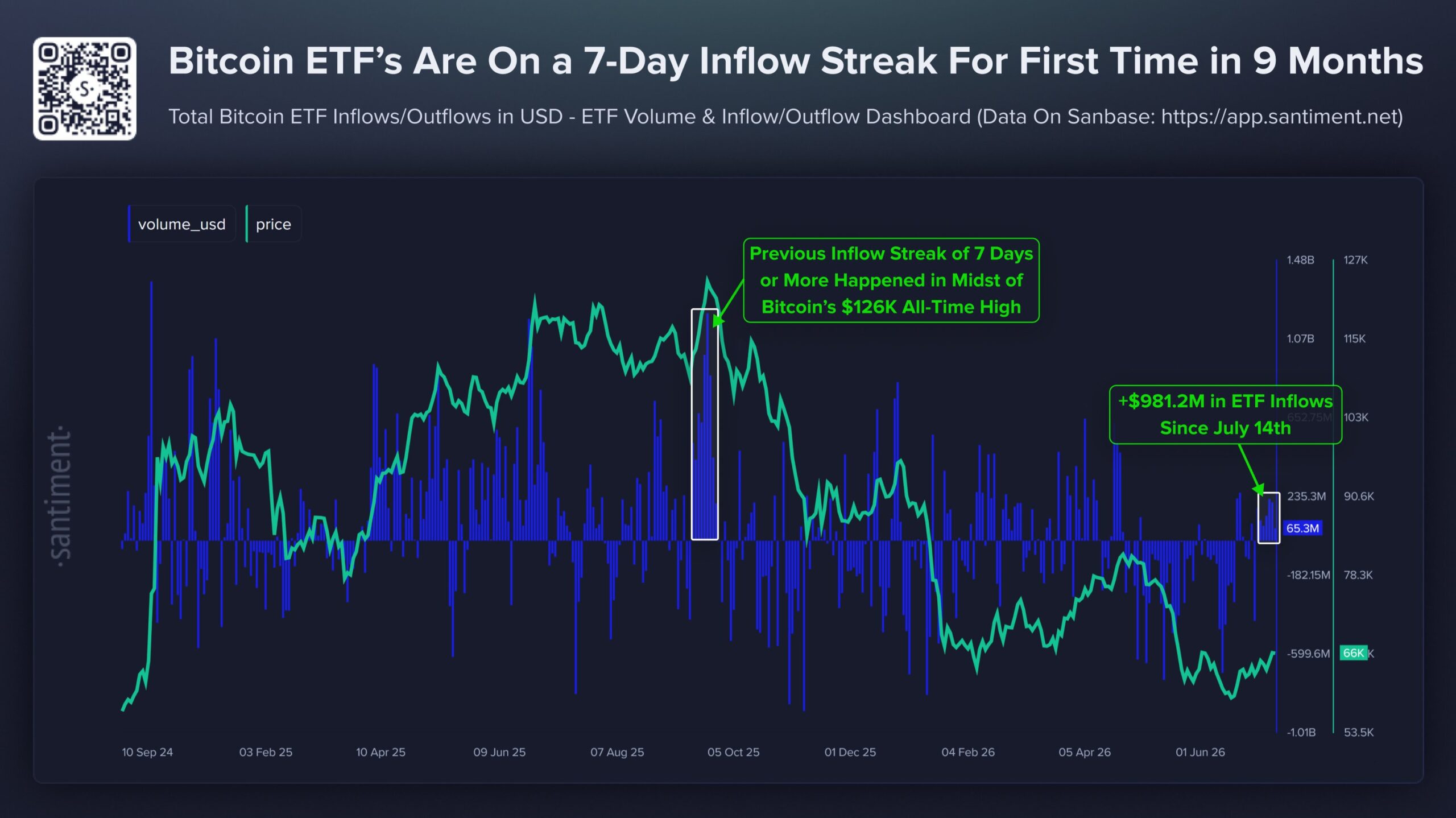
US spot Bitcoin ETFs have recorded seven consecutive days of net inflows for the first time in nine months, drawing $981 million back into Bitcoin investment funds as BTC trades above $66,000. The products, approved by the SEC in January 2024, have become a key barometer of institutional sentiment toward crypto, bridging traditional finance and digital asset markets. BlackRock's iShares Bitcoin Trust (IBIT) has led the latest wave of institutional demand, though analysts and asset managers remain divided on whether the streak signals a definitive end to the Bitcoin bear market.
Seven-Day ETF Inflow Streak
Market intelligence platform Santiment reported that US spot Bitcoin ETFs have seen seven straight days of net inflows since July 14. Over this period, $981 million returned to Bitcoin investment funds as BTC price climbed past $66,000.
According to Santiment, the sustained inflows represent a notable turnaround following heavy outflows during May and June, indicating that investor confidence in Bitcoin is recovering. The analytics firm noted that the last ETF inflow streak of comparable length occurred in early October 2025, when Bitcoin was approaching its all-time high of $126,000. Santiment added that current inflows could provide sufficient momentum to push BTC toward $70,000.
However, the firm cautioned that an unusually large single-day ETF inflow could signal excessive investor FOMO, potentially indicating the formation of a local market top.
On Wednesday, July 22, spot Bitcoin ETFs recorded net inflows of $69 million. BlackRock's IBIT led the session, posting net inflows of 589 BTC worth $38.78 million, according to data from Farside Investors. The spot Bitcoin ETF also generated approximately $900 million in trading volume during the session. IBIT has consistently dominated spot Bitcoin ETF flows since launch, reflecting BlackRock's position as the world's largest asset manager and its ability to channel established institutional client demand into the crypto vehicle.
Grayscale: Bear Market May Persist Through Autumn
Despite the recovery in institutional inflows, investors remain uncertain whether the streak marks the end of the Bitcoin bear market. Crypto asset manager Grayscale stated that Bitcoin's current bear market could persist until September or October, based on the four-year crypto market cycle thesis — a framework historically tied to Bitcoin's halving events, which cut the rate of new BTC supply roughly every four years and have coincided with major market cycle turning points.
According to Grayscale, previous Bitcoin bear markets typically bottomed approximately one year after the market peak, with BTC experiencing drawdowns of up to 80%. Over the past year, BTC price has declined roughly 50% from its all-time high of $125,000.
However, Grayscale indicated it places greater emphasis on a macroeconomic framework. The asset manager believes BTC has matured as an asset class, with its performance closely tied to economic growth and interest rate movements. For Bitcoin to thrive under this scenario, Grayscale stressed the importance of a resilient US economy, noting that attention will remain focused on upcoming Federal Reserve interest rate decisions. This reflects a broader shift among institutional investors who increasingly evaluate Bitcoin alongside traditional risk assets, weighing factors such as inflation trajectories, real yields, and global liquidity conditions.
Whales Reduce Long Exposure
Crypto analyst Justin Bennett suggested that Bitcoin may be exhibiting signs of distribution rather than accumulation. Citing on-chain indicators, Bennett said BTC whales have reduced their long exposure relative to retail traders.
The analyst noted that this shift in whale positioning does not necessarily signal an imminent selloff but urged investors to remain cautious at this stage. Bennett added that although market participants expect Bitcoin to rally toward $67,300 and $69,000, the current move lacks sufficient fuel to sustain upward momentum.
He identified $66,240 as a key support level, stating that the uptrend remains intact as long as BTC holds above it on the 4-hour timeframe and higher.