SpaceXAI Releases Grok 4.6, Undercutting Rivals on AI Pricing
Key Takeaways
- •Grok 4.6 is priced at $2 per million input tokens and $6 per million output tokens, compared to $5 and $15 for GPT-5.6 Sol and $5 and $25 for Claude Opus 5.
- •The model is specifically designed for long-running agents that autonomously perform multi-step tasks including research, coding, and iterative development.
- •Grok 4.6 integrates with the Cursor AI coding platform, which SpaceXAI acquired in June, to strengthen its appeal to enterprise developers.
- •Analysts warn that total AI costs include API fees, inference, caching, integration effort, and vendor lock-in risks not reflected in per-token pricing.
- •SpaceXAI's accelerated release schedule, with Grok 4.7 already announced, may create friction for enterprise teams needing stability windows for testing and compliance.
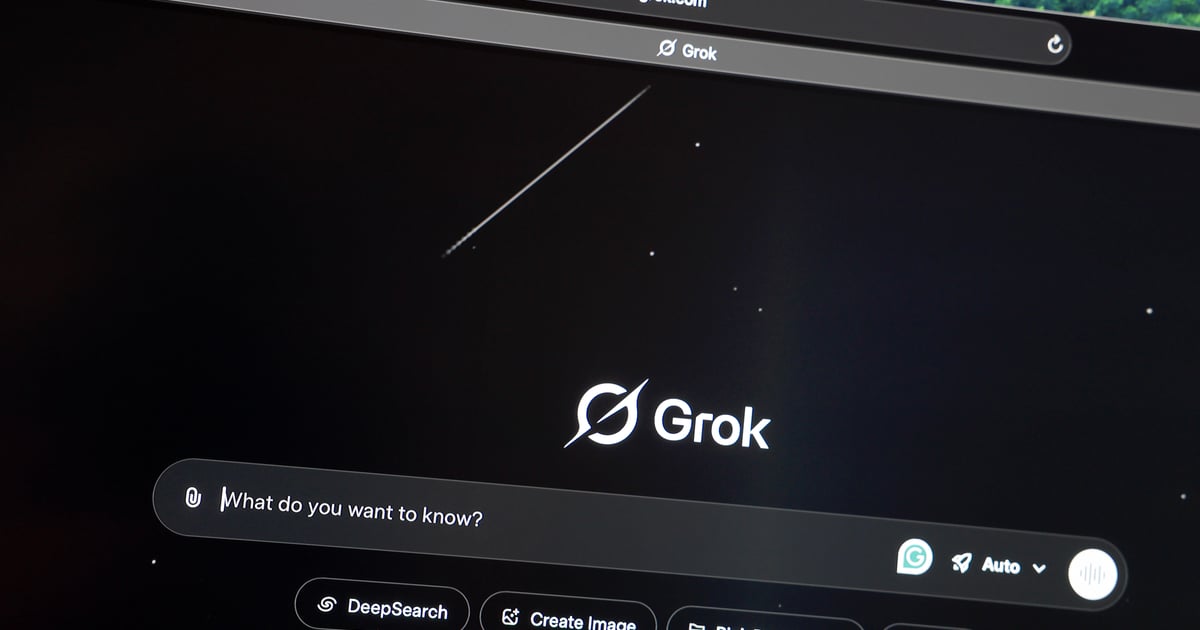
As the AI pricing war intensifies, Elon Musk's SpaceXAI is positioning itself to offer enterprises the most cost-efficient frontier model with the release of Grok 4.6.
Introduced this week — just over a month after Grok 4.5 — Grok 4.6 is designed primarily for long-running agents, AI systems that can autonomously execute multi-step tasks such as researching, coding, and iterating on a goal over extended periods. According to SpaceXAI, the model was trained on a variety of agentic reinforcement learning tasks spanning knowledge work, general coding, and domain-specific environments. The vendor states that Grok 4.6 is effective at transforming a broad product concept into a functional first version and at evaluating its own output.
While Grok 4.6 competes with frontier models such as Anthropic's Claude Code and OpenAI's GPT-5.6 in supporting long-running agents, it is priced significantly below those alternatives. The pricing strategy appears aimed at enterprises grappling with the high costs of deploying more expensive AI models, a concern that has grown as organizations move from pilot projects to production-scale deployments where token consumption — the fundamental unit of how API-based AI services are billed — can multiply rapidly.
"It's really more about AI economics than anything else," said Sid Nag, founder and chief research officer of independent analyst firm Tekonyx. "There's a pricing war going on in this industry."
AI Pricing War
Price competition in the AI market has become increasingly visible, with major model providers rolling out cheaper models in recent months. OpenAI's latest model is less expensive than its predecessors, and Anthropic has followed a similar trajectory with recent releases. The downward pressure reflects a broader dynamic: as the number of capable frontier models has increased, differentiation on raw capability has narrowed, pushing vendors to compete on cost per token as a primary adoption lever. Even so, Grok 4.6 remains less costly than the offerings from its two more established rivals, both of which command substantially larger customer bases.
Grok 4.6 is priced at $2 per million input tokens and $6 per million output tokens. By comparison, GPT-5.6 Sol costs $5 per million input tokens and $15 per million output tokens. Claude Opus 5 is priced even higher, at $5 per million input tokens and $25 per million output tokens.
"Grok is addressing the tokenomics aspect of the market," Nag said, referring to the rapidly growing practice of optimizing token usage to control costs.
Grok 4.6's integration with the AI coding platform Cursor — which SpaceXAI acquired in June — adds to its appeal for enterprise developers. The emphasis on long-running agents could also translate into meaningful productivity gains. Nag noted that when enterprises need to scale up their input and output token volumes to drive productivity, the model that enables them to do so at the lowest token price is likely to be the one they select.
"So that boils down to pricing," he said.
Remaining Challenges
Despite its competitive pricing, SpaceXAI still faces hurdles. Cheaper tokens do not necessarily equate to cheap AI, Nag cautioned. Enterprises must also account for additional expenses — such as API fees, inference costs, and caching — that are not reflected in per-token pricing. For organizations evaluating total cost of ownership, factors such as developer integration effort, existing toolchain compatibility, and vendor lock-in risk also weigh heavily in procurement decisions.
Nag added that SpaceXAI will need to ensure its governance policies are compatible with enterprise requirements. The company may also need to give greater consideration to its model lifecycle and release cadence so that enterprise customers can effectively plan their adoption strategies. SpaceXAI only just released Grok 4.6, and Musk said this week that the company plans to release Grok 4.7 in the near future. The accelerated release schedule — a pattern now common across the industry — can create friction for enterprise teams that require stability windows for testing, compliance review, and deployment planning.
