SpaceX Stock Reclaims IPO Price as Vietnam's VinSpace Secures Satellite Launch Deal
Key Takeaways
- •SpaceX will launch VinSpace's first satellites in the second quarter of 2027 aboard its Transporter rideshare program, consolidating multiple customer payloads on a single rocket.
- •SPCX shares recovered to $138.74 after falling near $105 in early August, with Monday's 4.2% gain building on a roughly 16% surge on August 7 despite a doubling of public float.
- •SpaceX posted $7.8 billion in second-quarter revenue, up 92% year-over-year, but recorded a $541 million net loss driven by $18.4 billion in AI-related capital expenditures.
- •VinSpace was established by Vingroup in November with approximately $11.5 million in committed capital and is 71% owned by founder Pham Nhat Vuong, Vietnam's wealthiest individual.
- •Vietnam designated space technology a national strategic priority for the first time in 2024, having previously placed a satellite in orbit with VINASAT-1 in 2008.
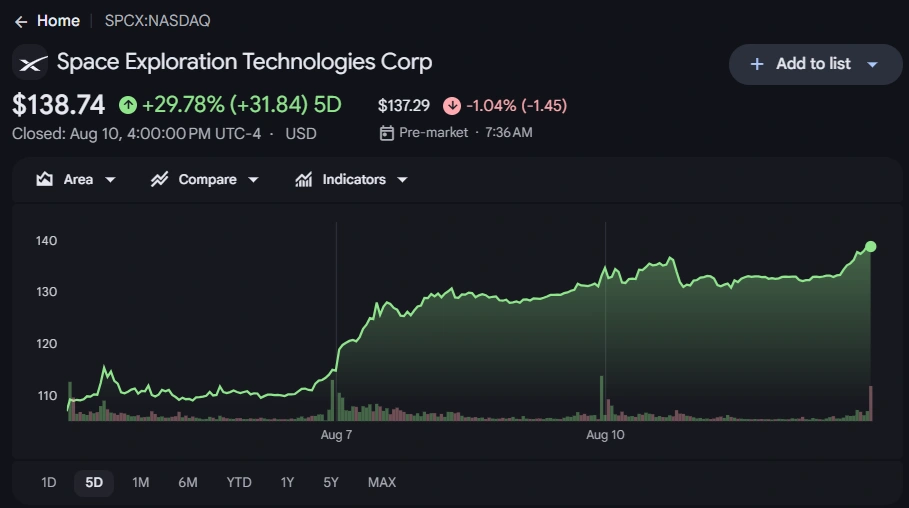
SpaceX (NASDAQ: SPCX) closed above its $135 IPO price on Monday for the first time in recent weeks, propelled by news that the company will assist Vietnam's VinSpace in launching its inaugural satellites in 2027.
The announcement, made on Tuesday, deepens SpaceX's involvement in Vietnam's expanding space program. The country's ruling Communist Party designated space technology a national strategic priority for the first time in 2024. Vietnam previously sent satellites into orbit with VINASAT-1 in 2008.
The VinSpace contract also extends a commercial relationship that has been tightening across 2026. Vietnam granted Starlink, SpaceX's satellite-internet service, a license for its first large-scale connectivity trial in the country in April, making SpaceX a partner in both Vietnam's connectivity and orbital ambitions.
SPCX Recovers After Volatile Stretch
SPCX closed Monday trading at $138.74, gaining 4.2% for the session, marking its strongest performance in weeks. The stock has been on a volatile ride since its June 12 debut, when it was priced at $135 and opened at $150. Shares hit an intraday peak of $225.64 on June 16 before sliding to a low near $105 in early August.
Monday's gain built on a roughly 16% single-day surge on Friday, August 7. The upward momentum held even as public float more than doubled on August 6, when 911.5 million previously restricted SPCX shares became eligible for trading.
Spending Concerns Drove Earlier Decline
Analysts attributed SpaceX's earlier slide to concerns over capital expenditure rather than revenue weakness. Second-quarter revenue surged 92% to $7.8 billion, driven by more than 12 million paying Starlink subscribers.
However, a massive $18.4 billion AI capital expenditure bill for the quarter left the company with a $541 million net loss. On the August 4 earnings call, Musk told investors the firm is "building AI compute capacity at scale faster than anyone else."
Musk has also highlighted the $16.8 billion semiconductor complex dubbed "Terafab," announced by SpaceX and Tesla on August 6 in Grimes County, Texas. Total investment across multiple phases could reach $119 billion.
The same AI buildout that worried some investors attracted others. Argus Research upgraded SPCX to Buy with a $160 price target.
VinSpace Books Rideshare Mission
VinSpace, the space division of Vietnamese conglomerate Vingroup, announced that its first satellites will launch during the second quarter of 2027 aboard SpaceX's Transporter program, which consolidates payloads from multiple customers onto a single rocket, Al Jazeera reported. The company will build and operate the satellites once they reach orbit.
The Transporter rideshare program, operational since 2021, has become SpaceX's primary vehicle for smaller satellite operators, offering scheduled launch slots at per-kilogram pricing that undercuts traditional dedicated-launch arrangements. That structure has made orbital access more attainable for emerging space programs across Southeast Asia and other developing regions.
Vu Trong Thu, VinSpace's chief executive, described the mission as a proving ground. Putting "domestically developed satellite modules in orbit," he said in a statement, is what transforms his engineering team's research into operational missions. He called the SpaceX contract a step in a broader effort to connect Vietnam to "the global space value chain."
Vingroup established VinSpace in November with committed capital of 300 billion Vietnamese dong, approximately $11.5 million. Pham Nhat Vuong, Vietnam's wealthiest individual and Vingroup's founder, holds a 71% stake, according to company filings cited by Al Jazeera.

