SpaceX Stock Falls as Starlink Mobile Takes Aim at U.S. Carriers
Key Takeaways
- •SpaceX agreed to acquire a nationwide portfolio of low-band spectrum licenses, positioning its Starlink satellite-to-cell service to compete directly with AT&T, T-Mobile, and Verizon pending FCC approval.
- •Starlink is SpaceX's only profitable segment, earning over $1.6 billion in the second quarter while the space and AI businesses posted losses of $542 million and $1.25 billion, respectively.
- •The company is seeking to raise $40 billion to purchase Nvidia chips in a bid to become the largest provider of AI compute services, having already secured contracts with Google paying $925 million monthly and Anthropic paying $1.25 billion.
- •SpaceX's capital expenditure climbed above $15.8 billion in the last quarter, and the proposed financing has driven a surge in bond yields and rising default insurance costs.
- •SPCX formed a shooting star candlestick pattern after rallying from $105.27 in July to a high near $176, with the stock holding above its 50-day EMA and eyeing support at $157.9 and potential rebound targets at $176 and $200.
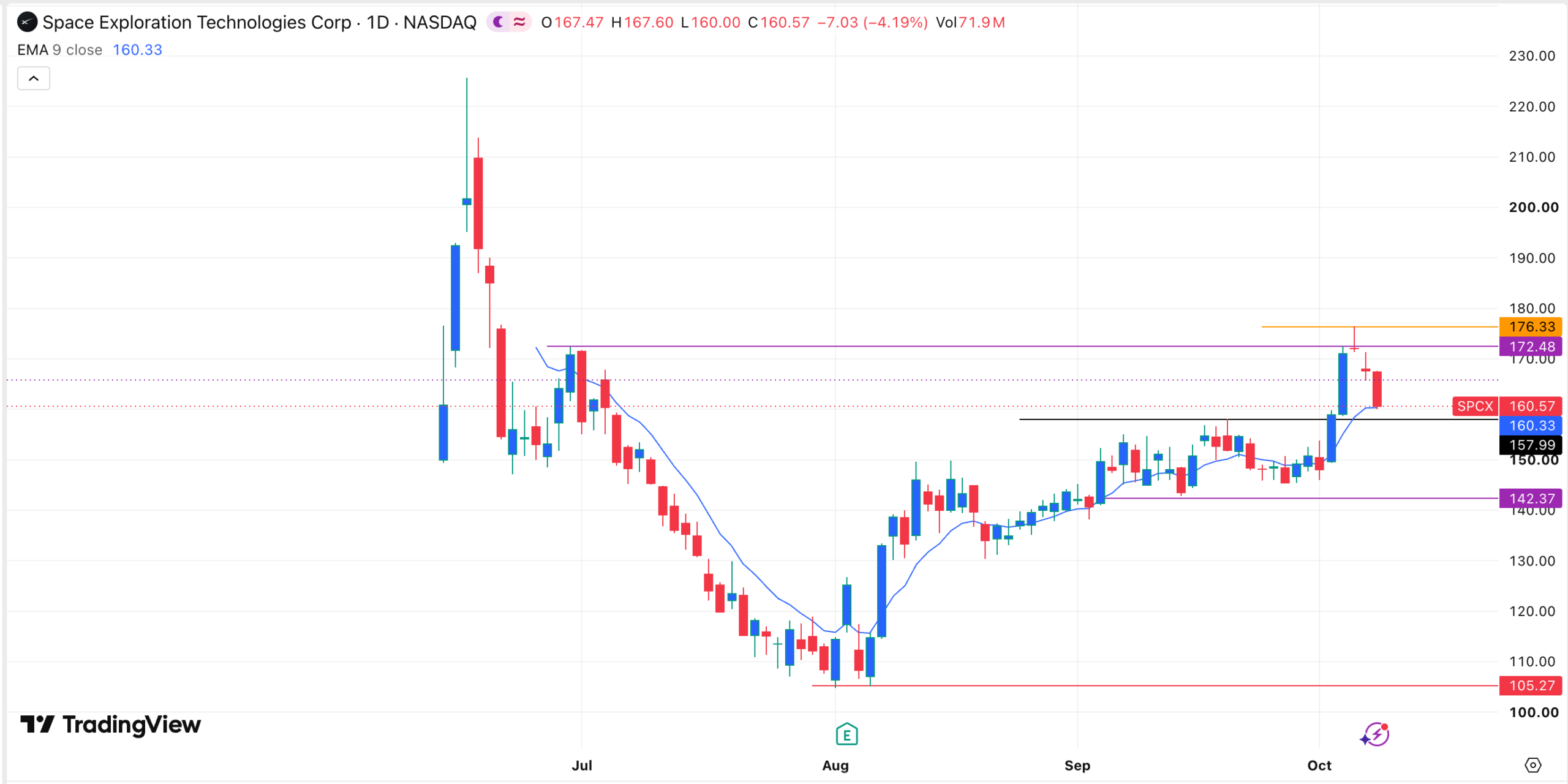
SpaceX shares pulled back sharply this week even as the company announced a major expansion of its Starlink Mobile strategy. SPCX closed at $160.57 on Oct. 8, down from an intraday high of $176.42 reached on Oct. 6, as the stock's recent momentum stalled.
The latest telecom agreement could strengthen SpaceX's position against established U.S. wireless carriers. At the same time, however, the company is increasing its exposure to capital-intensive AI infrastructure through a proposed $40 billion financing package. Both commitments tie the company's outlook to heavy upfront spending in arenas where returns take time to materialize.
Spectrum Deal Puts SpaceX in Direct Competition With AT&T, T-Mobile and Verizon
Elon Musk's SpaceX is positioning itself as a bigger competitor to AT&T, T-Mobile, and Verizon. The company has agreed to acquire a nationwide portfolio of low-band spectrum licenses, a move that will allow it to use its Starlink satellite service to become a major player in the carrier industry. Low-band frequencies are among the most coveted assets in wireless because they travel farther and penetrate buildings more effectively than higher-frequency airwaves, which is a key reason national carriers have historically held such licenses close.
After receiving approval from the Federal Communications Commission (FCC), SpaceX plans to combine its satellite-to-cell services with a terrestrial network designed to connect devices everywhere. It is a significant development because, if the strategy works, the company would be well placed to capture a substantial share of the United States market. The same approach could then be applied as it seeks to offer the service in other countries. Direct-to-cell coverage is designed to reach rural and remote areas where building towers is uneconomical — terrain where traditional networks have historically been weakest — and how quickly SpaceX can turn the newly acquired spectrum into a working network is the key execution question for the strategy.
The most recent results show that Starlink is currently SpaceX's biggest cash generator. The satellite unit has 12 million customers globally and more than 10,200 satellites in orbit. It generated over $4.2 billion in revenue, accounting for 53% of the company's total.
Starlink is also the only profitable part of SpaceX's business. It made over $1.6 billion in the second quarter, compared with losses of $542 million in the space business and $1.25 billion in the AI business. That reliance on a single profitable segment is part of what makes the spectrum bet notable: the expansion is being built on the one unit currently generating profits while the other divisions absorb losses.
SpaceX is additionally working to improve its satellite business. It recently launched a test of the third version of its satellite, which weighs about 2,000 kilograms and will be able to deliver roughly 1 terabyte of capacity along with 160 Gbps of uplink capacity.
Rising Costs and a $40 Billion Raise Weigh on the Stock
Despite the growth across its businesses, SpaceX faces major challenges that help explain why its stock has pulled back in recent days. As reported earlier this week, the company is seeking to raise $40 billion to purchase Nvidia chips. Its goal is to become the biggest provider of compute services to companies in the artificial intelligence (AI) industry.
SpaceX has already won major contracts with companies including Google and Anthropic. Google is paying it $925 million a month, while Anthropic is paying it $1.25 billion.
The challenge, however, is that the business will take time to become profitable. In the last quarter, the AI unit recorded a loss of over $1.25 billion, while the company's capital expenditure jumped to more than $15.8 billion.
The proposed $40 billion raise has also led to a surge in SpaceX's bond yields. In addition, the cost of insuring against a default has continued rising this year. Higher yields translate into a steeper cost of servicing debt, which is why the trajectory of those yields — along with the final terms of the raise — is a number to watch as the AI buildout scales.
Technical Picture Shows Momentum Stalling
The daily chart shows that SpaceX shares had been in a strong upward trend in recent months, jumping from a low of $105.27 in July to a high of $176.33. A closer look shows the stock formed a small shooting star candlestick pattern, a commonly watched bearish reversal signal in technical analysis.
The stock has remained above its 50-day Exponential Moving Average (EMA) and is seeking to retest the key support level of $157.9, its high on September 21. According to the analysis, the most likely scenario is a rebound, potentially toward the resistance level of $176, followed by the psychological level of $200.
This article is for informational purposes only and does not constitute financial or investment advice. Stock prices, financing plans, regulatory approvals, and technical levels may change as market conditions evolve.
This article originally appeared on The Market Periodical.

